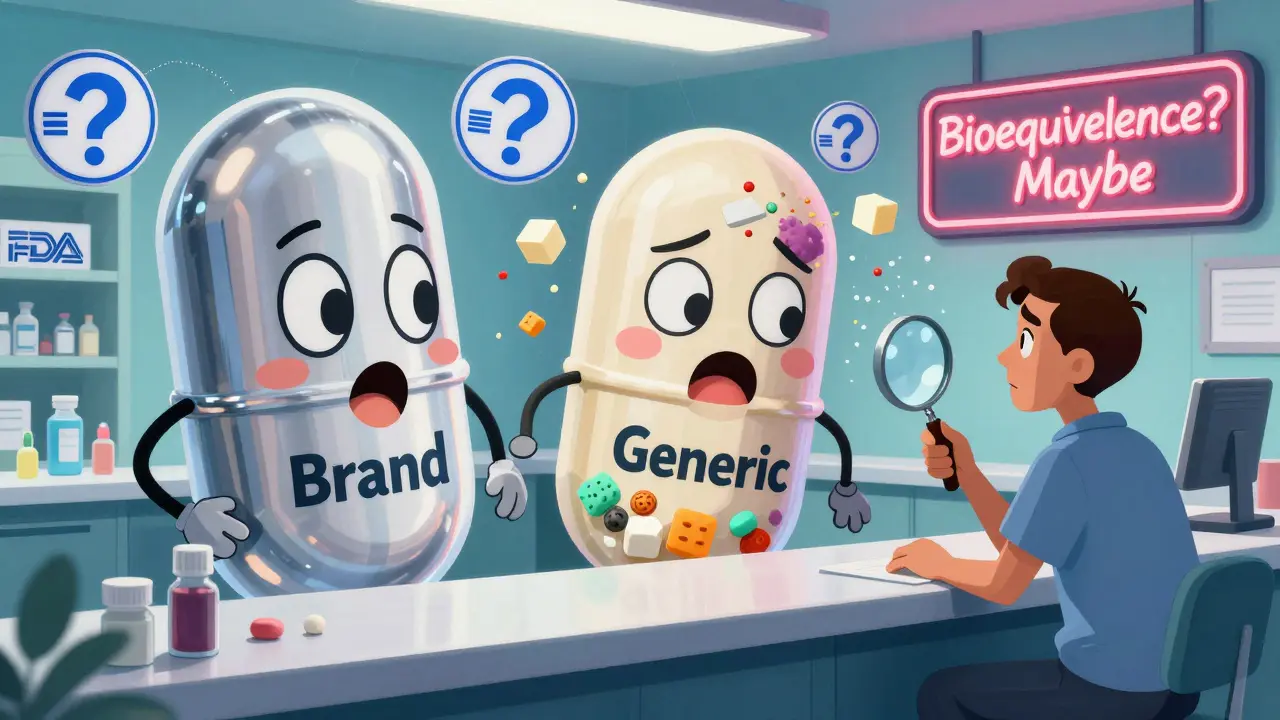
When you pick up a prescription, you might not think twice about whether it’s the brand name or the generic version. After all, generics are cheaper, widely available, and approved by the FDA. But here’s the catch: even when the active ingredients are identical, the inactive components in generic combination drugs can be wildly different from the brand version-and that difference can matter more than you’d expect.
What’s Really in Your Pill?
Generic drugs are required to have the same active pharmaceutical ingredients (APIs) as their brand-name counterparts, in the same strength and dosage form. That’s the law. But when it comes to fillers, binders, coatings, preservatives, and coloring agents? The rules open the door for big changes. These are called inactive ingredients, and they don’t directly treat your condition. But they can change how your body absorbs the medicine. For example, two versions of a combination drug like metformin/sitagliptin might both contain exactly 500 mg of metformin and 100 mg of sitagliptin. But one might use lactose as a filler, while the other uses microcrystalline cellulose. One might have a delayed-release coating made with ethylcellulose; the other might use a different polymer entirely. Sounds harmless? For most people, yes. But for others? Not even close.Why Some Patients Notice the Difference
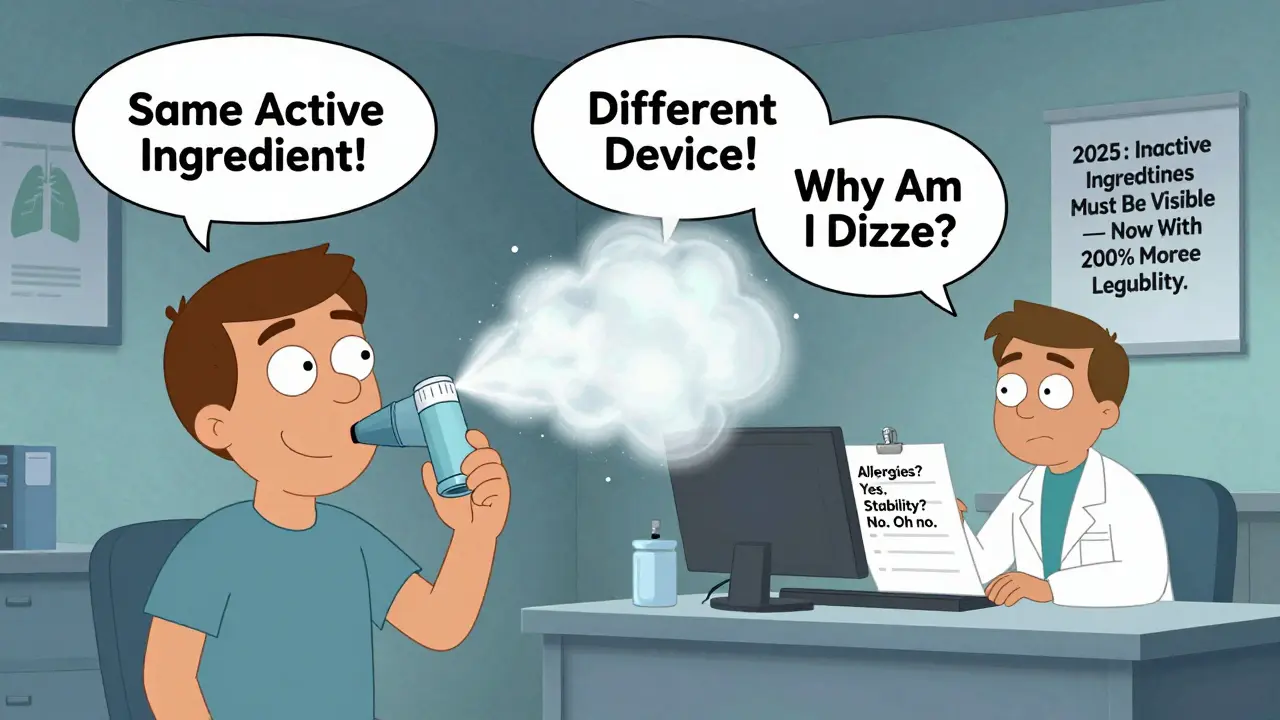
The FDA requires generics to prove bioequivalence: the drug must reach the bloodstream at roughly the same rate and level as the brand. That means the area under the curve (AUC) and peak concentration (Cmax) must fall within 80-125% of the brand’s numbers. Sounds precise? It is-except it doesn’t capture everything. Take extended-release tablets. These are designed to release the drug slowly over hours. The inactive ingredients control how fast the tablet breaks down in your gut. If a generic uses a different binder or coating, the drug might release too fast-or too slow. In one 2021 study, patients switching from Advair Diskus to a generic version reported a 23% increase in rescue inhaler use within 90 days. Why? The generic inhaler delivered less medication to the lungs because the device’s internal mechanics didn’t match the original. This isn’t rare. A 2017 study in the Journal of the American Pharmacists Association found that nearly half of all generic combination drugs had different inactive ingredients than their brand equivalents. Magnesium stearate? Changed in 38% of cases. Lactose? Changed in 29%. These aren’t just random swaps-they can trigger allergic reactions, alter absorption, or cause GI upset.Narrow Therapeutic Index Drugs: The High-Risk Zone
Not all drugs are created equal. Some have a narrow therapeutic index (NTI), meaning the difference between a therapeutic dose and a toxic one is tiny. Even a 10% change in blood levels can cause serious harm. The FDA lists 14 NTI drugs, including warfarin, levothyroxine, and certain seizure medications. When it comes to combination NTI drugs, the risk multiplies. A 2020 study in JAMA Internal Medicine tracked 89,453 Medicare patients who switched from brand to generic levothyroxine. Over 12% needed a dosage adjustment because their thyroid hormone levels shifted. That’s not a fluke. It’s a pattern. For patients with thyroid disease, diabetes, or epilepsy, a small change in absorption can mean hospitalization, seizures, or heart complications. And it’s not just about the pill. Combination products often involve complex delivery systems-like inhalers, patches, or injectables. A 2021 study found that some generic inhalers delivered 15-20% less medication to the lungs than the brand. The active ingredient was the same. The device wasn’t.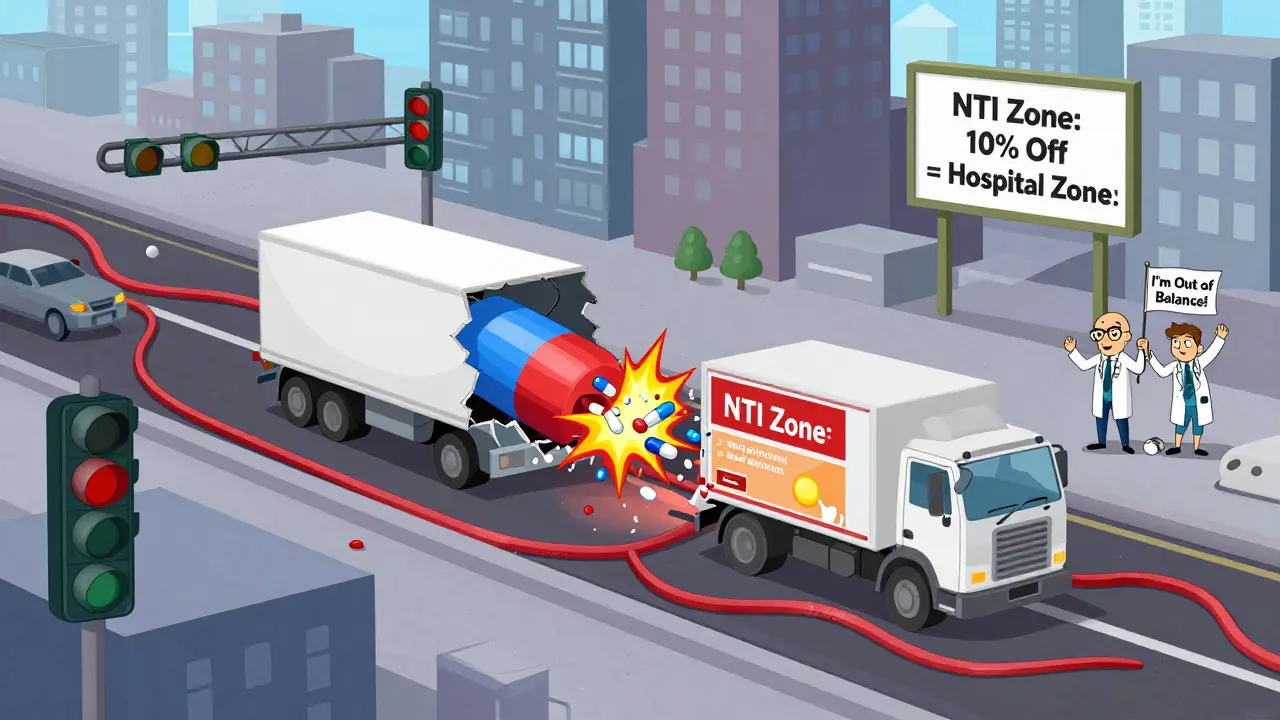
Who’s Most at Risk?
You might think, “I’m healthy-I’ll be fine.” But the real danger hits specific groups:- Elderly patients with multiple conditions and medications-small changes in absorption can throw off entire regimens.
- Pediatric and geriatric patients whose bodies process drugs differently.
- Patients with allergies to lactose, dyes, or sulfites-ingredients not always listed clearly on labels.
- Patients with chronic conditions like epilepsy, heart failure, or organ transplants-where stability is everything.
What Pharmacists Are Doing About It
Most pharmacists don’t know the full story-until a patient walks in upset. But a growing number are using a five-point checklist before substituting:- Therapeutic index-Is this an NTI drug? If yes, proceed with caution.
- Patient history-Has this person had problems with generics before?
- Bioequivalence data-Check the FDA’s Orange Book. Look for ‘A’ (therapeutically equivalent) vs. ‘B’ (potential issues).
- Inactive ingredient screening-Ask: Does the patient have allergies? Are there new fillers?
- Disease stability-Is the patient’s condition well-controlled? Don’t rock the boat.
What’s Changing Now
The system is waking up. In 2022, the FDA released draft guidance requiring stricter testing for 28 high-risk combination products. In 2023, Teva’s generic version of Advair Diskus was approved-but only after proving its inhaler delivered the same lung dose as the original. That’s unprecedented. The 2022 Consolidated Appropriations Act forced the FDA to create a formal system to track adverse events linked to formulation differences. It launches in Q2 2024. That means real data, not just anecdotes. The Generic Pharmaceutical Alliance has also pledged to clearly label all inactive ingredients in combination generics by 2025. Right now, that info is buried in fine print. Patients shouldn’t have to dig for it.What You Can Do
If you’re on a combination drug-especially for thyroid, epilepsy, heart disease, or mental health-here’s what to do:- Ask your pharmacist: Is this the brand, a generic, or an authorized generic?
- If you’re switched to a generic, monitor symptoms for 30 days. Keep a log: energy levels, side effects, mood, blood pressure, blood sugar.
- If something feels off, don’t assume it’s “in your head.” Go back to your doctor. Say: I think the formulation changed.
- Ask about authorized generics-they’re made by the brand company, so the formula is identical. They cost more than generics but still 60-70% less than the brand.
- Check the FDA’s Orange Book. Search your drug. Look for the therapeutic equivalence code. ‘A’ = usually fine. ‘B’ = proceed with caution.
The Bigger Picture
Generics saved the U.S. healthcare system over $1.67 trillion from 2006 to 2019. That’s huge. But cost savings shouldn’t come at the cost of safety. The system works for most people. But for 1-2% of patients-those on NTI drugs, with allergies, or complex regimens-the differences in inactive ingredients can be life-changing. The goal isn’t to scare people away from generics. It’s to make sure we’re not treating everyone the same. Medicine isn’t one-size-fits-all. And neither are pills.Can generic combination drugs really be less effective than brand names?
Yes, in rare cases. While generics must meet FDA bioequivalence standards, those standards don’t always capture differences in how the drug is released over time-especially with extended-release or inhaled products. For example, some generic inhalers deliver less medication to the lungs than the brand, and some oral generics release the drug too quickly or too slowly. This can lead to reduced effectiveness or increased side effects, particularly in patients with narrow therapeutic index conditions like epilepsy or thyroid disease.
How do I know if my generic drug has different inactive ingredients?
The FDA doesn’t require manufacturers to list all inactive ingredients on the prescription label. You can check the drug’s package insert, which includes a full list, or ask your pharmacist for the manufacturer’s product information. Some pharmacies now provide this info upon request. Starting in 2025, the Generic Pharmaceutical Alliance plans to standardize and clearly label inactive ingredients on all combination generics.
What’s the difference between a generic and an authorized generic?
An authorized generic is made by the original brand-name company but sold under a generic label. It has the exact same ingredients, inactive components, and manufacturing process as the brand. The only difference is the packaging and price-it’s cheaper than the brand but more expensive than a standard generic. If you’ve had problems with generics before, an authorized generic is the safest switch.
Should I avoid generic combination drugs altogether?
No. For most people, generics are safe and effective. But if you’re taking a drug with a narrow therapeutic index (like warfarin, levothyroxine, or certain seizure meds), have a history of adverse reactions to generics, or have allergies to common fillers like lactose or dyes, talk to your doctor. Ask about therapeutic equivalence ratings in the FDA’s Orange Book and consider an authorized generic if available.
Why don’t pharmacists always warn me about switching to a generic?
Many pharmacists aren’t aware of the subtle formulation differences between brands and generics. The FDA considers most generics therapeutically equivalent, so substitution is automatic unless the prescriber blocks it. But as awareness grows, more pharmacists are using checklists to assess risk before switching-especially for high-risk patients. You can help by asking: “Is this the same formula as my last prescription?”