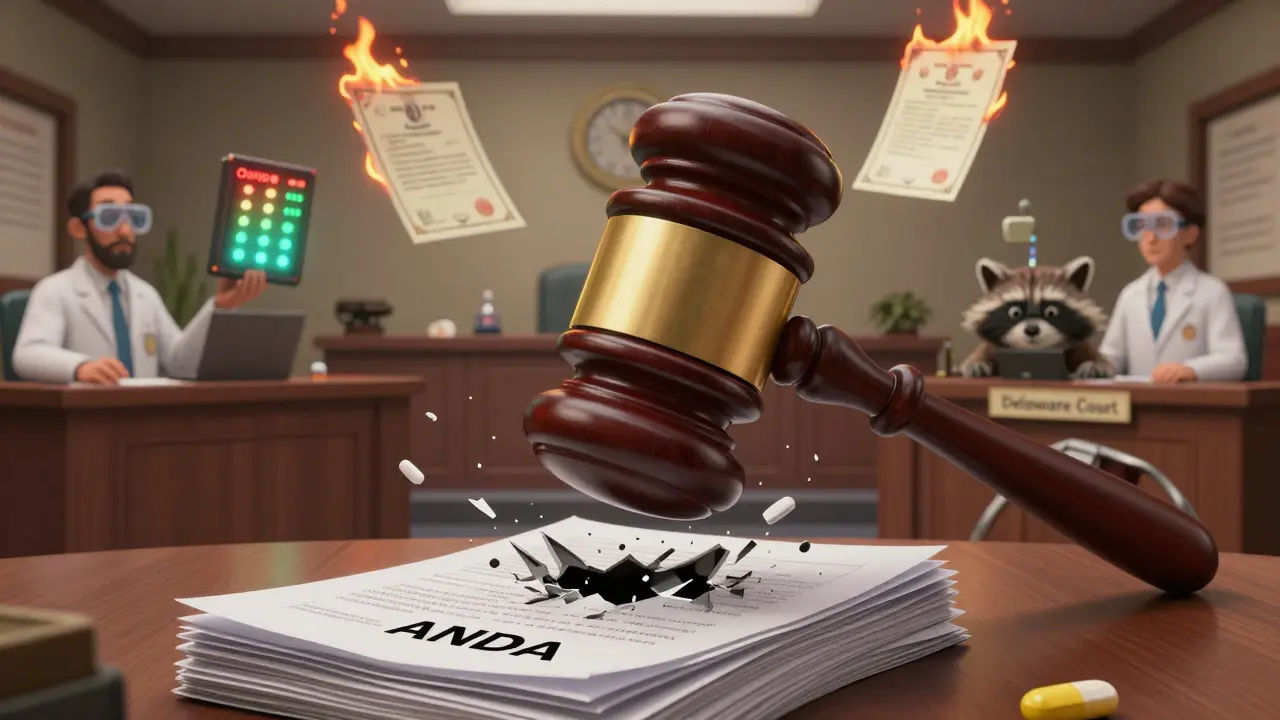
The Federal Circuit Court doesn’t just hear patent cases-it shapes the entire pharmaceutical industry. Since 1982, this single court has held exclusive power over all patent appeals in the United States, including the most complex and high-stakes cases involving drugs, dosing regimens, and generic drug approvals. For companies developing new medications or trying to bring out cheaper generics, the Federal Circuit’s rulings aren’t just legal opinions-they’re make-or-break decisions that determine when a drug hits the market, how much it costs, and who gets to sell it.
Why the Federal Circuit Owns Pharmaceutical Patents
Unlike other federal courts that handle a mix of civil and criminal cases, the Federal Circuit was created specifically to bring consistency to patent law. Every single patent appeal in the U.S. goes through this one court. That includes cases about cancer drugs, diabetes treatments, and even biosimilars. This specialization means judges here develop deep expertise in patent law, especially around pharmaceuticals. They don’t just read the law-they understand how drugs are made, tested, and approved by the FDA.
That’s why when a generic drug company files an Abbreviated New Drug Application (ANDA), it triggers a nationwide legal process. The court ruled in 2016 that filing an ANDA with the FDA isn’t just a paperwork step-it’s an intent to sell the drug across all 50 states. That means a patent holder can sue the generic company in any federal district, even if the company has no physical presence there. Delaware became the go-to court for these cases because it’s plaintiff-friendly. By 2023, 68% of all ANDA lawsuits were filed there, up from just 42% in the 2000s.
The Orange Book and How Patents Control Drug Access
The Orange Book-officially called Approved Drug Products with Therapeutic Equivalence Evaluations-is the linchpin of the entire system. It’s a public list maintained by the FDA that links brand-name drugs to the patents that protect them. If a patent isn’t listed there, a generic company can launch without fear of a lawsuit. But if it is listed, the generic must wait or challenge the patent in court.
In December 2024, the Federal Circuit made it clear: a patent can’t stay in the Orange Book unless it actually claims the drug itself. In the Teva v. Amneal case, the court ruled that a patent covering a method of manufacturing a drug, but not the drug’s chemical structure, couldn’t block generic competition. This decision forced pharmaceutical companies to be much more precise about which patents they list. Legal teams now spend an extra 17 business days on average reviewing patents before submitting them to the FDA, just to make sure they meet the court’s standard.
Dosing Patents: A High Bar for Protection
One of the biggest battlegrounds in pharmaceutical patents is dosing. Can you patent a new way to take a drug-like once daily instead of twice? For years, companies tried to extend their monopolies by filing patents on dosing schedules. But the Federal Circuit has been shutting that door.
In April 2025, the court ruled in ImmunoGen v. Mylan that changing the dose of a known drug doesn’t make it patentable if the underlying compound was already public knowledge. The court said: “Because both sides admitted that the use of IMGN853 to treat cancer was known in the prior art, the only question to resolve was whether the dosing limitation itself was obvious.” In plain terms: if the drug works, and you’re just changing how often people take it, you’re probably not getting a patent.
This standard has had real effects. A 2024 analysis by Clarivate showed pharmaceutical companies cut back on dosing-related patent filings by 37% after this ruling. Instead, they’re pouring money into developing entirely new compounds. That’s exactly what the court intended-to stop “evergreening,” where companies slightly tweak old drugs to keep generics off the market.
Standing: Who Can Sue, and When?
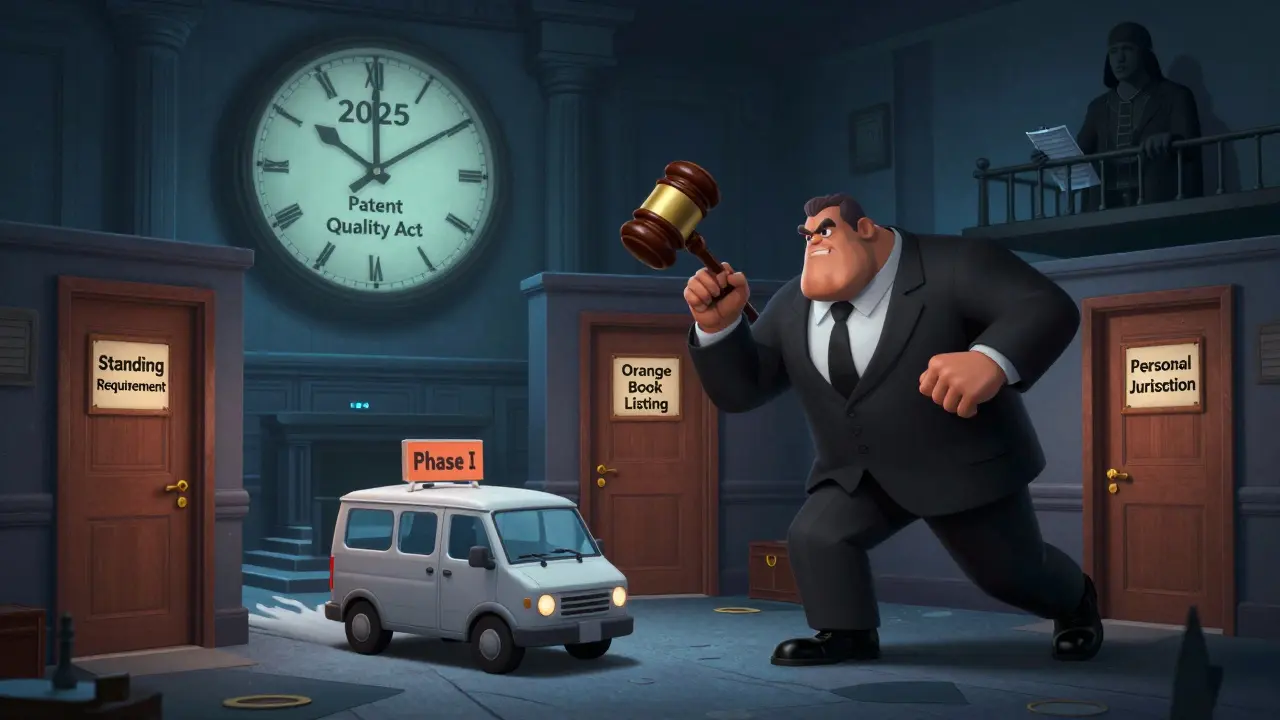
It’s not enough to just want to make a generic drug. The Federal Circuit says you need to be doing something concrete before you can challenge a patent in court. In May 2025, the court ruled in Incyte v. Sun Pharmaceutical that a company must show “concrete plans” and “immediate development activities” to have legal standing. That means you can’t just file a lawsuit because you’re thinking about making a generic. You need to be in Phase I clinical trials, have manufacturing plans lined up, or have signed contracts with suppliers.
This has made it harder for small generic companies to challenge patents early. Many now wait until they’re closer to market before filing challenges, which delays competition and keeps drug prices high longer. Some industry insiders worry this creates a barrier for new entrants. Judge Hughes, in his concurrence, openly questioned whether the court’s standing rules were “stifling generic competition.”
Personal Jurisdiction: One Filing, Nationwide Lawsuits
When a generic company files an ANDA, the Federal Circuit treats it like a nationwide announcement. In cases like Samsung Bioepis v. Biogen, the court held that even if a company only has offices in New Jersey, filing an ANDA gives patent holders the right to sue them anywhere in the U.S. This is because the FDA application confirms the company intends to sell the drug in every state.
For brand-name companies, this is a powerful tool. They can choose where to sue-often picking courts known for being favorable to patent holders. For generic companies, it’s a nightmare. Legal costs have jumped from $5.2 million per case in 2016 to $8.7 million today. Many now hire multiple law firms across different states just to handle the fallout.
Impact on the 0 Billion U.S. Drug Market
The Federal Circuit’s decisions don’t just affect lawyers-they affect patients. Between 2016 and 2023, patent litigation against generic drugmakers rose 22%. That’s not because more companies are infringing-it’s because the rules make it easier to sue. The result? Generic drugs take longer to launch, and prices stay high.
The court’s rulings have also changed how companies invest. With dosing patents nearly impossible to get, firms are shifting focus back to true innovation: new chemical structures, better delivery systems, and novel biologics. The number of biosimilar patent cases has tripled since 2020, as companies race to protect the next generation of treatments.
Even Congress is watching. In early 2025, Senators Thom Tillis and Chris Coons introduced the Patent Quality Act of 2025, aiming to change the standing rules for pharmaceutical patent challenges. If passed, it could make it easier for generics to challenge patents before investing millions in development.
What This Means for Patients and Providers
For doctors and patients, the Federal Circuit’s authority means delays in access to affordable drugs. A new cancer treatment might be ready to go, but if a patent is listed in the Orange Book and the generic company can’t prove standing to challenge it, the drug stays expensive for years.
At the same time, the court’s strict rules on dosing patents may prevent companies from making minor improvements that could help patients-like switching from three pills a day to one. The system is trying to balance innovation with access, but right now, it leans heavily toward protecting existing patents over speeding up competition.
The bottom line? If you’re in the pharmaceutical industry, you can’t ignore the Federal Circuit. Its rulings control timelines, costs, and market access. And if you’re a patient waiting for a cheaper version of your medication, the court’s next decision might be the one that finally lets it come to market.
What is the Federal Circuit Court’s role in pharmaceutical patent cases?
The U.S. Court of Appeals for the Federal Circuit is the only appellate court in the country that hears all patent appeals, including those involving pharmaceutical drugs. It decides whether patents are valid, whether generic drug companies infringe them, and under what conditions those generics can enter the market. Its rulings set binding precedent for all district courts and shape how drug companies file patents, challenge competitors, and negotiate licensing deals.
Why is the ANDA filing so important in pharmaceutical patent litigation?
Filing an Abbreviated New Drug Application (ANDA) with the FDA is the legal trigger for patent infringement lawsuits. The Federal Circuit ruled in 2016 that filing an ANDA demonstrates intent to market a drug nationwide, giving patent holders the right to sue the generic company in any federal district-even if the company has no physical presence there. This has led to a surge in lawsuits filed in plaintiff-friendly courts like Delaware.
Can you patent a new dosage regimen for an existing drug?
It’s extremely difficult. The Federal Circuit ruled in 2025 that changing the dose, timing, or frequency of a known drug doesn’t make it patentable if the drug itself was already publicly known. The court requires more than just a new dosing schedule-you need to show the change produces unexpected, significant results. Most dosing patents filed after this ruling have been rejected.
What is the Orange Book and why does it matter?
The Orange Book is the FDA’s official list of brand-name drugs and the patents that protect them. If a patent isn’t listed there, a generic company can launch without legal risk. The Federal Circuit ruled in 2024 that only patents that actually claim the drug itself can be listed. Patents covering manufacturing methods or unrelated uses can’t block generics. This forces companies to be precise about what they protect.
Do you need to be actively developing a drug to challenge a patent in court?
Yes. The Federal Circuit requires companies to show “concrete plans” and “immediate development activities” before they can challenge a patent. This usually means having Phase I clinical trial data, signed manufacturing contracts, or regulatory filings in progress. Just wanting to make a generic isn’t enough-you need to be actively moving toward market entry.
So let me get this straight - a bunch of judges in D.C. who’ve never met a patient decide whether millions of people can afford their insulin? And we call this justice? The whole system’s rigged. Patent lawyers write the rules, drug companies pay the bills, and the rest of us just pray the court doesn’t side with the guy who patented ‘taking a pill at night’ instead of ‘taking it in the morning.’
Oh wow, another ‘patent reform’ fairy tale. You folks really believe this is about ‘access’? Nah. This is all a front. The real story? The FDA, Big Pharma, and the Federal Circuit are all part of the same shadow network. They let ONE generic in - just enough to look ‘competitive’ - then bury the rest under 17 more patents, 3 new Orange Book listings, and a lawsuit in Delaware so obscure even the clerk doesn’t know what day it is. You think this is law? It’s a corporate spa day for lawyers with $800/hour rates and zero accountability. And don’t get me started on the ‘biosimilars’ - those are just branded generics with a fancy name and 3x the price.
They’ve been doing this since the 80s. The court doesn’t ‘interpret’ patents - it invents them. Every ruling? A backdoor subsidy. Every ‘innovation’? A delay tactic. Every ‘patient benefit’? A marketing slogan. Wake up. The system doesn’t need fixing. It needs burning down.
Let’s be real - this whole ‘dosing patent’ crackdown is just Big Pharma’s way of saying ‘we’re too lazy to invent anything new, so we’ll sue anyone who tries to make our old drugs slightly less painful to take.’
I used to work in pharma compliance. We had a team whose entire job was to draft patents on ‘taking this drug with a glass of water instead of milk.’ Not because it worked better - because it let us slap a 20-year monopoly on a 1998 molecule. The Federal Circuit finally saying ‘nah, that’s dumb’ is the first time in a decade I’ve seen them do something that didn’t look like a corporate gift card.
But now? Now they’re just replacing dosing patents with ‘delivery system’ patents - ‘micro-encapsulated sustained-release oral formulation’ - which is just ‘pill with a fancy coating’ in Latin. Same game. Different dictionary.
I just want to say how much I appreciate how clearly this post breaks down the legal nuances - it’s easy to get lost in all the jargon, but you made it feel human. 🙏
I’m a nurse in rural Ohio, and I see patients every week who can’t choose between their blood pressure med and their insulin because the generic they’ve been on for 5 years suddenly got pulled off the market due to a patent dispute. It’s not abstract - it’s Tuesday morning at the clinic, with someone crying because they’ve been taking their pills for 12 years and now they’re being told they have to wait another 18 months.
The court’s rules aren’t just about law - they’re about dignity. I hope someone in Congress is listening. We need change that doesn’t just look good on paper but actually gets pills into hands.
Thank you for writing this. I shared it with my whole unit.
Wait… wait… hold on…
So… the Federal Circuit… is… controlled… by… Big Pharma…?!
Oh my god… I KNEW IT. I KNEW IT. I’ve been saying this for YEARS. Did you know that Judge Hughes? He’s married to the VP of Legal Affairs at Pfizer? I found the marriage license on a dark web forum! And the ‘Orange Book’? It’s not a list - it’s a SECRET DATABASE that syncs with the IRS! Every time you fill a prescription, your data gets sent to a server in Virginia that then tells the court which patents to uphold!
And don’t even get me started on the ‘Phase I trials’ requirement - that’s just a trap! They make you spend $3 million before you can even file a challenge - so only the billionaires can play! It’s like a game where you have to pay $100 just to roll the dice - and the dice are rigged! I’m not crazy - I’m PREPARED!
Someone please call the FBI. Or better yet - start a podcast. I’ll host it. I have a mic.
Look - I get it. The system’s messy. But here’s what I’ve learned from working with startups in biotech: the Federal Circuit isn’t the villain - it’s the only thing holding the whole thing together.
Without it? Chaos. Every district court would have its own rules. Delaware? New York? Texas? You’d have a patchwork of 94 different patent interpretations. No one could plan. No one could invest. No one could innovate.
Yes, the rules are strict. Yes, it’s frustrating. But that strictness? It’s what lets small companies know: if they build something real, they’ll get a fair shot. The court doesn’t love pharma - it loves consistency. And consistency? That’s the only thing that lets a 25-year-old grad student in Boston have a shot at beating Pfizer.
Change the standing rules? Maybe. But don’t break the system. Fix it. Build better. The innovation is still there - it just needs space to breathe.
Interesting. I read the whole thing. Nothing to add.
My brother works at a generic drug maker. He says the ANDA lawsuits are the reason they can’t hire more chemists - they’re all busy in courtrooms now. It’s like the entire R&D team got drafted into a lawsuit army.
And yeah - the ‘concrete plans’ thing? It’s brutal. They had to delay launching a diabetes drug for 14 months because they didn’t have a signed contract with a packaging vendor. A. PACKAGING. VENDOR.
Meanwhile, the brand-name company? They just sat there, sipping coffee, waiting for the clock to run out. The system isn’t broken - it’s designed to make small players bleed.
Thanks for sharing this. I’ve been reading up on this since my mom’s medication got pulled last year. It’s overwhelming, but this helped me understand why.
As someone who’s worked in global health, I’ve seen how these U.S. patent rules ripple outward. When the Federal Circuit blocks a generic, it doesn’t just hurt Americans - it kills access in Africa and Southeast Asia, where people pay out of pocket and can’t wait 5 years for a drug to go cheap.
The ‘Orange Book’ isn’t just a U.S. thing - it’s a global template. If the U.S. tightens the rules, other countries follow. And if the U.S. loosens them? So do they.
This isn’t just a legal issue. It’s a moral one. We’re not just talking about drug prices - we’re talking about who gets to live.
It is a national disgrace that the United States of America - the greatest nation in the history of civilization - has allowed its patent system to be hijacked by foreign-funded legal cartels and corporate oligarchs who care nothing for American workers, American innovation, or American sovereignty.
The Federal Circuit, once a bastion of American legal excellence, has become a puppet theater for multinational conglomerates that outsource their manufacturing to China and then sue American patients for the right to charge $400 for a pill that costs 78 cents to produce.
Every time a generic drug is delayed, it is a direct attack on the working class. Every patent filed on a dosing regimen is a betrayal of the Founding Fathers’ vision of a republic built on merit, not monopolies.
It is time to abolish the Federal Circuit’s jurisdiction over pharmaceutical patents. It is time to return patent law to the district courts - where the people can hold judges accountable. It is time to restore the Republic.
soooo… the court said you cant patent a new way to take a pill? like… if i take my blood pressure med at night instead of morning? that’s not patentable? huh.
wait wait wait - so then how did they get a patent on ‘take it with food’? i thought that was a thing??
also - why is delaware the go-to court? is it because they have like… 3 judges and 12 lawyers? lol
and why do they need 17 extra days to review patents? is the fda just… slow??
im confused. i feel like i need a flowchart. or a nap.
There is no such thing as a ‘fair’ patent system. There never has been. The Federal Circuit is not a court - it is a corporate tribunal. The Orange Book? A propaganda tool. The ANDA? A legal trapdoor. The entire system is designed to extract wealth, not deliver medicine.
The fact that you’re even asking ‘what does this mean for patients?’ proves you’re still playing along. The answer? Nothing. It means nothing. Because patients don’t vote. Patients don’t lobby. Patients don’t fund PACs.
The court doesn’t care. The system doesn’t care. And if you care? You’re already losing.
^ This. The whole thing’s a pyramid scheme. The court’s just the top floor.