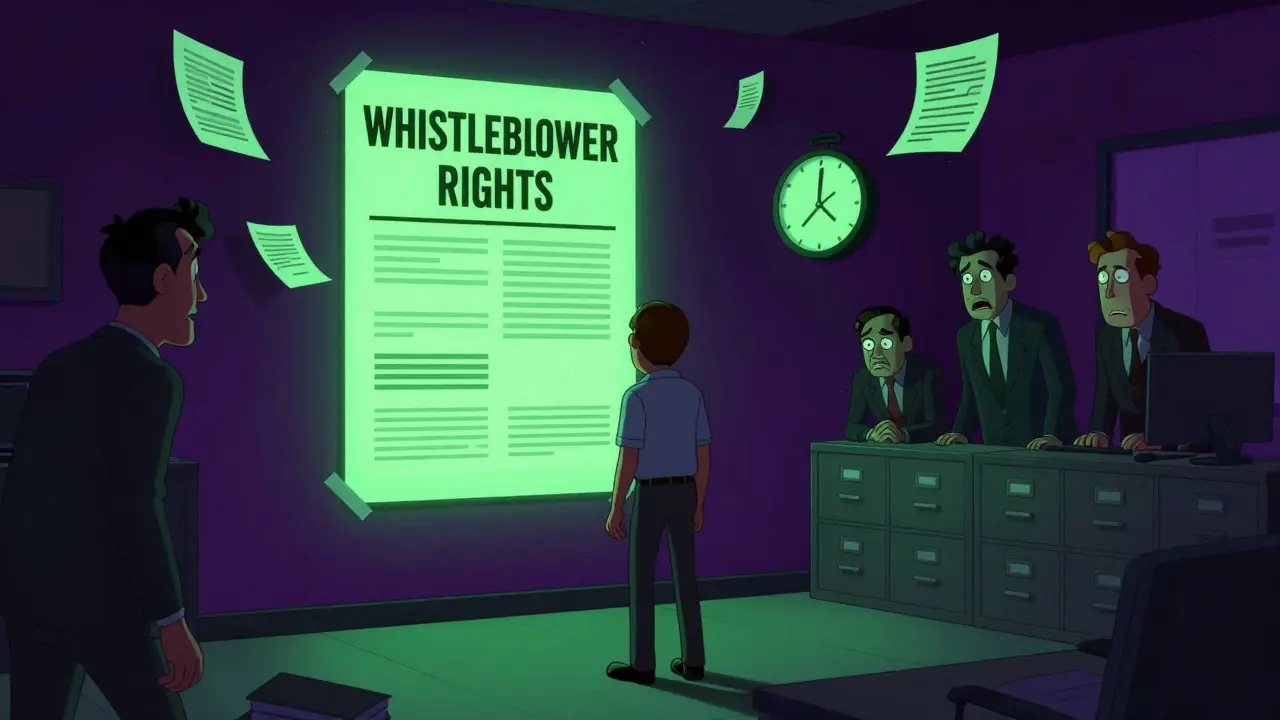
When you see something wrong at work-unsafe conditions, financial fraud, illegal dumping, or cover-ups-and you speak up, you’re not just doing the right thing. You’re risking your job, your reputation, even your livelihood. That’s why whistleblower laws exist. They’re not just legal technicalities; they’re lifelines for people who step forward when no one else will.
What Counts as Protected Reporting?
Under California’s Labor Code Section 1102.5, you’re protected if you report something you reasonably believe violates state or federal law. That includes anything from falsifying safety logs to hiding toxic waste disposal. It doesn’t matter if you’re wrong in the end-if your belief was honest and based on facts you had access to, the law backs you up. This protection isn’t just for current employees. Job applicants, former workers, and even people who are just suspected of planning to report are covered. If your boss cuts your hours after you mention you’re thinking of filing a complaint, that’s retaliation-and it’s illegal. Federal laws are more limited. The Sarbanes-Oxley Act only protects employees of public companies reporting financial fraud. The False Claims Act covers fraud against government programs, like overbilling Medicare. The Dodd-Frank Act goes further: if your tip leads to a penalty over $1 million, you could get 10% to 30% of the money back. But these protections don’t apply to most private-sector workers unless they’re in specific industries like aviation, nuclear power, or finance.What Counts as Retaliation?
Retaliation isn’t always firing someone. It’s often quieter, more sneaky. It’s being moved to the graveyard shift after reporting a safety violation. It’s getting negative performance reviews out of nowhere. It’s being excluded from meetings, denied promotions, or having your workload suddenly doubled. It’s HR telling you, “We’re just reorganizing,” while your name disappears from the schedule. California law lists these as clear violations: termination, demotion, pay cuts, harassment, and creating a hostile work environment. The Department of Industrial Relations says even subtle tactics-like assigning you impossible deadlines or publicly criticizing your work after you report-are illegal if they’re meant to punish you for speaking up. Federal protections under OSHA cover 25 different laws, but enforcement is inconsistent. In 2024, OSHA missed its 90-day deadline to investigate complaints in 63% of cases. That means many whistleblowers wait months-sometimes over a year-just to get an initial review.California’s 2025 Rules Are a Game Changer
Starting January 1, 2025, every employer in California must post a clear, visible notice about whistleblower rights. It has to be in at least 14-point font, include the Attorney General’s hotline (1-800-952-5225), and be placed where employees can easily see it-break rooms, bulletin boards, time clocks. This isn’t optional. Failure to comply can cost employers up to $10,000 per violation. This change came from Assembly Bill 2299, signed in July 2024. It’s the first state law in the U.S. to require physical posting of whistleblower rights. Most federal laws don’t even require employers to tell workers they have these protections. California is forcing transparency. But there’s a catch. California workers can’t sue in federal court under Section 1102.5. They’re stuck in state labor courts, which can be slower and less predictable. Federal whistleblowers under some laws, like Dodd-Frank, can take their cases to federal court. That’s a major advantage for those who qualify.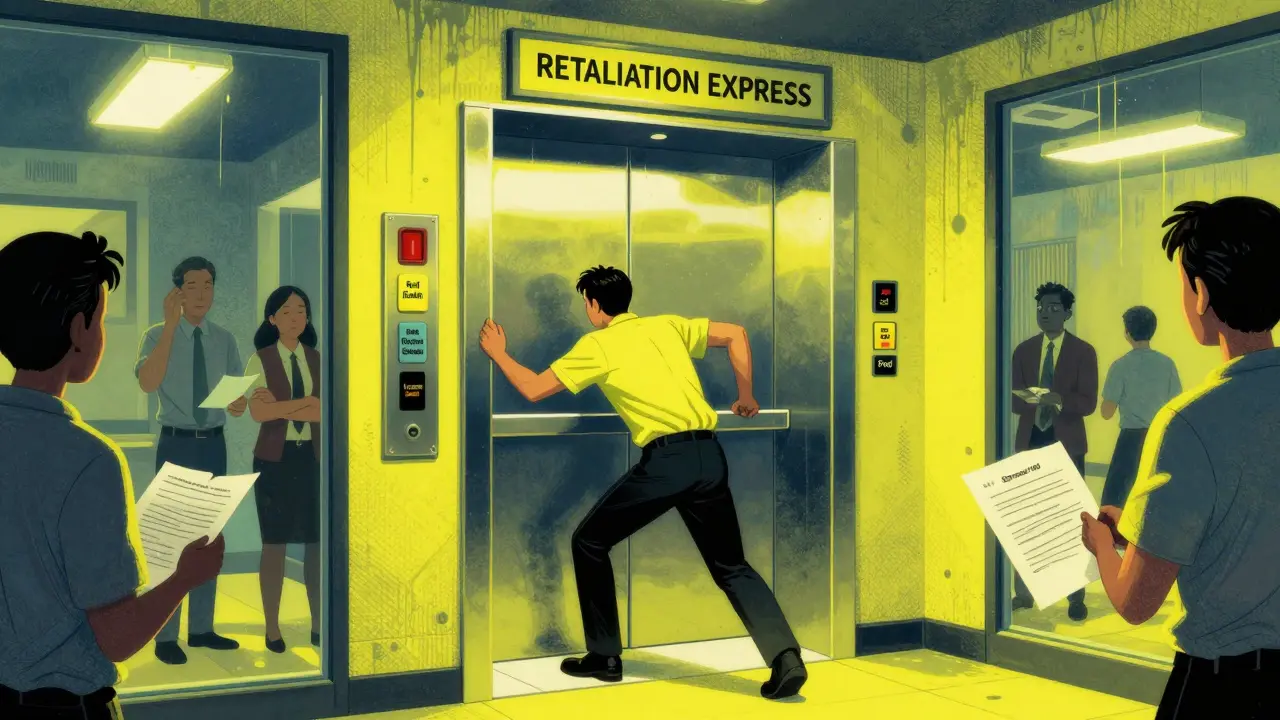
How Long Do You Have to Act?
Timing matters. Miss the deadline, and your case is dead. Federal laws vary wildly:- 30 days for Clean Air Act or CERCLA complaints
- 90 days for Anti-Money Laundering or Asbestos Hazard laws
- 180 days for the Consumer Financial Protection Act
What You Need to Do Before Speaking Up
Document everything. Save emails, texts, performance reviews, shift schedules. Write down dates, times, and names of people involved. If you report something verbally, follow up with an email: “As discussed today, I reported [issue] and am concerned about potential retaliation.” Don’t rely on HR. Most HR departments work for the company, not you. In a 2024 survey by the National Whistleblower Center, 42% of whistleblowers said HR dismissed their claims as “not meeting the legal threshold.” Talk to a lawyer first. The National Whistleblower Center found that 78% of successful cases had legal representation. You don’t need a big firm-there are nonprofits and legal aid groups that specialize in whistleblower cases. The California Attorney General’s hotline (1-800-952-5225) can connect you to free resources.Real Stories, Real Consequences
In 2023, a nurse in Los Angeles was fired after reporting that a doctor was skipping mandatory patient safety checks. She filed under Labor Code 1102.5. After 18 months, she won $287,000 in back pay and damages. But she lost two years of her career. She couldn’t pay her mortgage. Her kids changed schools. On Reddit, a user named u/SafetyFirstCA described being assigned overnight shifts after reporting OSHA violations. “I didn’t quit,” they wrote. “I was forced out. The law says I’m protected, but no one checks if they’re following it.” These aren’t rare cases. A 2024 survey of 500 whistleblowers found 68% experienced retaliation-even with legal protections in place. The system works for some. For many, it’s a long, lonely fight.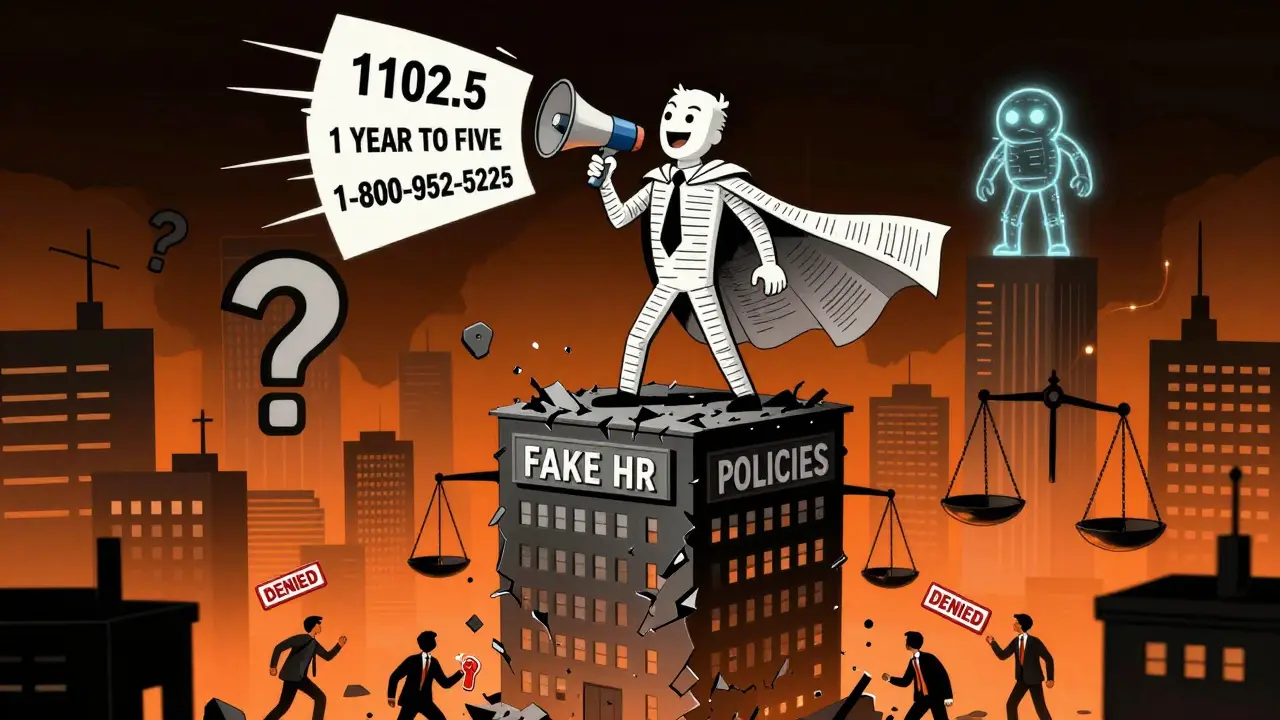
What’s Coming Next?
In May 2025, Senator Chuck Grassley introduced the AI Whistleblower Protection Act. It would give legal shields to employees in artificial intelligence companies who report unethical algorithms, biased data, or hidden surveillance tools. Right now, there’s no federal law protecting them. If you report that your company is using AI to manipulate users or violate privacy, you’re on your own. The Department of Labor is also working on new rules to cut investigation times from 90 to 60 days. That’s a start. But without consistent enforcement, even fast timelines won’t help. California’s 2025 posting rule is already pushing other states to consider similar laws. New York and Illinois are drafting bills. The European Union’s 2019 whistleblower directive-requiring companies to set up anonymous reporting systems-is being used as a model.Who Can Help?
You don’t have to go it alone:- California Attorney General’s Whistleblower Hotline: 1-800-952-5225 (free advice, referrals)
- OSHA Whistleblower Protection Program: 1-800-321-6742 (for federal claims)
- National Whistleblower Center: Offers free legal aid to over 1,200 people in 2024 alone
- Legal Aid Societies: Many offer free consultations for employment law cases
Final Reality Check
Whistleblower laws are powerful-but they’re not magic. They don’t stop retaliation before it happens. They don’t guarantee a quick win. They give you a path to fight back. And that’s worth something. If you’re thinking about reporting something illegal or dangerous, don’t wait for someone else to fix it. Document everything. Know your rights. Get legal help early. The system is broken in places-but it’s still the best tool we have to hold power accountable.Standing up isn’t easy. But it’s the only way change happens.
Can I be fired for reporting a violation at work?
No, it’s illegal. Under California’s Labor Code 1102.5 and multiple federal laws, firing someone for reporting violations is considered retaliation-and punishable by law. But proving it can be hard. Employers often hide behind vague reasons like "poor performance" or "restructuring." That’s why documentation and legal advice are critical before speaking up.
What if I report something that turns out to be false?
You’re still protected if you had a reasonable belief the violation occurred. The law doesn’t require you to be right-it requires you to be honest and based on facts you had access to. If you report in good faith, even if you’re mistaken, you can’t be punished for it. But if you knowingly lie or fabricate evidence, that’s a different story.
Do I have to report internally first before going to authorities?
No. California law lets you report directly to government agencies without telling your employer first. In fact, going to HR first can sometimes put you at greater risk. Many whistleblowers are advised to skip internal channels entirely and go straight to the Attorney General’s hotline or OSHA. The law doesn’t require you to give your employer a chance to fix it.
How long does a whistleblower case usually take?
On average, it takes 22 months to resolve a whistleblower case in California, according to the Division of Labor Standards Enforcement. Federal cases can take even longer, especially if OSHA misses its investigation deadlines-which happened in 63% of cases in 2024. Financial hardship is common during this time. That’s why many people seek legal aid early to speed up the process.
Are remote workers protected under California’s whistleblower laws?
Yes. California’s Labor Code 1102.5 protects remote workers just like in-office employees. But there’s a gap: while the law allows employers to email whistleblower notices to remote staff, it doesn’t require them to provide clear reporting channels for remote workers. This creates confusion. If you’re working from home and see something wrong, you should still report it-but make sure to document every step and contact the Attorney General’s hotline directly.
Can I get paid for reporting fraud?
Yes-if it’s under the federal False Claims Act or Dodd-Frank Act. Under Dodd-Frank, if your information leads to a government penalty over $1 million, you can receive 10% to 30% of the total amount recovered. In fiscal year 2023, the SEC paid out $637 million to 131 whistleblowers. This doesn’t apply to most workplace safety or labor violations, only fraud involving government funds or securities.
What if my employer doesn’t have a whistleblower policy?
You still have rights. California law doesn’t require employers to have a formal policy-you’re protected even if they don’t. Starting in 2025, they must post a notice about your rights, but that’s just the minimum. Your legal protections come from state and federal statutes, not company handbooks. If they don’t have a policy, that’s their problem-not yours.
Is there a federal whistleblower law that covers everyone?
No. There’s no single federal law that protects all workers across all industries. Protections are scattered across 25 different statutes, each covering specific sectors like aviation, nuclear energy, or financial services. That’s why California’s law is so important-it’s broader and applies to nearly all workers in the state. Federal law is patchy. State law, especially in California, is becoming the real safety net.
People who speak up are saints. Everyone else is just complicit. I don't care if it's risky-silence is violence. If your company is hiding toxic waste, you're not just a worker-you're a moral agent. And if you're too scared to act, that's your problem, not theirs.
California’s 2025 posting rule is huge. Finally, someone’s forcing transparency. But let’s be real-posting a notice doesn’t stop HR from gaslighting you. I’ve seen it. Managers say ‘we’re reorganizing’ while quietly pushing out the ones who complained. The law’s good, but enforcement? Still a joke.
California leads. Federal law? A mess. 25 different statutes. No one knows what applies to them. That’s why workers stay silent. Simple fix: one law. One agency. One hotline. Done.
Let’s be honest-most whistleblowers are either naive or dramatic. I’ve worked in finance. People report ‘fraud’ because they got passed over for a promotion. The Dodd-Frank bounty? Yeah, it’s real. But 10-30%? That’s not justice-it’s a lottery ticket for the emotionally unstable. 😒
My cousin reported unsafe scaffolding at a construction site. Got moved to night shifts. Lost her sleep. Lost her social life. Won her case 18 months later. Got $120k. But she still cries when she talks about it. This isn’t a victory. It’s survival.
Document everything. Even if it feels weird. Save that email where your boss says 'we’ll handle it.' Write down what was said in the hallway. HR will say you made it up. They always do. You need proof. Trust me. I’ve been there.
Let’s cut through the noise. 68% of whistleblowers face retaliation? That’s not a failure of the system-it’s proof the system is working exactly as intended. Employers aren’t breaking the law-they’re exploiting loopholes. The real issue? Legal representation is expensive. The system favors those with money. That’s not a bug. It’s a feature.
Oh honey, you think you’re brave? Most of these people just can’t handle being told ‘no.’ They don’t want justice-they want to be the hero. And then they’re shocked when no one claps. The law protects you, sure. But nobody likes a tattletale. Especially not in a small town. Or a small company. Or a family-run business. You think you’re changing the world? You’re just making everyone uncomfortable.
USA thinks it's the only country with ethics? 😂 Nigeria has whistleblower protections too-since 2017! And guess what? We don’t need posters on the wall. We have community pressure. If you report corruption and survive? You’re a legend. If you get fired? You’re still a legend. The system doesn’t protect you-we do. 🇳🇬🔥
If you're thinking about reporting something, don't wait. Talk to a lawyer first. Not HR. Not your buddy. A lawyer. Free ones exist. The National Whistleblower Center will help. You don't need to be a hero. Just be smart.
I work in healthcare. Saw a nurse get fired for reporting understaffing. She was told she was 'not a team player.' No one stood up for her. I cried for weeks. We need more people like her. Not more posters. More courage.
What’s the actual success rate of whistleblower cases? And how many result in actual policy change-not just cash payouts? I’m curious. The emotional weight is heavy, but I want data. Is this really moving the needle, or just giving people a sense of closure?
Wait… so you’re telling me that if I report my boss for lying about safety logs, and then he starts 'reorganizing' me, and then my laptop 'accidentally' gets wiped, and then I get a 'random' audit, and then my cat dies… that’s ALL part of the same pattern? And they’re just waiting for me to crack? I’m not paranoid. I’m PREPARED. 🕵️♀️🚨
California’s law is beautiful. But let’s not pretend this is a revolution. The EU directive from 2019? That’s real. Mandatory anonymous channels. Independent oversight. Protection for contractors. And guess what? Britain’s still dragging its feet. We’re not leaders-we’re latecomers with a fancy poster. 🇪🇺 > 🇺🇸
Just added the AG hotline to my phone’s emergency contacts. If you’re reading this and you’re scared-don’t be. You’re not alone. I’ve helped 3 people file complaints this year. All won. All got their lives back. It’s slow. It’s hard. But it’s possible. You’ve got this.