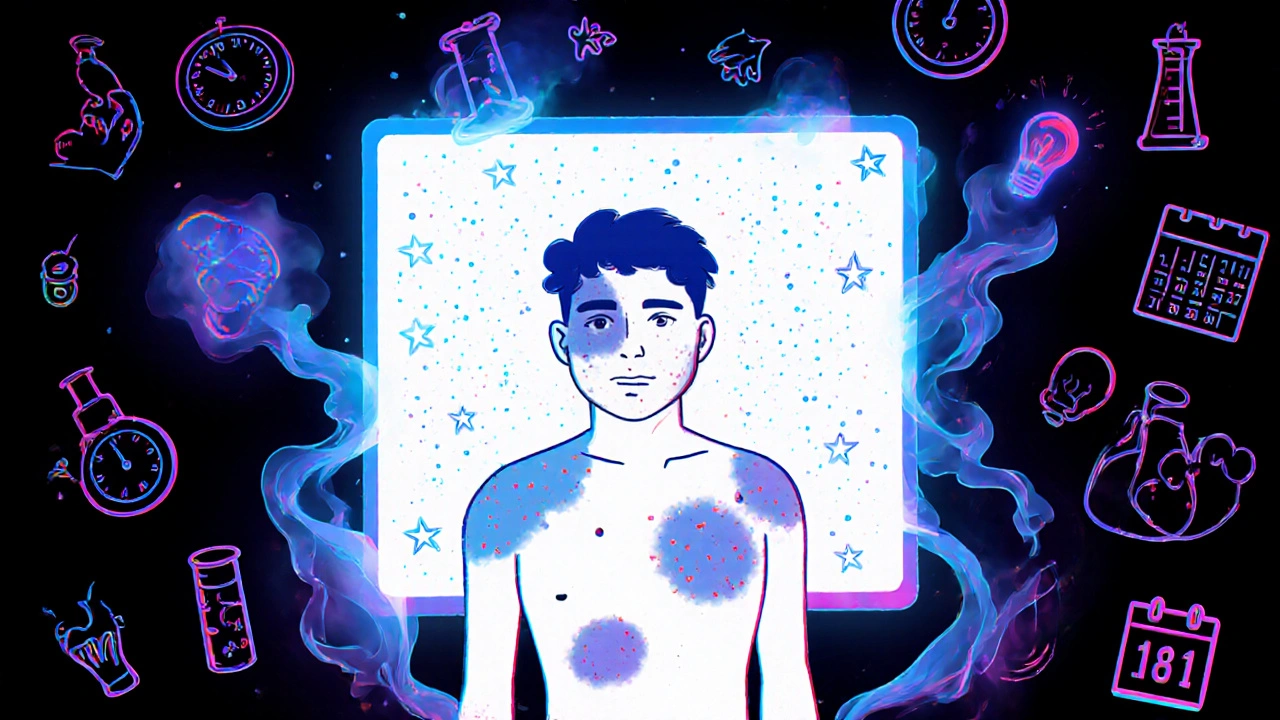
When you have vitiligo, the patches of lost pigment don’t just change how your skin looks-they can change how you feel about yourself. Many people start treatment hoping for quick results, only to realize it’s not a simple fix. The truth is, phototherapy isn’t magic. It’s a slow, consistent process that works best when paired with the right support. And contrary to what some online sources claim, you don’t combine depigmentation with phototherapy. They’re opposites. One tries to bring color back. The other removes what’s left.
What Phototherapy Actually Does for Vitiligo
Phototherapy doesn’t cure vitiligo. It doesn’t stop your immune system from attacking melanocytes. But it does something powerful: it wakes up the dormant pigment cells hiding in your hair follicles. These cells are still there, even in areas that look completely white. Narrowband UVB (NB-UVB), the most common form of phototherapy, uses light at 311-313 nanometers to trigger these cells to multiply and move to the surface. It also calms down the inflammation that’s destroying them in the first place. This isn’t guesswork. A 2017 meta-analysis in JAMA Dermatology tracked over 1,200 patients and found that 56.8% of people saw at least half their skin repigment after 12 months of twice-weekly NB-UVB. That’s more than half. But it didn’t happen overnight. Most people didn’t see noticeable changes until after 3-4 months. And even then, results varied wildly by body part.Why Some Areas Respond and Others Don’t
If you’ve been told your hands or feet won’t respond to treatment, you’re not alone-and you’re not wrong. Facial skin, neck, and chest often repigment well, with up to 80% of patients seeing improvement in six months. But hands, fingers, toes, and lips? They’re stubborn. Only 15-20% show meaningful repigmentation even after a full year of treatment. Why? Because those areas have fewer hair follicles, and melanocytes need those follicles as their starting point. That’s why dermatologists don’t waste time pushing phototherapy on someone with vitiligo limited to their fingertips unless they’re prepared for a long haul. If you’re treating a small patch on your face, you might see results in 10 weeks. If you’re treating your knuckles, you might need 18 months-and still see little change.Phototherapy Types: NB-UVB, PUVA, and Excimer Laser
There are three main types of phototherapy used today:- Narrowband UVB (NB-UVB): The gold standard. It’s safer than older methods, requires no chemicals, and works for large areas. Sessions last under a minute, 2-3 times a week. Doses start low and increase by 10-20% each visit based on your skin’s reaction.
- PUVA: Uses UVA light combined with psoralen, a light-sensitizing drug taken orally or applied topically. It’s effective but carries higher risks-nausea in 20-30% of users and a 13-fold increase in skin cancer after 200+ treatments. Most clinics now avoid it unless NB-UVB fails.
- Excimer Laser (308 nm): A focused beam for small patches under 10% of your body. It delivers higher doses to just the white spots, sparing healthy skin. You might see results in 8-12 weeks, but it’s impractical for widespread vitiligo. Each session takes less than 30 minutes.
Most people start with NB-UVB. It’s the most balanced option-effective, safe, and affordable. Home devices are now common, with models like the Philips TL-01 costing $2,500-$5,000 upfront. Medicare covers 80% for qualifying patients since 2021, and private insurers often follow suit.
The Real Problem: Sticking With It
The biggest reason phototherapy fails isn’t the light-it’s the schedule. Two to three clinic visits a week, every week, for six months to a year? That’s a huge commitment. A 2020 study found 68% of patients missed at least a quarter of their sessions. Time, travel, and work made it impossible for many. Home phototherapy changed the game. In the same study, 82% of people using home units completed 80% or more of their treatments. But there’s a catch: 22% more had mild burns because they didn’t follow dosing rules. One woman in Ohio told her dermatologist she increased her exposure because she “felt like it wasn’t working.” She got second-degree burns. Dosing isn’t guesswork. It’s science. Successful users track every session. Some use apps linked to their device. Others keep paper logs. UC Davis Health found that 92% of patients who tracked their doses stuck with treatment for over a year. Those who didn’t? They dropped out by month four.Combination Therapy: What Actually Works
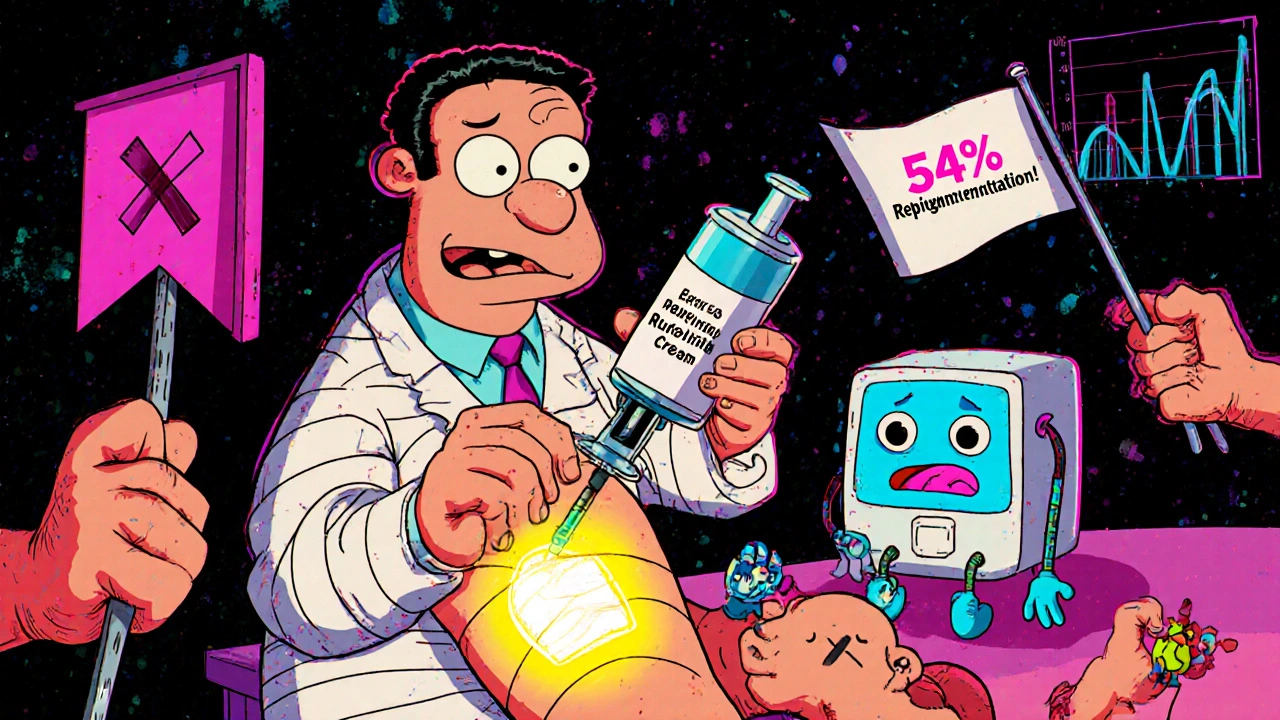
You don’t combine phototherapy with depigmentation. That’s a myth. But you do combine it with topical treatments-and that’s where real progress happens. Topical calcineurin inhibitors like tacrolimus or pimecrolimus are commonly used alongside NB-UVB. They reduce inflammation and help melanocytes survive. Mayo Clinic data shows this combo boosts repigmentation by 25-30% compared to phototherapy alone. Even newer options are joining the mix. In 2023, the FDA approved ruxolitinib cream (Jakafi for vitiligo). When paired with NB-UVB, it doubled the response rate: 54% of patients got over 50% repigmentation at 24 weeks, compared to just 32% with phototherapy alone. That’s a game-changer. It means fewer sessions, faster results, and less frustration. The future? AI-powered devices like Vitilux AI, cleared in October 2023, use your smartphone camera to analyze your skin and calculate the exact dose you need. In trials, it cut dosing errors by 37%. Imagine your phone telling you, “Today’s dose: 320 mJ/cm²,” instead of guessing based on a chart.Cost, Insurance, and Accessibility
Phototherapy isn’t cheap, but it’s cheaper than most alternatives. A full year of clinic-based NB-UVB runs $1,200-$2,500. Topical ruxolitinib? Over $5,000 a year. Insurance often covers phototherapy, but not always fully. Forty-three percent of insured patients still pay over $1,000 out of pocket because insurers limit sessions to twice a week, even though three times is more effective. Home units are a smart investment if you can afford the upfront cost. No commute. No waiting. No missed days. But you need discipline. And you need to know how to use it safely. Most clinics offer training. Some even loan devices for a trial period.
What to Expect-And What Not To
Here’s what you’ll likely see:- Weeks 1-4: No visible change. You might feel a little redness after sessions-that’s normal.
- Weeks 6-12: Tiny dots of color appear around hair follicles. This is the first sign melanocytes are waking up.
- Months 4-6: Patches begin to blend. Color spreads outward from the follicles.
- Months 8-12: Significant repigmentation in responsive areas (face, chest, arms).
- Months 12+: Hands and feet may still show little change. That’s not failure. That’s biology.
Don’t quit if you don’t see results in three months. That’s too early. The JAMA study proved six months is the minimum to judge effectiveness. And if you’re still not seeing progress after 18 months? Your dermatologist might suggest stopping-or switching to another option.
When Phototherapy Isn’t the Right Choice
Phototherapy works best for non-segmental vitiligo covering more than 5% of your body. If your patches are small and stable, topical creams alone might be enough. If your vitiligo is spreading rapidly, you might need oral medications first to stop the immune attack before starting light therapy. And if over 80% of your skin is depigmented? Then depigmentation becomes an option-not to cure, but to unify. Using monobenzone to lighten the remaining pigmented skin can create a more even tone. But this is permanent. And it’s not combined with phototherapy. It’s an entirely different path.Final Thoughts: Patience Is the Real Treatment
Vitiligo isn’t something you fix in a month. It’s something you manage-with consistency, support, and realistic expectations. Phototherapy is one of the most proven tools we have. But it only works if you show up. If you track your sessions. If you use the right creams alongside it. If you let your dermatologist adjust your plan as you go. The goal isn’t perfection. It’s progress. One patch of color at a time.Can phototherapy cure vitiligo?
No, phototherapy doesn’t cure vitiligo. It doesn’t stop the autoimmune attack on melanocytes. But it can stimulate dormant pigment cells to return, leading to repigmentation in many cases. Results vary, and maintenance may be needed long-term.
Is it safe to combine phototherapy with depigmentation?
No, you should never combine phototherapy with depigmentation. They have opposite goals. Phototherapy restores pigment. Depigmentation removes it. Depigmentation is only considered for people with vitiligo covering over 80% of their body who want a uniform skin tone. It’s a last-resort option, not a combo treatment.
How long does it take to see results from NB-UVB?
Most people start seeing small dots of color around hair follicles after 6-12 weeks. Meaningful repigmentation usually takes 4-6 months. The 2017 JAMA Dermatology study showed 56.8% of patients achieved at least 50% repigmentation after 12 months. Six months is the minimum time to judge if it’s working.
Why doesn’t phototherapy work on hands and feet?
Hands and feet have far fewer hair follicles than other areas. Melanocytes need these follicles to repopulate the skin. With fewer follicles, there’s less raw material for repigmentation. Even after a full year of treatment, only 15-20% of people see noticeable improvement on fingers and toes.
Are home phototherapy devices effective?
Yes, home devices are just as effective as clinic-based treatments when used correctly. A 2020 study found 78% of home users achieved over 50% repigmentation after six months, compared to 82% in clinics. The big advantage? Better adherence-82% of home users completed most sessions. The downside? Higher risk of burns from improper dosing. Always follow your dermatologist’s instructions.
What’s the best cream to use with phototherapy?
Topical calcineurin inhibitors like tacrolimus or pimecrolimus are most commonly used. They reduce inflammation and help melanocytes survive. Ruxolitinib cream, approved in 2022, is now also used in combination and has been shown to boost repigmentation rates by over 20% compared to phototherapy alone.
How much does phototherapy cost?
Clinic-based NB-UVB costs $1,200-$2,500 per year. Home devices cost $2,500-$5,000 upfront but eliminate ongoing visit fees. Insurance often covers 70-90% of clinic visits, but many patients still pay over $1,000 out of pocket due to session limits. Ruxolitinib cream costs over $5,000 a year, making phototherapy a more affordable long-term option.
Can children use phototherapy?
Yes. NB-UVB is considered safe for children and is the most common treatment for pediatric vitiligo. Mayo Clinic data shows 85% of children with vitiligo receive NB-UVB because it avoids systemic side effects. Dosing is adjusted for age and skin type, and sessions are kept short and supervised.

Phototherapy isn't magic but it's the closest thing we got for vitiligo. I've been doing NB-UVB for 14 months and yeah, my face repigmented pretty well but my knuckles? Still white as paper. No shame in that. It's not failure, it's biology. The follicles just ain't there to kickstart color. I used to cry over it but now I just focus on the patches that are coming back. One day at a time.
And yeah, home device saved my life. No more driving 45 minutes twice a week. But I almost burned myself twice because I got impatient. Dosing isn't guesswork. Trust the numbers. My derm gave me a chart and I stuck to it like gospel. You want results? Be boring. Be consistent.
Ruxolitinib cream? Game changer. I started it at month 8 and my chest went from ghost to glow in like 10 weeks. Worth every penny even if insurance fought me. Don't let cost scare you. This isn't a luxury, it's medical care.
And no, don't mix depigmentation with light therapy. That's like trying to fill a leaky bucket while you're still drilling holes in it. Two different paths. One rebuilds. One erases. Choose your war.
Also, kids can totally do this. My niece started at 8. No systemic meds. Just short sessions. She's now 12 and her arms look normal. No one even notices the spot on her knee anymore. Progress isn't perfect. It's just progress.
So you're telling me I wasted a year of my life doing this? I thought I was healing. Turns out I was just paying to get slightly less pale on my neck. And my hands? Still white. Like, permanently. Why does everyone act like this is some miracle cure? It's not. It's expensive, time-consuming, and mostly useless for half your body. I'm done.
I hear you. I was that person who quit after six months because nothing changed. Then I met someone online who'd been doing it for three years. She showed me her photos. Month 1: nothing. Month 6: tiny dots. Month 18: half her arms back. She didn't give up because she knew the timeline. It's not about speed. It's about showing up. Even on the days you feel like it's pointless. Even when you're tired. Even when you're angry. That's the real treatment.
And if your hands don't respond? That's okay. Your face does. Your chest does. That's still you. Still beautiful. Still whole. You don't need every patch to be perfect to be whole.
I still use the cream with the light. Still track every session. Still feel frustrated sometimes. But I don't regret it. Not one bit. Because I'm still here. Still trying. Still alive in my skin.
From india here and i used nb-uvb for 11 months. My face came back almost fully. But my legs? Barely. I think it's because we have darker skin here and the light dose is often too low. My clinic used same setting as white patients. I had to beg them to increase it. Took 6 months to convince them. Now i have 30% on my thighs. Not perfect but better than nothing.
Also home device is a dream. No waiting. No shame. I do it in my room at night. No one sees. No one judges. Just me and the light. And the app that reminds me. I forget sometimes. But the app doesn't.
And ruxolitinib? I can't afford it. But i hope one day insurance here covers it. This treatment should be for everyone. Not just the rich.
People don't get it. This isn't some vanity project. This is about surviving. I had vitiligo spread to my eyelids. I couldn't go outside without sunglasses and a hat. I felt like a ghost. Like I didn't belong. Phototherapy didn't just change my skin. It changed my life. I stopped hiding. I started dating again. I got a job I was too scared to apply for.
And yeah, it's hard. Two sessions a week. Every week. For a year. I missed 12 times. I cried after each one. But I went back. Because I didn't want to be afraid anymore.
And don't even get me started on people who say 'just cover it with makeup.' Like I'm not already doing that. Like I don't spend 20 minutes every morning trying to look normal. This isn't about looks. It's about dignity.
And if you think it's not worth it? You haven't lived in your own skin like I have. You don't know what it's like to look in the mirror and not recognize yourself. This treatment? It gave me back my reflection. That's worth every penny. Every hour. Every burn.
Wow. So you're telling people to spend thousands of dollars and waste a year of their lives chasing a 'cure' for something that's not even a disease? Vitiligo isn't a defect. It's a natural variation. Why are you all so desperate to erase it? You're teaching people to hate their skin. This isn't medicine. It's cultural coercion.
And now you're pushing expensive creams and AI gadgets? Next thing you know, they'll be charging you for 'repigmentation subscriptions.' This is capitalism at its worst. Let people be who they are. Stop pathologizing difference.
I have vitiligo. I don't treat it. I live with it. And I'm happier than you'll ever be.
Oh please. Another white American with a $5000 machine thinking they're saving the world. In my country, people with vitiligo are respected. They're not treated like broken things that need fixing. You people turn every difference into a medical emergency. It's exhausting.
And don't even get me started on 'ruxolitinib.' That's just a fancy name for a steroid in disguise. You're all so obsessed with 'progress' you forgot what normal looks like.
My cousin has vitiligo. She's a professor. She's married. She's happy. She doesn't need your light machine or your fancy cream. She just needs you to stop staring.
Thank you for writing this. I've been doing phototherapy for 10 months. My chest is 70% back. My arms? Still patchy. I used to think I was failing. Now I know it's just the way my body works. I don't need to be 'fixed.' I just need to be seen. And this post? It saw me.
To everyone who says 'just accept it' - I'm trying. But acceptance doesn't mean giving up. It means choosing your battles. I chose to fight for my chest. I let my hands be. That's okay. That's enough.
You're not broken. You're not wrong. You're just human. And that's beautiful.
Let's be real. This entire article reads like a pharmaceutical ad. 'Ruxolitinib doubled response rates!' 'AI-powered devices cut dosing errors by 37%!' Where's the data on long-term safety? Where's the independent study? This isn't science. It's marketing dressed in lab coats.
And home devices? Sure, they're convenient. But who's regulating them? Anyone can buy one online. One guy in Texas burned his entire back because he thought 'more light = faster results.' He ended up in the ER. This isn't progress. It's a liability waiting to happen.
And don't get me started on insurance. They cover the bare minimum because they don't want to pay. Then they act surprised when people quit. Classic. They profit from your frustration.
This isn't treatment. It's a business model.
Interesting. The JAMA study says 56.8% achieved 50% repigmentation. But what's the baseline? How many started with less than 10% coverage? How many had segmental vs non-segmental? The data's too broad to be useful. Also, 'meaningful repigmentation' is undefined. Is that 20%? 50%? 80%? Without metrics, this is just anecdote wrapped in science-speak.
And the 2020 adherence study? 68% missed 25% of sessions. That's a 75% success rate for compliance? No. That's a 25% failure rate. And home device burns? 22% increase? That's not a trade-off. That's a red flag.
This isn't a cure. It's a high-risk, low-reward gamble with your skin. And the people selling it? They're not doctors. They're salespeople with stethoscopes.
As a father of a child with vitiligo, I want to say: this article saved us. My son was 6 when he started. He cried every time we walked into the clinic. He thought people were staring. We switched to home phototherapy. Now he does it while watching cartoons. He doesn't even think about it anymore.
The cream? We use tacrolimus. It stings at first. But he says it feels like a warm hug on his skin. And now? He wears shorts in summer. He doesn't hide. He smiles.
I don't care if it's 'perfect.' I care that he's not afraid. That's the real win.
And to the people who say 'just accept it' - we did. But acceptance doesn't mean surrender. It means fighting for peace. And sometimes, peace looks like a little bit of color returning to his shoulder.
Phototherapy is a psychological crutch. The real issue is societal stigma. You do not need to repigment to be worthy. You do not need to conform to aesthetic norms to be loved. The medical industry profits from your insecurity. You are not broken. You are being manipulated.
And why is there no mention of alternative healing? Ayurveda? Traditional Chinese medicine? No. Only Western pharmaceuticals. Of course. Because they own the patents. They own the narrative.
Let the skin be. Let the soul be. Let the light be.
my hands still white but i got a lil color on my neck and its enough. i use the cream and the light and i track every session on my phone. i dont care what anyone says. this is my journey. not yours. i dont need your pity or your praise. just let me be.
Author here. Thank you all. Really. I didn't expect this much response. I've been doing this for 18 months. My face is 85% back. My hands? Still white. I used to hate them. Now I just call them my quiet patches. They don't define me. But they're part of me.
To the ones who say 'stop treating it' - I get it. But for me, this wasn't about changing who I am. It was about reclaiming the right to be seen without fear.
To the ones who say it's a scam - I wish I could say you're right. But I've seen the change. In my skin. In my daughter's eyes. In my own reflection.
This isn't about perfection. It's about presence. And sometimes, presence looks like showing up. Even when it hurts. Even when it's slow. Even when no one else understands.
You're not alone.