For decades, proving that a generic drug works just like the brand-name version meant putting volunteers through blood draws, waiting weeks for results, and sifting through mountains of data by hand. It was slow, expensive, and often frustrating for regulators and manufacturers alike. But since 2023, that’s changed. bioequivalence testing is no longer just about measuring drug levels in blood. It’s becoming a digital, automated, and highly precise science powered by artificial intelligence, advanced imaging, and virtual models.
What bioequivalence testing really means
Bioequivalence testing answers one simple question: Does the generic version of a drug get into your bloodstream the same way - and at the same speed - as the original? If yes, it’s considered bioequivalent. That means it’ll work the same in your body. For simple pills, this used to be straightforward. But today’s drugs aren’t always simple. Think inhalers that deliver medicine deep into lungs, patches that slowly release drugs through skin, or implants that dissolve over months. These complex formulations don’t behave the same way in the body as a regular tablet. Traditional methods struggled to prove they were equivalent.AI is cutting study time in half
The biggest shift? Artificial intelligence. In 2024, the FDA launched BEAM - a data analysis tool built specifically for bioequivalence reviews. It doesn’t replace scientists. It replaces hours of manual work. BEAM scans study reports, pulls out key pharmacokinetic data, flags inconsistencies, and even suggests potential issues before a human even opens the file. Internal FDA metrics show it cuts reviewer workload by 52 hours per application. That’s more than a full workweek saved per case. This isn’t just about saving time. It’s about accuracy. Machine learning models now analyze how drugs move through the body - absorption, distribution, metabolism, excretion - using historical data from thousands of past studies. These models predict outcomes before a single volunteer is even enrolled. According to Artefact’s 2024 white paper, AI-driven methods reduce study timelines by 40-50% and cut costs by 35%. Data accuracy improves by 28% because machines spot patterns humans miss.Virtual bioequivalence: Testing without people
For complex products like PLGA implants or certain inhalers, clinical trials are risky and costly. That’s why the FDA funded two major projects in 2024: a virtual bioequivalence platform and a mechanistic IVIVC (in vitro-in vivo correlation) model for implants. These aren’t sci-fi. They’re real tools being tested right now. Virtual bioequivalence uses computer simulations to predict how a drug behaves in the human body based on lab data. Instead of giving a drug to 24 volunteers and waiting for blood samples, scientists run hundreds of simulations using real-world parameters: stomach pH, gut motility, enzyme activity. If the simulation matches the original drug’s profile, it’s considered bioequivalent. The FDA estimates this could eliminate the need for clinical endpoint studies in 65% of complex generic applications.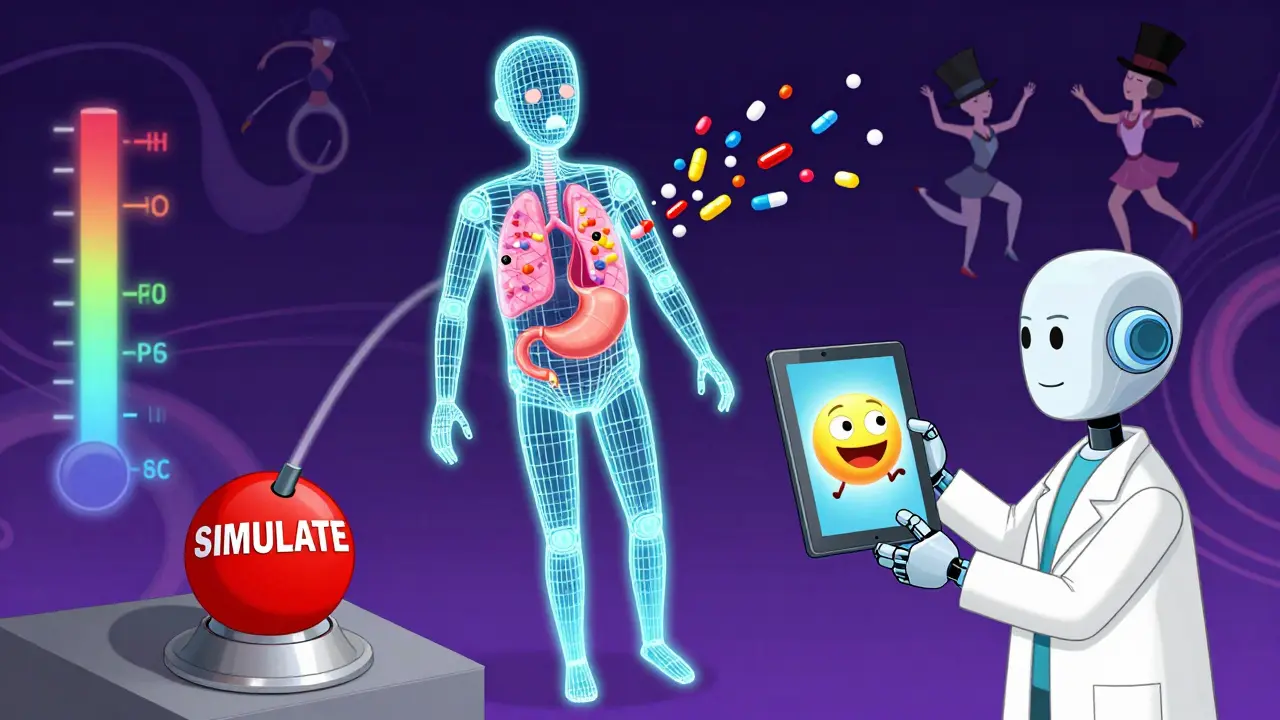
Advanced imaging reveals what blood tests can’t
Sometimes, you need to see the drug - not just measure it. That’s where imaging tech comes in. Scanning electron microscopy (SEM) shows the exact surface structure of a tablet. Focused ion beam imaging reveals how layers inside a patch break down. Optical coherence tomography maps how a cream spreads on skin. These tools help scientists understand why a drug might behave differently in the body, even if the chemical composition is identical. For example, two inhalers might have the same active ingredient and dose. But if one has a slightly different particle size distribution, it won’t reach the same part of the lung. Traditional dissolution tests couldn’t catch that. Now, with advanced imaging and infrared spectroscopy, regulators can see those differences - and require manufacturers to fix them before approval.Standardization is finally happening
Before 2024, bioanalytical testing rules varied wildly between the FDA and EMA. One region wanted one method. Another wanted another. That meant companies had to run duplicate studies - doubling costs and delays. The ICH M10 guideline, adopted by the FDA in June 2024 and endorsed by WHO in August 2024, changed that. It created one global standard for validating bioanalytical methods. The result? A 62% drop in method validation discrepancies between regions. Manufacturers no longer need to rebuild their entire testing pipeline for each market.