After surgery, pain doesn’t have to mean opioids. For years, hospitals relied on morphine and oxycodone to manage post-op pain. But the opioid crisis changed everything. Today, the standard isn’t just about controlling pain-it’s about controlling it without turning patients into long-term opioid users. That’s where multimodal analgesia (MMA) comes in. It’s not a single drug. It’s a smart mix of medications, nerve blocks, and non-drug tools that work together to block pain at multiple points-so you need less, or sometimes zero, opioids.
Why Opioids Alone Don’t Work Anymore
Opioids were once the go-to for surgical pain. But they come with a heavy cost: nausea, vomiting, constipation, drowsiness, and a real risk of dependence. A 2022 review of orthopedic surgeries showed patients on opioids alone had 41% more opioid use and 28% more nausea than those on multimodal plans. Even worse, some patients who never used opioids before ended up still taking them months after surgery. That’s not recovery-it’s a new problem. The CDC’s 2016 guidelines started the shift, but it wasn’t until 2021 that 14 major medical societies-like the American Society of Anesthesiologists and the American Academy of Pain Medicine-agreed on seven core principles for pain care. The message was clear: opioids should be the last resort, not the first.What Multimodal Analgesia Actually Looks Like
MMA isn’t theoretical. It’s used daily in hospitals like Rush University Medical Center and McGovern Medical School. Here’s how it works in practice:- Before surgery: Patients get acetaminophen (1,000 mg), gabapentin (300-600 mg), and celecoxib (400 mg) orally. This isn’t just a head start-it’s a way to calm the nervous system before the cut even happens.
- During surgery: Anesthesiologists add ketamine (0.5 mg/kg IV), lidocaine (1.5 mg/kg IV followed by infusion), and dexmedetomidine. These drugs don’t just numb-they stop the brain from amplifying pain signals.
- After surgery: Scheduled acetaminophen every 6 hours, celecoxib or naproxen twice daily, and gabapentin three times a day. Opioids? Only for breakthrough pain, and only in tiny doses-like 1-2 mg of morphine IV, given no more than every 15 minutes if needed.
Who Benefits the Most
MMA works best where pain is predictable. Spine and joint surgeries are ideal. For total knee replacements, MMA can cut opioid needs by 50-60%. For minor procedures like knee arthroscopy, the drop is still strong-30-40%. Even in trauma cases, McGovern Medical School saw hospital stays shrink by 1.8 days and same-day discharge rates jump from 12% to 37%. But MMA isn’t just for healthy patients. It’s especially critical for people who already take opioids, have chronic pain, or are at risk for addiction. The Compass SHARP Guidelines recommend adding ketamine infusions (0.1-0.3 mg/kg), dexmedetomidine, or lidocaine drips for these high-risk cases. Some hospitals now offer “opioid-free surgery” options for patients who refuse opioids altogether-using regional nerve blocks and non-opioid meds as the full backbone of care.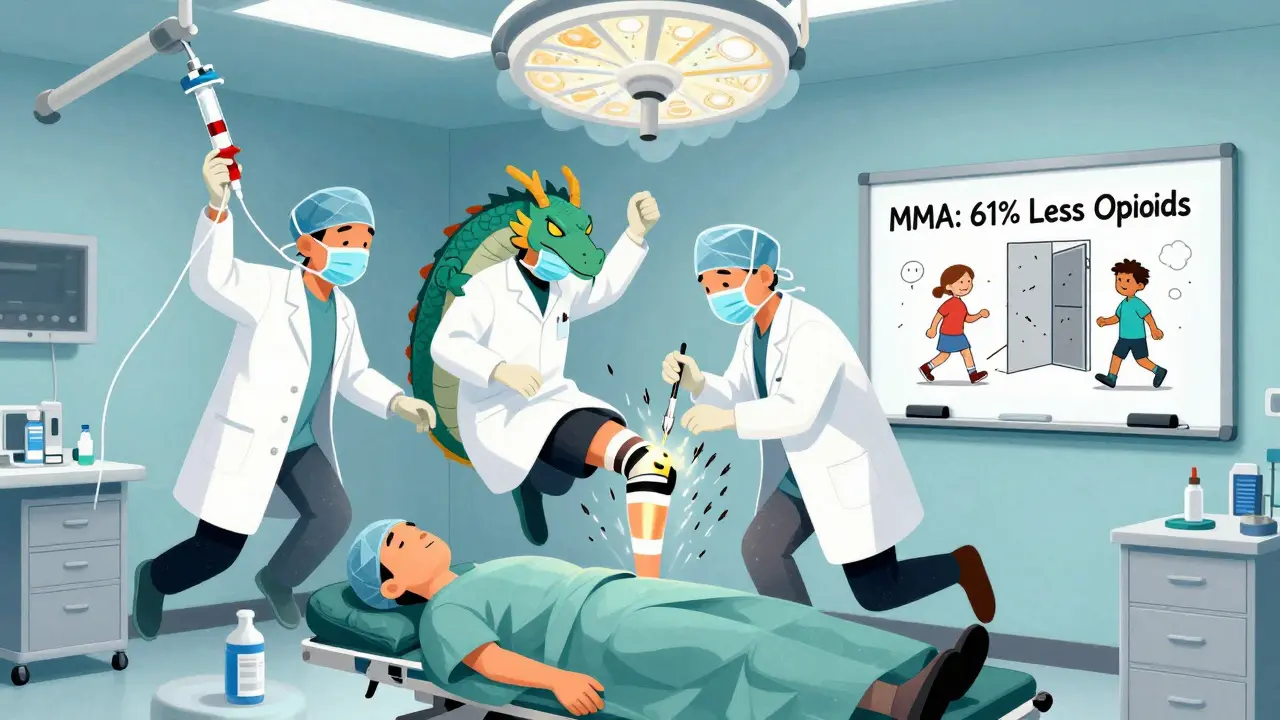
The Hidden Players: Non-Drug Tools
MMA isn’t just pills and IVs. It includes:- Regional nerve blocks: Ultrasound-guided injections that numb specific areas-like a femoral nerve block for knee surgery. These can last 12-24 hours and reduce opioid use by half.
- Continuous wound infusions: A small catheter left in the surgical site slowly delivers numbing medicine (like ropivacaine) for up to 72 hours.
- Physical therapy and movement: Getting patients up and walking early reduces pain sensitivity and speeds healing.
- Patient education: Telling patients what to expect, how to use pain scales, and when to call for help reduces anxiety-and pain perception.
What Goes Wrong-and How to Fix It
MMA sounds simple. But it’s not easy to run. It needs coordination. A nurse in the PACU, a pharmacist checking kidney function, a pain specialist scheduling a nerve block, and a surgeon who understands the protocol-all have to be on the same page. Common mistakes:- Forgetting to start meds before surgery. If you wait until after the cut, you’re already behind.
- Using naproxen in patients with poor kidney function. It’s contraindicated if eGFR is below 30 mL/min.
- Not adjusting gabapentin for kidney issues. In renal impairment, dose drops from 300 mg three times a day to 200 mg once daily.
- Not using a validated pain scale. Pain must be tracked every 2 hours for the first 24 hours. If you don’t measure it, you can’t improve it.
What’s Next for Pain Management
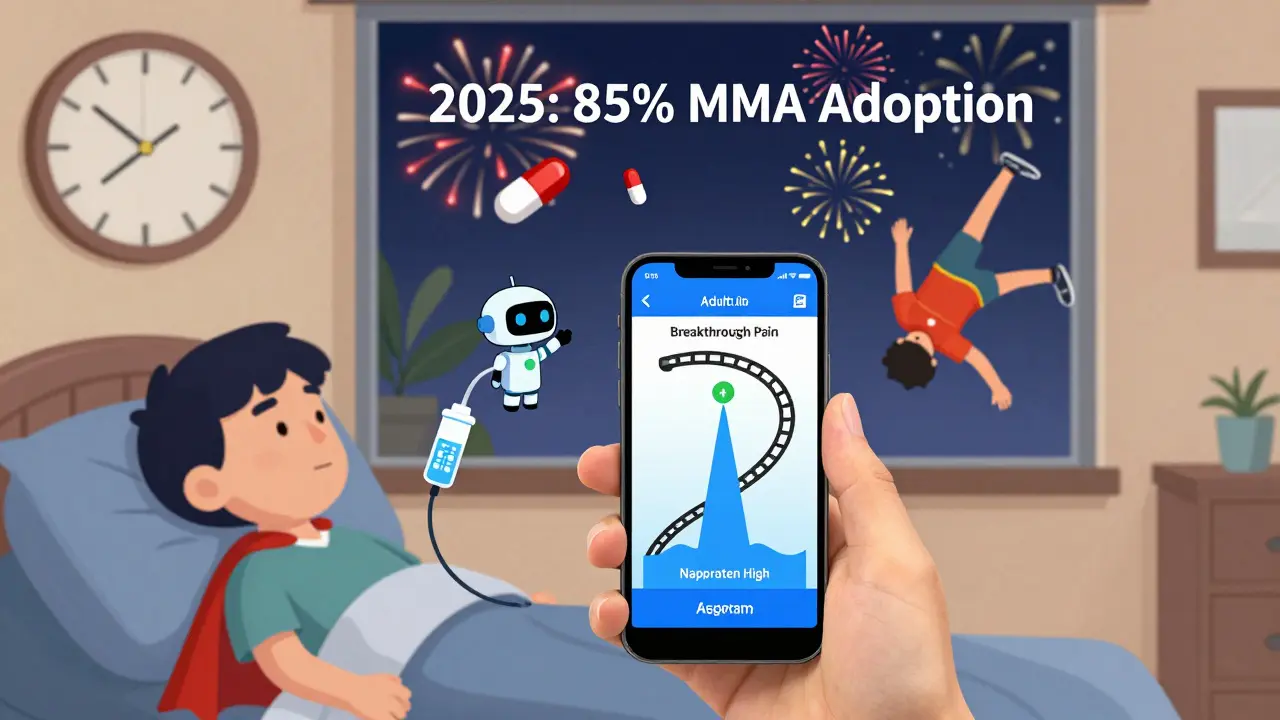
By 2025, the American Society of Anesthesiologists predicts 85% of major surgeries will use formal MMA protocols-up from 60% in 2022. New trends include:- Prescribing gabapentinoids for 5-10 days after discharge to prevent chronic pain.
- Using continuous epidural infusions for complex spine cases.
- Integrating digital tools-like apps that track pain scores and medication use-into discharge plans.
What You Can Do as a Patient
If you’re scheduled for surgery:- Ask if your hospital uses a multimodal pain plan.
- Request pre-op meds like acetaminophen and gabapentin-don’t wait until after surgery.
- Ask about nerve blocks. Even if you’re having a minor procedure, they can make a big difference.
- Know your pain scale. If your pain is above 4/10 after meds, speak up. Don’t suffer silently.
- Ask about discharge meds. You might need gabapentin or NSAIDs for days after you leave the hospital.
Is multimodal analgesia safe for everyone?
Most patients tolerate MMA well, but it’s not one-size-fits-all. People with severe kidney disease can’t take naproxen, and gabapentin doses must be lowered if eGFR is below 30 mL/min. Those with liver disease need careful dosing of acetaminophen. Patients with a history of substance use disorder benefit from MMA but need extra monitoring. Your care team will adjust the plan based on your medical history, allergies, and surgical type.
Can I avoid opioids completely after surgery?
Yes, many patients do. Hospitals with strong MMA programs offer opioid-free surgery options using regional nerve blocks, continuous infusions of lidocaine or ketamine, and scheduled non-opioid meds. This works best for procedures like knee replacements, hernia repairs, and some spine surgeries. If you’re concerned about opioids, tell your surgeon and anesthesiologist ahead of time-they’ll design a plan around your wishes.
How long do I need to take non-opioid pain meds after surgery?
Typically, scheduled meds like acetaminophen and NSAIDs are used for 3-7 days. Gabapentin or pregabalin may be continued for 5-10 days after discharge to prevent nerves from becoming hypersensitive-a key step in avoiding chronic pain. Always follow your provider’s instructions. Stopping too early can cause rebound pain.
Why isn’t everyone using multimodal analgesia yet?
It requires coordination. Not all hospitals have the staff, training, or equipment-like ultrasound machines for nerve blocks. Some providers still default to opioids out of habit. Insurance doesn’t always cover extended infusions or specialized pain consults. But adoption is growing fast. By 2025, most major hospitals in the U.S. are expected to have formal MMA protocols in place.
Does multimodal analgesia cost more?
Upfront, it might seem more expensive due to extra medications or equipment. But the real savings come from shorter hospital stays, fewer complications like nausea or constipation, and less risk of opioid dependency requiring long-term treatment. Studies show MMA reduces total costs by 15-20% per patient when you factor in readmissions and follow-up care.
This is the kind of post that makes me want to scream at every surgeon I’ve ever met. Why the hell are we still letting people walk out of the hospital addicted to opioids like it’s normal? I had a knee replacement last year and they gave me 30 oxycodone pills like it was candy. I threw half of them out. My pain was managed better with ice packs and screaming into a pillow. It’s not rocket science. Stop being lazy.
Just to clarify: acetaminophen 1,000 mg pre-op? Yes. Gabapentin 300–600 mg? Absolutely. Celecoxib 400 mg? Only if renal function is normal. Always check eGFR. Also, don’t forget-gabapentin needs to be titrated down in CKD. And please, for the love of all things medical, use a validated pain scale. If you’re not measuring pain every two hours, you’re flying blind. This protocol works. But only if you do it right.
It’s fascinating how medicine has evolved from treating symptoms to preventing suffering. Opioids were never meant to be a long-term solution-they were a bridge. But we built a house on that bridge. Now we’re tearing it down, brick by brick, with science, coordination, and humility. The real breakthrough isn’t the drugs. It’s the mindset shift.
I’m a nurse in a trauma unit and I swear by this stuff. We started doing MMA last year and the difference is night and day. Patients are awake, talking, walking the next day. No more zombie mode. One guy told me, ‘I didn’t feel like I’d been hit by a truck’-and he’d had a triple fracture. I cried. Not because I’m dramatic (okay maybe a little), but because we finally got it right.
Pre-op meds matter. If you wait until after surgery, you are too late. Start acetaminophen and gabapentin before the incision. That’s not optional. That’s science. Also, NSAIDs are not for everyone. Check kidneys. Check liver. Check history. Simple rules. Big results.
YESSSSS. This is the future. No more opioids unless you’re dying. I had a cousin who got addicted after a wisdom tooth extraction. Five years later, still on pills. This protocol could’ve saved her. Tell your surgeon. Demand it. You deserve to heal without becoming a statistic.
Okay so like… I read this whole thing and I’m like… wait, so we’re just… not giving opioids? Like… at all? I mean… I get it, but what if you’re in, like, actual pain? Like, screaming pain? Isn’t that, like, cruel? Also, I think ‘multimodal’ is just a fancy word for ‘more pills.’
As a patient advocate, I’ve seen too many people dismissed because their pain ‘wasn’t bad enough.’ This protocol changes that. It gives patients agency. It gives clinicians structure. And it respects the body’s ability to heal-without chemical crutches. This isn’t just better care. It’s more humane care.
In Nigeria, we don’t have access to ultrasound machines or IV ketamine for most patients. But we do have paracetamol, aspirin, and cold compresses. We also have community nurses who sit with patients and talk them through pain. Maybe the real lesson isn’t the drugs-it’s the presence. The human touch. That’s universal.
The pharmacokinetic profile of lidocaine infusion at 1.5 mg/kg followed by maintenance infusion is well-documented in the Journal of Clinical Anesthesia, 2021. The NMDA antagonism provided by ketamine, combined with alpha-2 agonism from dexmedetomidine, significantly attenuates central sensitization. This is not anecdotal-it’s evidence-based multimodal analgesia.
Of course this works. People just need to stop being weak. I’ve had three surgeries. I never took opioids. I used ice, deep breathing, and willpower. If you need pills, you’re not trying hard enough. This isn’t medicine-it’s coddling.
I appreciate the depth of this post. The inclusion of patient education and early mobilization as core components is critical. Many protocols focus only on pharmacology, but pain is a biopsychosocial experience. Addressing anxiety, expectation, and movement is what makes MMA sustainable. Thank you for highlighting this.
My mom had back surgery last month and they used this exact plan. She was up walking the same day. No nausea. No constipation. She didn’t even need a single opioid pill. I’m telling everyone I know.
Someone actually said ‘willpower’? Wow. You’re not a doctor, are you? I hope you never need surgery. Because when you’re screaming in pain and your body is shutting down, your ‘willpower’ won’t stop your nerves from firing. This isn’t about being weak-it’s about science. Grow up.