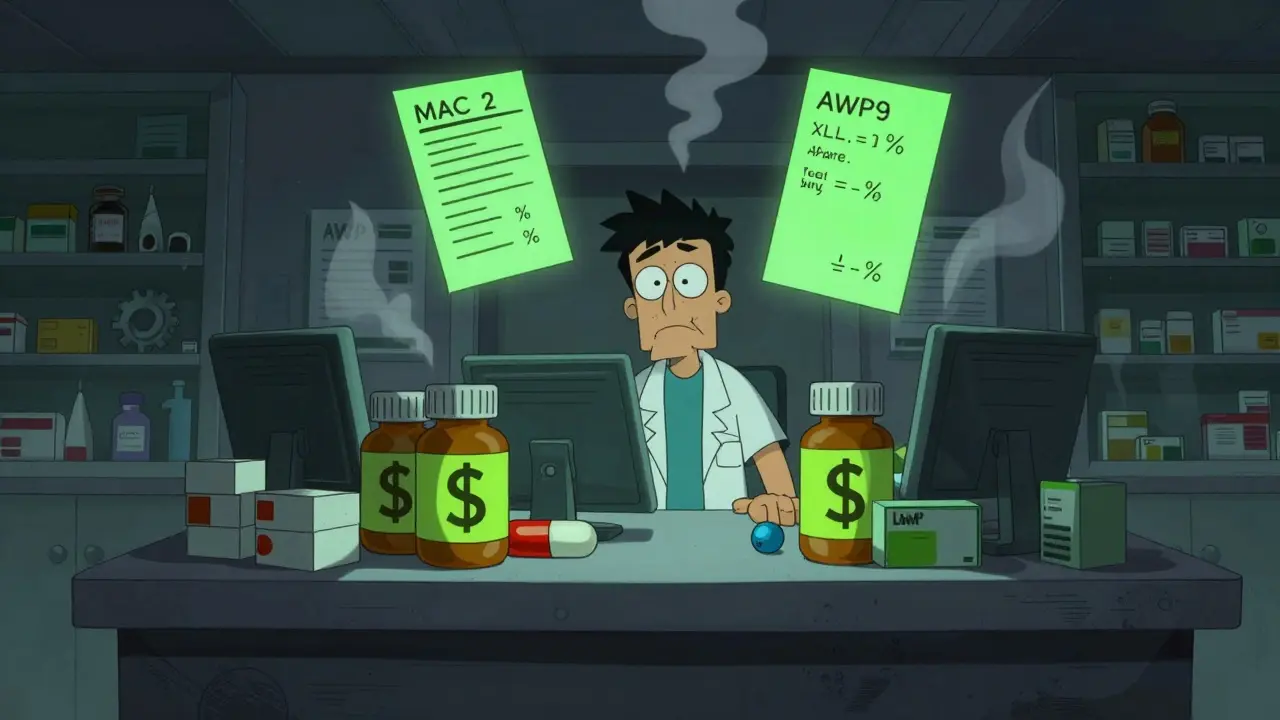
Have you ever wondered why switching a brand-name drug to a generic version doesn't always mean lower costs for everyone involved? On paper, Generic Substitution isthe practice of dispensing a less expensive, therapeutically equivalent medication instead of the prescribed brand. We assume this saves money. It does, for sure. But when we look closely at the machinery behind the scenes-specifically how pharmacies get paid-the picture gets much more complicated. In many cases, the financial incentives built into Pharmacy Reimbursement isthe payment structure pharmacies receive for dispensing medications, covering ingredient costs and dispensing fees actually encourage behaviors that might not align with pure savings.
The story isn't just about pill prices. It's about who gets the margin and how the system rewards volume over value. As of 2026, these dynamics remain central to every pharmacy owner's bottom line. Let's break down exactly how these mechanisms work and why they matter to your daily practice and the broader healthcare economy.
The Basics of Payment Structures
To understand the implications, we first need to grasp how a pharmacy gets reimbursed. Historically, the standard was fairly linear: a payer pays for the cost of the drug plus a fee for the service of dispensing it. This is known as the "cost-plus" model. Under this older framework, if a pharmacy bought a generic tablet for $10, they might get reimbursed $10 plus a $5 fee. Simple enough.
However, modern payment flows operate differently. Today, Average Wholesale Price (AWP) isa published list price for pharmaceutical drugs used as a benchmark for calculating reimbursement rates plays a massive role. Often, payers deduct a percentage from the AWP to determine the "ingredient cost." For brand-name drugs, this deduction is common. For generics, though, the math shifts toward Maximum Allowable Cost (MAC) Lists iscaps set by payers on the maximum amount they will reimburse for off-patent drugs.
These MAC lists are essentially speed bumps for profitability. They dictate the ceiling of what you can claim back. The problem arises because these lists vary wildly depending on who holds the contract. One insurance plan might cap a generic atorvastatin at $15, while another allows $20. Without industry-wide standardization, pharmacies navigate a maze of conflicting limits. This lack of consistency creates friction. If the MAC list sets a limit below the actual purchase price, the pharmacy loses money on every prescription filled. This forces operators to balance stocking essential inventory against the risk of selling it at a loss.
The Mechanics of Spread Pricing
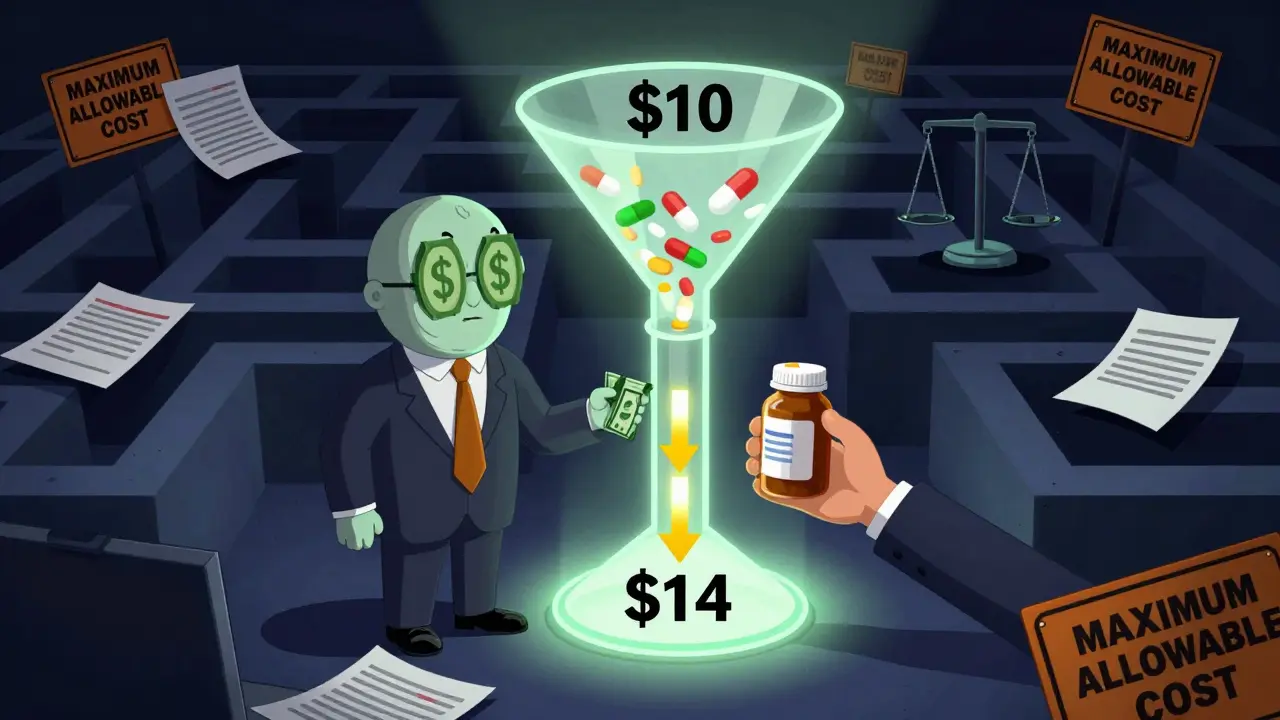
Perhaps the most contentious element in the current ecosystem is Spread Pricing isa practice where PBMs charge plans higher prices than they reimburse pharmacies. Imagine a scenario where a generic drug costs the pharmacy $10. The Pharmacy Benefit Manager (PBM) tells the health plan the cost is $14 but pays the pharmacy only $10. That $4 difference is the "spread."
Why does this happen? It turns out that generic substitution has become a lever for profit rather than just savings. Research indicates that PBMs often steer patients toward specific generic options that carry higher spreads. For instance, if two generic versions of the same drug exist-one from Manufacturer A and one from Manufacturer B-the PBM might favor the more expensive one simply because their rebate agreement or spread potential is better there.
| Reimbursement Model | Profitability Cap | Incentive for Generics | Payer Control |
|---|---|---|---|
| Cost-Plus | Limited | Moderate (Fixed %) | High |
| AWP Percentage | Volatile | Low (Price fluctuation) | Medium |
| MAC Lists | Strict Cap | Variable | High |
This preference for higher-priced generics has tangible effects. Studies show that substituted generics can cost significantly more than the therapeutic alternatives available. In some analyses, substituted drugs within the same class were priced up to 20 times higher than other clinically similar options. While the goal is ostensibly cost control, the result can sometimes be inflated spending within the system, hidden from the view of the average patient who just sees a low copay.
Impact on Independent Pharmacy Survival
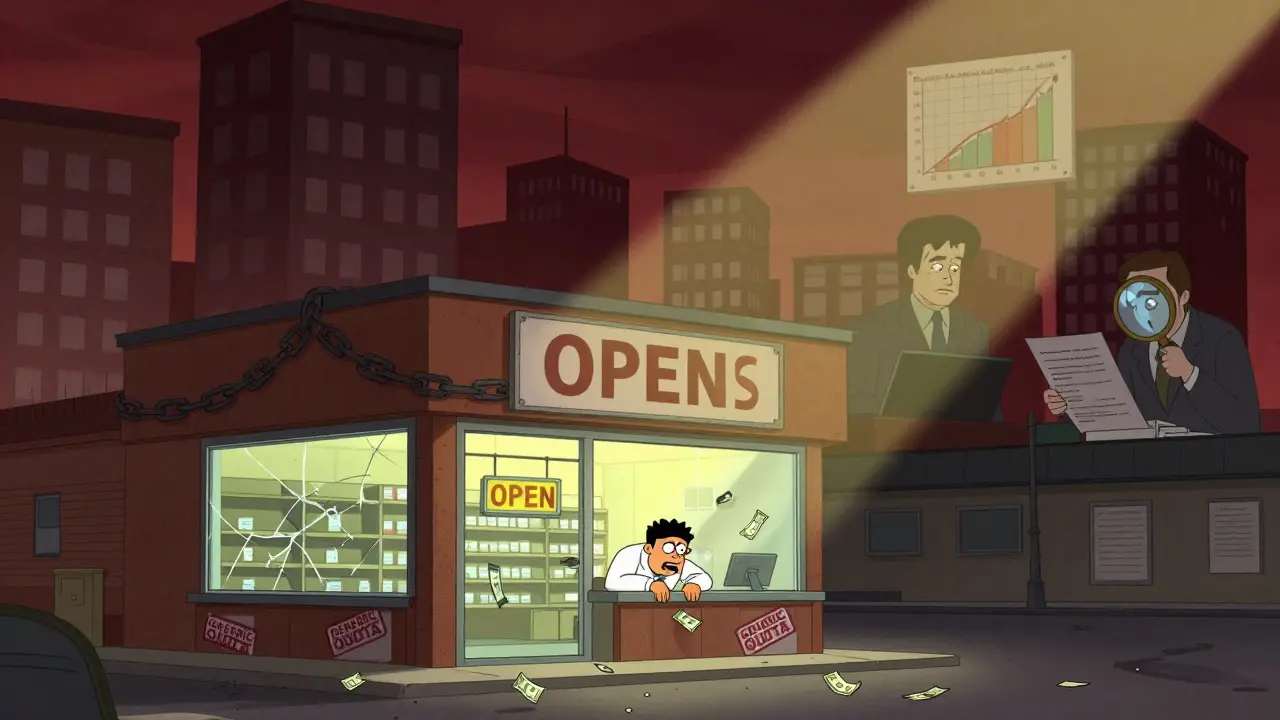
You might ask, who feels this pressure the most? The answer is usually the independent community pharmacist. While big chains absorb losses in exchange for customer traffic, independents often cannot operate under negative margins. Between 2018 and 2022, over 3,000 independent pharmacies closed their doors. A significant driver of this trend was narrow margins caused by aggressive MAC policies.
When generic utilization goes up-a target that hit 90% by 2023-margins actually squeeze harder if the reimbursement doesn't track with acquisition costs. Large chains benefit from purchasing power that allows them to secure lower buy-in prices, making a $0.50 margin per script survivable for volume. For a neighborhood pharmacy handling fewer scripts, that gap becomes fatal.
Additionally, contracts with PBMs increasingly include Generic Effectiveness Rates (GERs) isclauses stipulating minimum percentages of generic prescriptions to be dispensed to maintain contract validity. These clauses force a certain volume of generics to be processed. While generic drugs are great for affordability, meeting these quotas often means working for pennies. This dynamic has accelerated consolidation in the market, pushing smaller operators toward larger networks just to stay solvent.
Therapeutic Substitution Versus Standard Generic Swaps
There is another layer here: Therapeutic Substitution isswitching a prescription to a different drug class that offers similar clinical benefits. Many people confuse this with swapping Brand X for Generic X. But true therapeutic substitution involves swapping a brand drug for a generic in a different class or choosing a lower-cost alternative within the same class that isn't the direct chemical equivalent.
The potential savings here are massive. Analyses suggest that switching single-source brand names to generic alternatives in specific therapeutic classes could save billions annually compared to standard brand-to-generic swaps. However, reimbursement structures often penalize or fail to recognize these switches unless there is strict adherence to formularies.
For pharmacists, identifying these opportunities requires deep knowledge of therapeutics, not just supply chain logistics. When done correctly, it lowers costs without compromising care. Yet, restrictive pricing policies make it harder to stock the diverse inventory needed to support these swaps. If you can't stock Drug Y, you can't suggest the switch to Doctor Z, and the patient stays on the expensive Drug X.
Regulatory Scrutiny and Future Outlook
As we progress through 2026, the conversation has shifted from internal efficiency to regulatory oversight. The Federal Trade Commission (FTC) has intensified its focus on how PBMs handle these spreads. Transparency is no longer optional; new provisions in laws like the Inflation Reduction Act demand clearer visibility into pricing.
States are reacting, too. Prescription Drug Affordability Boards (PDABs) in fifteen states now establish Upper Payment Limits (UPLs). While the intention is to cap costs for consumers, there is a risk. If limits are set too aggressively, they threaten the availability of necessary branded medications that have no generics yet. The balance is delicate.
Experts predict a move toward value-based arrangements by 2031. Instead of paying per pill, payers and pharmacies might negotiate based on patient outcomes. Until that fully matures, however, the current model of opaque spreads and varying MAC lists remains the reality on the counter. Understanding these mechanics isn't just academic; it's survival strategy for pharmacy operations.
What is the main financial impact of generic substitution on pharmacies?
While generic substitution lowers the price of the drug itself, it can reduce overall revenue for pharmacies because reimbursement margins on generics are often lower than brand-name drugs. Additionally, aggressive rebates and MAC lists can squeeze profits to near zero per transaction, relying on volume to survive.
How do PBMs profit from generic drugs?
PBMs often engage in spread pricing, buying drugs from pharmacies or manufacturers at a lower rate and billing the insurance plan at a higher rate. They also earn rebates based on formulary placement, which incentivizes steering patients to specific generic suppliers.
Are MAC lists standardized across the industry?
No, MAC lists vary substantially between PBMs and state Medicaid programs. There is no single national standard for calculation methodology, leading to confusion and inconsistent reimbursement rates for the exact same drug at different locations.
Does therapeutic substitution save more money than generic substitution?
Yes, therapeutic substitution generally offers greater savings potential. Switching to a generic equivalent in a different therapeutic class can cut costs significantly more than a direct chemical substitution of a brand to a generic.
How does the Inflation Reduction Act affect reimbursement?
The Inflation Reduction Act includes provisions requiring greater transparency in Medicare Part D pricing. These changes are expected to extend to commercial markets, forcing PBMs to disclose more details about pricing and spread practices.
Honestly this is just another way to say we're being screwed by corporate greed.
The shadow networks pulling these strings are darker than anyone admits.
They weave through the legislation to ensure profit always trumps patient safety.
You can almost smell the corruption radiating off these financial models.
I'm tired of seeing these greedy companies win 😤
We deserve better healthcare systems that don't rely on hidden fees 🙄
It's morally wrong to charge people extra for cheap drugs ✋
We often think about money when we talk about medicine.
But really it is about power dynamics between corporations.
The system rewards those who know the rules best.
Small players get crushed by invisible walls of paperwork.
It feels like a game designed to be unwinnable for honest folk.
You see numbers moving around but no one sees the truth behind them.
Perhaps the spread pricing is the real evil here.
They hide the costs in layers of complex spreadsheets.
A regular person cannot hope to understand that maze alone.
Independence becomes a luxury you cannot afford.
We sacrifice local shops for efficiency that does not exist.
Trust is eroding with every new policy change announced.
It is time we question why we accept these terms silently.
Knowledge should be shared openly instead of locked away.
Until then we remain stuck in this loop of artificial scarcity.
I think simple changes could fix many of these problems.
The MAC lists vary widely because payers negotiate different contracts.
This creates confusion for pharmacists trying to manage inventory costs.
Understanding the specific rebates helps clarify the margin squeeze.
Oh please spare me the technical jargon while your margins vanish.
It's cute how you try to explain the math of your own demise.
Our domestic pharmacy chains should lead the way on transparent pricing.
Foreign competition threatens our national supply chain security.
These global PBMs are encroaching on American jobs and profits.
Regulation must favor local ownership over international conglomerates.
It is patriotic to support businesses that reinvest locally.
Your blind nationalism ignores the market reality of global trade.
Over here in Australia we struggle with similar issues regarding scripts.
The government subsidies help a bit but it still hurts small pharmacies.
Comparisons across borders highlight how systemic these issues truly are.
Maybe cooperation between regions would solve some of the pricing anomalies.
This situation is absolutely catastrophic for the average consumer wallet.
We need dramatic reform before the next decade ends.