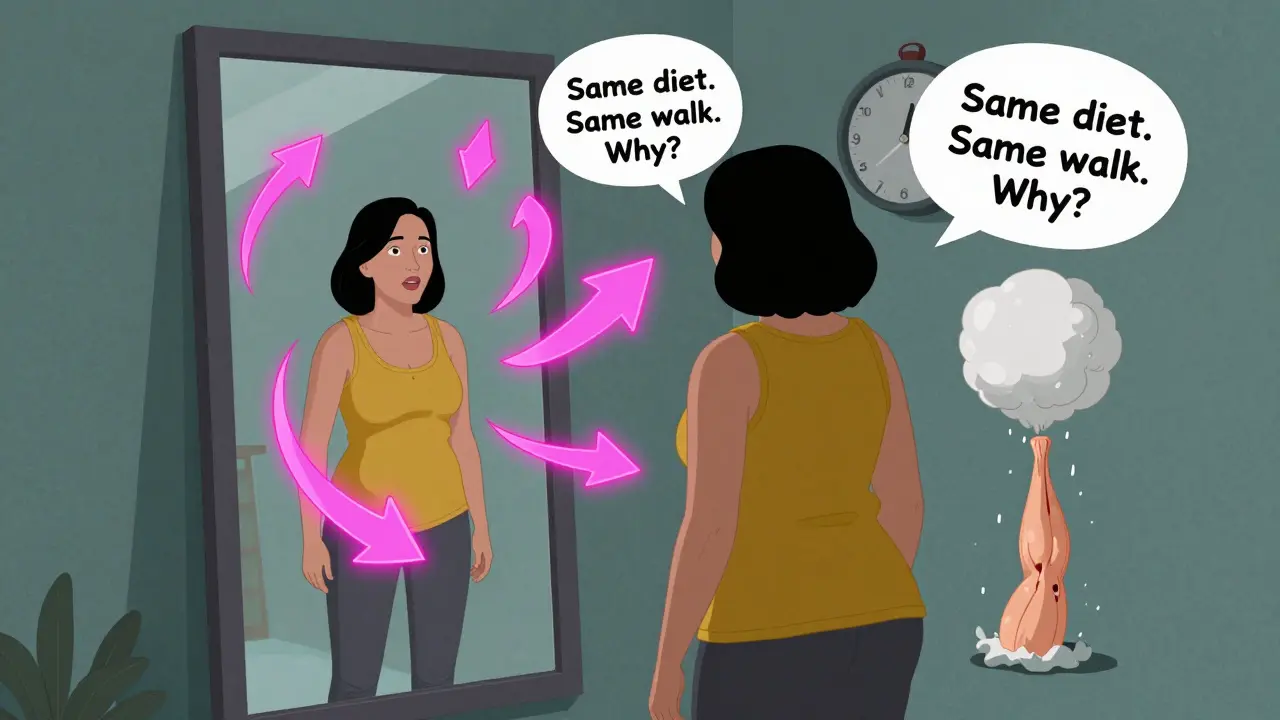
Women in their 40s and 50s often wake up one day to find their clothes don’t fit-even though they haven’t changed what they eat or how much they move. It’s not laziness. It’s not a lack of willpower. It’s biology. Menopause weight gain isn’t just about eating too much. It’s about hormones shifting, muscle disappearing, and metabolism slowing down-all at once. And if you’re trying to lose weight the same way you did in your 30s, you’re fighting an uphill battle with the wrong tools.
Why Your Body Changes During Menopause
The drop in estrogen during menopause isn’t just about hot flashes and sleepless nights. It’s a full-system reset. Estrogen, especially estradiol, used to help your body store fat in your hips and thighs. That was the safe, stable kind of fat. When estrogen levels crash-from around 70-150 pg/mL down to 10-20 pg/mL-your body doesn’t know what to do with fat anymore. So it starts storing it in your belly. That belly fat? It’s not just inconvenient. It’s visceral fat-deep inside your abdomen, wrapped around your organs. This type of fat is metabolically active. It pumps out inflammatory chemicals and makes your body resistant to insulin. That’s why postmenopausal women are nearly five times more likely to develop abdominal obesity than women before menopause. And even if your overall weight stays the same, this shift increases your risk of heart disease by 25-30%, regardless of your BMI.It’s Not Just Hormones-Muscle Is Disappearing
You lose muscle every year after 30. About 3-8% per decade. Menopause speeds that up. By the time you hit your 50s, you might be losing an extra 1-2% of muscle each year. And here’s the kicker: muscle burns calories even when you’re sitting still. Less muscle means your resting metabolism drops by 2-3% every decade. That’s like losing 100-150 calories a day without lifting a finger. That’s why many women say: “I ate the same for years. I walked every day. Then menopause hit, and I gained 20 pounds.” It’s not that they ate more. It’s that their body started burning fewer calories-even if they did everything right.Appetite Gets Messed Up, Too
Estrogen helps regulate leptin, the hormone that tells your brain you’re full. When estrogen drops, leptin drops too. That means you feel hungrier, even if you’ve eaten enough. At the same time, sleep problems from night sweats spike ghrelin-the hunger hormone-by 15-25%. So you’re hungrier, you’re tired, and you crave carbs and sugar for quick energy. It’s a perfect storm. Your body is screaming for fuel, your metabolism is slowing, and your fat is being stored in the worst possible place. No wonder diets that worked before now feel useless.What Actually Works: The Science-Backed Strategy
Forget crash diets. Forget cutting out carbs entirely. The real fix is rebuilding what you’ve lost: muscle. And that means lifting weights. A 2022 clinical trial found that women who did strength training 2-3 times a week, combined with high-intensity interval training (HIIT) once or twice a week, gained 1.8-2.3 kg of muscle and lost 8-12% of belly fat in just six months. That’s not magic. That’s science. Strength training doesn’t just burn calories during the workout-it boosts your metabolism for hours after. It also improves insulin sensitivity, which helps your body stop storing fat in your belly.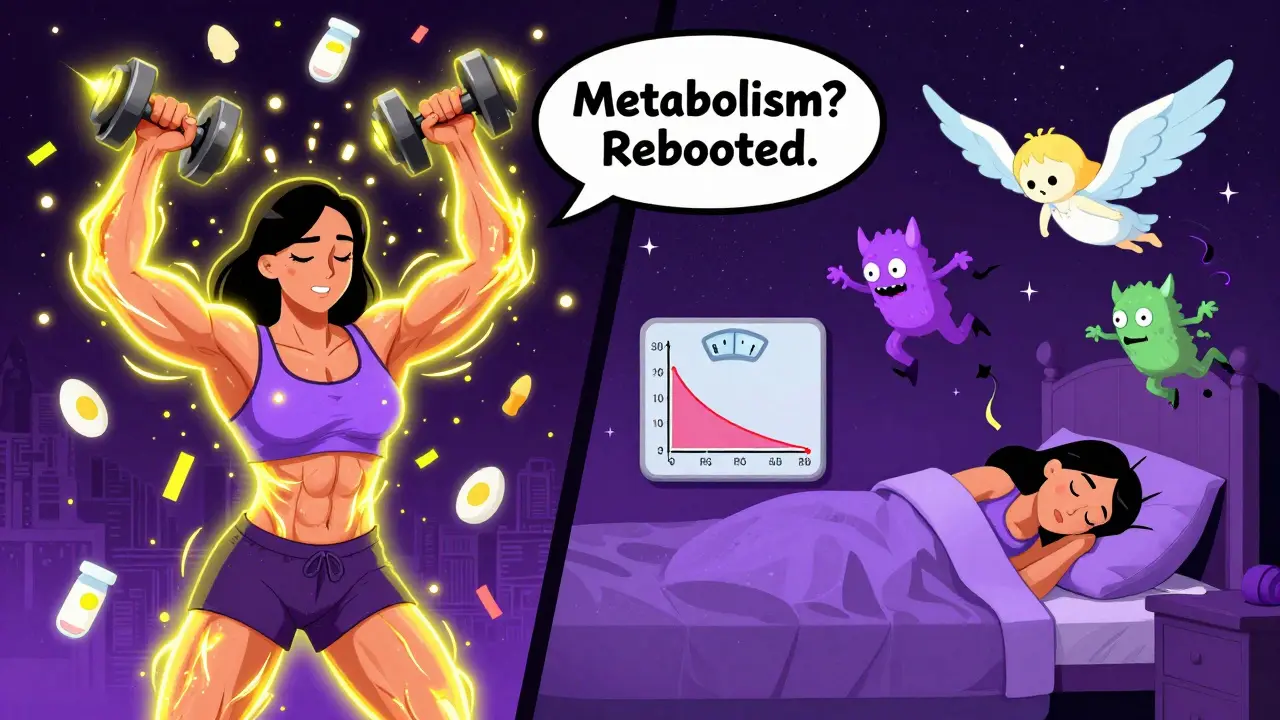
Protein Isn’t Optional-It’s Essential
As you age, your body becomes resistant to the signals that tell it to build muscle. This is called anabolic resistance. To fight it, you need more protein-spread evenly across meals. Aim for 25-30 grams of protein per meal. That’s about three eggs and a cup of Greek yogurt at breakfast. Or a 150g chicken breast, half a cup of lentils, and a handful of almonds at lunch. Studies show that women who hit this target daily lose more fat and keep more muscle than those who just eat protein at dinner. The British Menopause Society recommends 1.2-1.6 grams of protein per kilogram of body weight. If you weigh 70kg, that’s 84-112 grams of protein a day. Don’t wait until dinner to get it. Distribute it.Sleep Is Part of the Plan
You can’t out-exercise bad sleep. Hot flashes and night sweats affect 75% of perimenopausal women. And when you sleep less than 7 hours, ghrelin spikes and leptin drops. Your appetite goes haywire. Your stress hormone cortisol rises. Your body holds onto fat. Prioritize sleep like it’s medicine. Cool your bedroom. Avoid caffeine after 2 p.m. Try magnesium glycinate or low-dose melatonin if you’re struggling. One study showed that getting 7-8 hours of sleep reduced ghrelin by 15-25% and improved leptin sensitivity by 20-30%. That’s like adding a free workout to your day.Why Traditional Diets Fail
Low-calorie diets might work for a while. But when your metabolism is already slowed, cutting calories too much backfires. Your body thinks it’s starving. It slows down even more. Muscle melts. Fat clings tighter. Women in the SWAN study gained 4.5-6.8 kg (10-15 pounds) over the menopausal transition-even when they kept their calorie intake and exercise the same. That’s not failure. That’s physiology. The goal isn’t to lose weight fast. It’s to rebuild your body so it can burn fat efficiently again. That takes time. Most women see real changes in 3-6 months. And it’s not about the scale. It’s about how your clothes fit, your energy levels, and your waist measurement.What to Measure Beyond the Scale
The North American Menopause Society now recommends measuring waist circumference. If it’s over 88 cm (35 inches), your risk for metabolic syndrome jumps. That’s a better predictor than BMI. Track your waist every month. Take photos. Notice how your jeans feel. Muscle weighs more than fat. You might not lose pounds-but you’ll lose inches. And that’s the real win.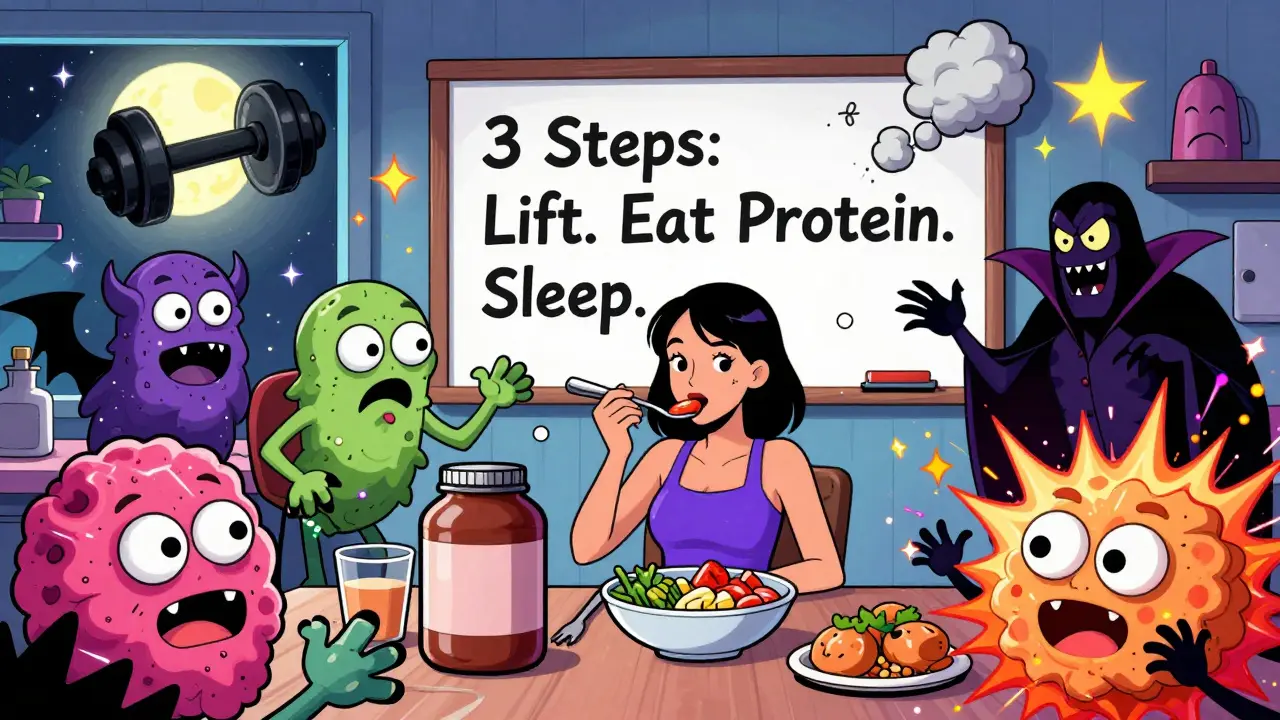
The Future Is Personalized
New tools are coming. In January 2023, Mayo Clinic launched a metabolic test that checks 17 hormonal and metabolic markers to build a custom plan for each woman. The FDA has approved bimagrumab-a drug that increases muscle by 5-7% and cuts fat by 8-10% in 24 weeks-for Phase 3 trials. And the NIH is funding a five-year study to see if early hormone therapy can prevent fat from shifting to the belly. But you don’t need to wait. Right now, you have everything you need: protein, movement, sleep. You just need to do it differently.Start Here: Your 3-Step Action Plan
- Step 1: Strength train 3 times a week. Squats, lunges, push-ups, rows, deadlifts. Even bodyweight exercises count. If you’re new, start with two days and add one.
- Step 2: Eat 25-30g of protein at each meal. Eggs, chicken, fish, tofu, lentils, Greek yogurt, cottage cheese. Don’t skip breakfast.
- Step 3: Protect your sleep. Cool room, no screens after 9 p.m., consistent bedtime. Aim for 7-8 hours.
What Doesn’t Work (And Why)
- Cardio-only workouts: Running or cycling burns calories but doesn’t rebuild muscle. You’ll lose weight, but you’ll lose muscle too-and your metabolism will keep sinking.
- Extreme low-carb diets: They can worsen fatigue and sleep issues. Carbs fuel your brain and recovery. Focus on whole grains, fruits, and veggies instead.
- Skipping meals: That just makes your body hold onto fat. Eat regularly. Your metabolism needs fuel.
Final Thought: This Isn’t About Being Thin
It’s about being strong. It’s about staying healthy. Menopause doesn’t mean your body is broken. It means it’s changing. And you can meet that change with strategy, not shame. The women who thrive after 50 aren’t the ones who starve themselves. They’re the ones who lift, eat enough protein, sleep well, and stop fighting their biology. They understand that their body isn’t broken-it just needs a new plan.Why am I gaining weight even though I eat the same as before?
Your metabolism slows down because you’re losing muscle and estrogen levels drop. Even if you eat the same amount, your body burns fewer calories. Hormonal changes also shift fat storage to your belly, making weight gain more noticeable even without a calorie surplus.
Can hormone replacement therapy (HRT) help with weight gain?
HRT may help reduce abdominal fat gain in some women by stabilizing estrogen levels, but it’s not a weight-loss treatment. The main benefit is preventing fat redistribution to the belly. It works best when started early in menopause and combined with diet and exercise. Always discuss risks and benefits with your doctor.
How much protein do I really need after menopause?
Aim for 1.2-1.6 grams of protein per kilogram of body weight daily. For a 70kg woman, that’s 84-112 grams. Spread it across meals-25-30g per meal-to fight muscle loss. Protein helps preserve muscle, boosts metabolism, and keeps you full longer.
Is cardio enough to lose menopause weight?
No. Cardio helps burn calories, but without strength training, you’ll lose muscle along with fat. That lowers your metabolism even more. Combine cardio with resistance training 2-3 times a week to preserve muscle and target belly fat effectively.
Why is belly fat so hard to lose after menopause?
Belly fat after menopause is visceral fat-deep, active fat around your organs. It’s driven by low estrogen and high cortisol, and it’s more resistant to fat loss than fat stored in the hips or thighs. It requires muscle-building, protein intake, and good sleep to reduce-not just calorie cutting.
How long until I see results from these changes?
Most women notice changes in 3-6 months. Muscle takes time to build, and fat loss slows with age. Don’t judge progress by the scale. Track waist measurements, how your clothes fit, and your energy levels. Consistency beats speed.
Finally, someone gets it. I thought I was broken until I read this. I’ve been doing yoga and walking for years, and then-bam-50 hits and my jeans won’t zip. No, I didn’t start eating donuts. My body just rewired itself. Strength training changed everything. Not because I got lean, but because I got strong. And that’s the win.
Also, protein at breakfast? Game changer. I used to skip it. Now I have eggs, Greek yogurt, and a scoop of whey. I don’t crave sugar by 11 a.m. anymore. Simple. Not sexy. But it works.
Oh please. You think lifting weights is the answer? My cousin in Toronto tried that. She gained 10 pounds of ‘muscle’ and still looked like a sack of potatoes. This whole ‘menopause is just biology’ narrative is just corporate wellness propaganda. You’re not losing muscle-you’re losing discipline. Stop blaming estrogen and start blaming yourself. Eat less. Move more. Simple. Not rocket science.
Also, who even eats 30g of protein at breakfast? That’s like eating a steak before noon. Pathetic.
Tracy, I feel you. But you’re missing the point. This isn’t about blame. It’s about adaptation. My mom hit menopause at 52, started lifting with a physical therapist, and now she’s doing deadlifts with 80lbs. She doesn’t care about the scale. She cares about climbing stairs without gasping. That’s the real victory.
Also, sleep? Huge. I started using a cooling pillow and cut caffeine after 2 p.m. I swear, my cravings dropped by half. No magic. Just biology meeting common sense.
Y’all are overcomplicating this. It’s just menopause. You’re getting old. Your body’s failing. No amount of protein or squats is gonna fix that. I’ve seen it. My aunt tried everything. Keto. Intermittent fasting. Even that new ‘bimagrumab’ drug. She’s still got that muffin top. The truth? You’re not gonna win. So just accept it. Buy bigger pants. Stop pretending you can outsmart nature.
Also, who the hell is eating lentils at lunch? That’s just sad.
Okay I just wanna say thank you to the OP for actually explaining the science instead of just saying ‘do more cardio’ like every other blog. I’m 48 and I’ve been doing HIIT for 2 years but I was still gaining belly fat and I didn’t know why. When I started lifting 3x a week and hit 30g protein at every meal? My jeans fit again. Not because I lost weight-but because my body changed. My waist went from 36 to 32 inches. I didn’t even realize how much muscle I’d lost until I started rebuilding it.
Also I just wanna say I totally messed up my protein intake for years. I thought dinner was enough. Nope. Spreading it out is the secret. And sleep? I used to scroll till midnight. Now I read a book. Game changer.
Can I just say-this is the most coherent, science-backed, non-toxic piece on menopause I’ve ever read? Thank you. I’ve been reading ‘eat less, move more’ advice for years, and it made me feel like a failure. But this? This is like a map. Not a punishment. I’ve started doing bodyweight squats every morning. Just 10. And I’ve added cottage cheese to my lunch. It’s not glamorous. But it’s sustainable.
Also, I’ve stopped weighing myself. I measure my waist now. And I take photos. It’s weirdly empowering. Like, I’m not trying to look like I’m 25-I’m trying to feel like I’m 50 and strong.
Let me be blunt: this entire article is a placebo dressed in jargon. Hormonal shifts? Muscle loss? Please. The real issue is the decline in moral discipline. Modern women are coddled with ‘biohacking’ nonsense instead of being told to eat less and stop making excuses. Protein? Sleep? You think that’s new? My grandmother in Delhi ate dal and roti, rose at 5 a.m., and worked in the fields till dusk. She didn’t need a ‘metabolic test’-she had resilience.
Stop buying into Western wellness cults. The answer isn’t in a gym. It’s in discipline.
ok so i tried the protein thing and honestly i thought i was gonna puke at first. 30g at breakfast? like what am i, a bodybuilder? but i did it. scrambled eggs + greek yogurt + a handful of almonds. and guess what? i didn’t crave that 3pm donut. i didn’t even think about it. weird right? also i started sleeping better. maybe it’s the magnesium? or maybe i’m just tired of feeling like a zombie.
also i still hate lifting weights but i’m doing it. 2x a week. it’s not pretty. but i’m alive. and that’s enough.
Interesting perspective. But let us not forget: in ancient Vedic texts, menopause was called ‘Rituchakra Parivartan’-a cosmic cycle of transformation. The body does not ‘fail’-it ascends. Modern science is still catching up. The real solution? Ayurvedic herbs like Ashwagandha and Shatavari, combined with pranayama and sun salutations. Protein? Western obsession. Your body needs balance, not grams.
Also, why do you think the West is drowning in belly fat? Because they eat too much dairy. Cut the yogurt. Drink warm water with lemon. You’ll thank me in 6 months.
Thank you for writing this with such clarity. I’ve spent the last two years feeling ashamed of my changing body. This article didn’t tell me to fix myself-it told me how to work with myself. That’s revolutionary.
I started strength training last month. My knees ache. My form is terrible. But I show up. And I eat protein at every meal-even if it’s just a boiled egg and peanut butter on toast. I’m not losing weight. But I’m not shrinking anymore. That’s progress.
Is this not the ultimate irony? We live in an age of hyper-individualized data-genetic tests, metabolic scans, sleep trackers-and yet, the most profound biological transformation a woman undergoes is still reduced to ‘eat more protein and lift weights’? Where is the systemic support? Where are the policies for workplace flexibility? The subsidized childcare so women can actually rest? The affordable hormone therapy? We’re being told to fix our bodies while the world refuses to change for them.
Strength training helps? Fine. But let’s not mistake personal resilience for societal justice.
I’m the author of the original post, and I just want to say thank you to everyone here. This thread? This is why I wrote it. Not to be right. Not to sell a program. But to say: you’re not broken. You’re not lazy. You’re not failing. You’re adapting. And you’re not alone.
I lost 15 pounds of muscle in two years without realizing it. I thought I was just ‘getting older.’ Now I’m doing squats with a barbell. I cry sometimes when I lift. Not from pain. From relief. I’m finally listening to my body. And it’s listening back.