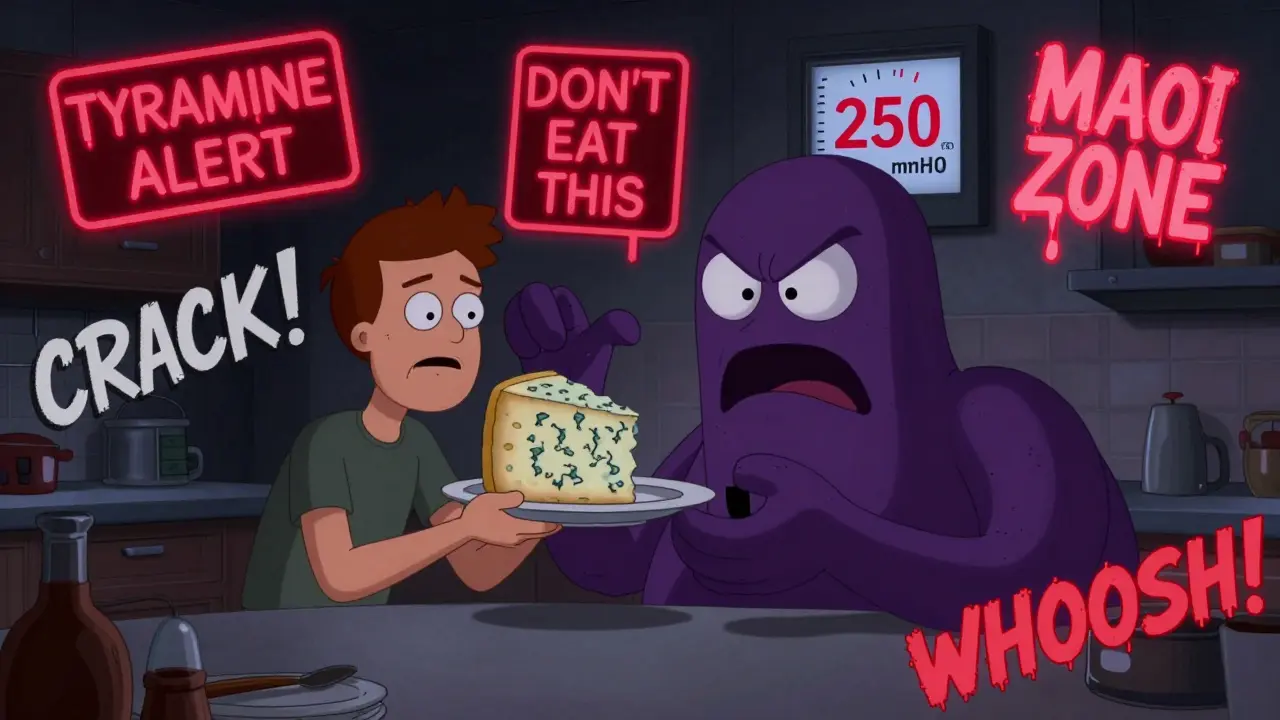
MAO inhibitors, or MAOIs, are one of the oldest classes of antidepressants still in use today. They work by blocking the enzyme monoamine oxidase, which normally breaks down key brain chemicals like serotonin, norepinephrine, and dopamine. This helps lift mood in people with treatment-resistant depression. But here’s the catch: MAO inhibitors don’t just affect your brain-they can turn everyday medications, supplements, and even foods into silent threats. A single wrong pill, cough syrup, or slice of aged cheese can trigger a medical emergency. This isn’t theoretical. People have died from these interactions.
How MAO Inhibitors Work-and Why They’re So Risky
MAOIs were discovered in the 1950s when scientists noticed that a tuberculosis drug, iproniazid, made patients feel unusually happy. That accidental finding led to the first real antidepressants. Today, only a handful are still prescribed: phenelzine (Nardil), tranylcypromine (Parnate), isocarboxazid (Marplan), and the patch form of selegiline (Emsam). They’re not first-line treatments anymore. SSRIs like Prozac and Zoloft took over because they’re safer and easier to use. But for some patients-those who haven’t responded to anything else-MAOIs can be the only option that works.
Here’s where the danger lies: MAOIs don’t just stop the enzyme in your brain. They shut it down everywhere-in your gut, your liver, your blood vessels. That means substances that normally get broken down quickly now build up to dangerous levels. Two major risks emerge: hypertensive crisis and serotonin syndrome.
Hypertensive Crisis: The Silent Blood Pressure Bomb
Hypertensive crisis happens when tyramine-a compound found in certain foods-builds up in your body. Normally, the enzyme monoamine oxidase breaks down tyramine. But when MAOIs block that enzyme, tyramine floods your system. It triggers a massive release of norepinephrine, which slams your blood pressure upward. Systolic pressure can spike from 120 to over 250 mmHg in under two hours. That’s enough to cause a stroke, heart attack, or brain hemorrhage.
Common foods that contain dangerous levels of tyramine include:
- Aged cheeses (Parmesan, blue cheese, cheddar over 6 months old)
- Tap beer and draft beer (fermentation increases tyramine)
- Soy sauce, miso, and fermented soy products
- Cured meats like pepperoni, salami, and pastrami
- Red wine, especially Chianti
Just one ounce of strong aged cheese can contain 15 mg of tyramine-enough to trigger a crisis in someone on an MAOI. A single tablespoon of soy sauce? That’s another 5-10 mg. It adds up fast. The good news? The Emsam patch at the lowest dose (6 mg/24hr) doesn’t require dietary restrictions. That’s why it now makes up nearly 70% of all MAOI prescriptions.
Serotonin Syndrome: When Your Brain Overloads
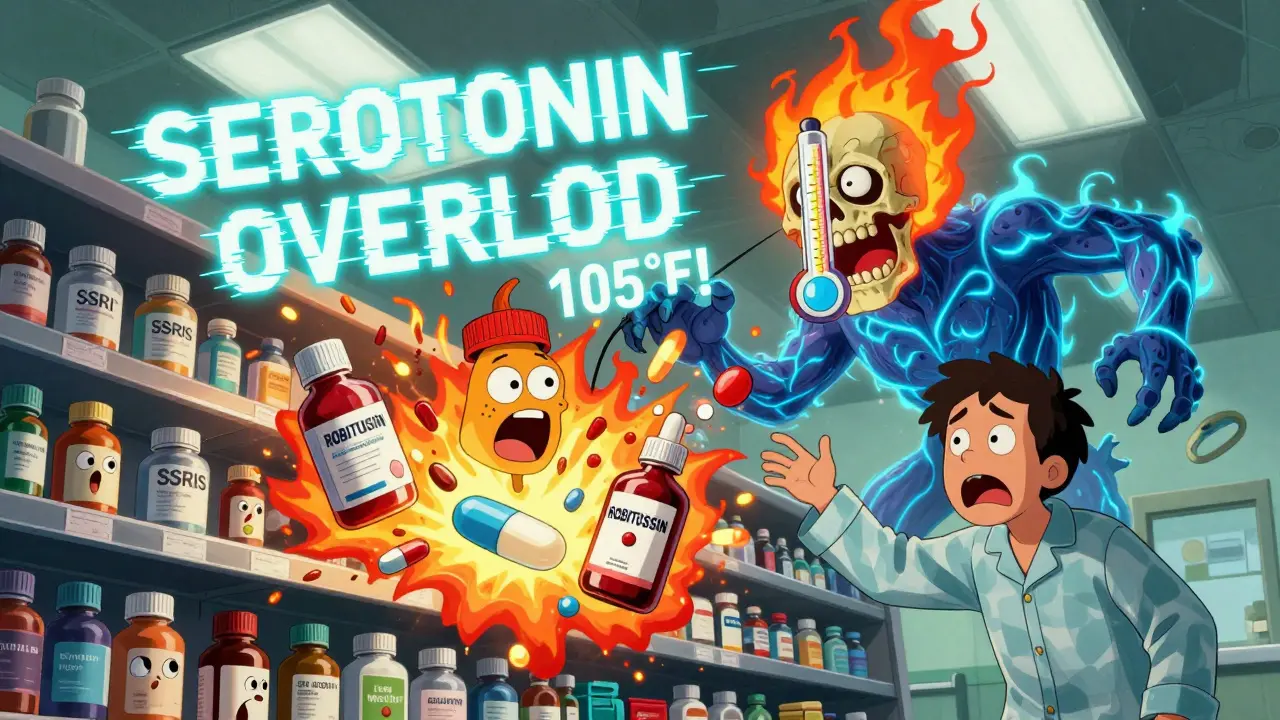
Serotonin syndrome is even more terrifying. It happens when you combine an MAOI with another drug that boosts serotonin. Your brain gets flooded. Symptoms start mild-shivering, diarrhea, restlessness-but can spiral into seizures, high fever (over 106°F), muscle breakdown, and organ failure. Mortality rates for severe cases range from 2% to 12%.
Some of the most dangerous combinations include:
- SSRIs (fluoxetine, sertraline, citalopram)
- SNRIs (venlafaxine, duloxetine)
- Dextromethorphan (in Robitussin, NyQuil, and over 100 other cough medicines)
- Tramadol, meperidine, methadone (painkillers)
- Linezolid (an antibiotic)
- St. John’s Wort, 5-HTP, SAMe (dietary supplements)
Even a single dose of dextromethorphan can be deadly. In one documented case, a 26-year-old woman on phenelzine took one 30mg dose of cough syrup and ended up in intensive care with a temperature of 105°F and uncontrollable shaking. The FDA issued a formal warning in 1992 after multiple similar cases. And yet, many people still don’t know this risk exists.
What About Over-the-Counter Drugs?
You might think cold and flu remedies are harmless. They’re not. Phenylephrine and pseudoephedrine-common ingredients in decongestants-can cause dangerous blood pressure spikes when mixed with MAOIs. Ephedra, banned in 2004 but still found in some herbal weight-loss products, is even worse. There are documented cases of people needing ICU care within 30 minutes of taking it.
Linezolid is another sneaky offender. It’s an antibiotic used for stubborn infections, and it also blocks MAO. When taken with an MAOI, it acts like a double hit. A 2008 case report described a 65-year-old woman who died after taking linezolid while on phenelzine. That’s why doctors now avoid prescribing linezolid to anyone on an MAOI-or vice versa.
Supplements Are Not Safe Either
Many people turn to natural remedies for mood support. But supplements like St. John’s Wort, 5-HTP, and SAMe are just as risky as prescription drugs. In 2018, a patient on phenelzine took 200mg of 5-HTP and developed a temperature of 105°F, blood pressure of 220/110, and required hospitalization. The American Psychiatric Association explicitly warns against these combinations. There’s no such thing as a "natural" safe dose when you’re on an MAOI.
What If You Need to Switch Medications?
If you’re switching from an MAOI to an SSRI-or vice versa-you can’t just stop one and start the other. There’s a mandatory waiting period. For most MAOIs, you must wait 14 days before starting an SSRI. But if the SSRI is fluoxetine (Prozac), you need to wait five weeks. Why? Because fluoxetine and its active metabolite stay in your body for days, even after you stop taking it. That lingering presence can still interact with an MAOI.
Electronic health records now have hard stops built in. If a doctor tries to prescribe an SSRI to someone on an MAOI, the system blocks it. That’s because between 1998 and 2003, 19 people died from these interactions. These rules exist for a reason.
Why Are MAOIs Still Used?
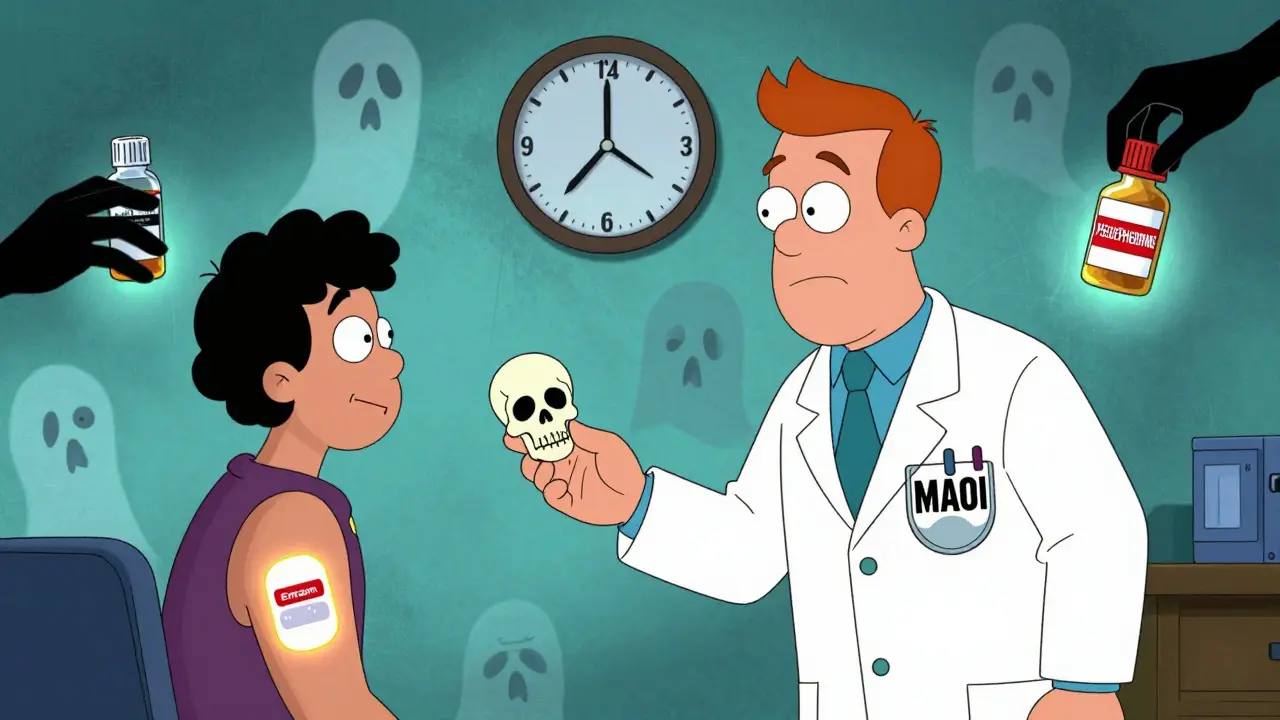
Despite the risks, MAOIs remain a vital tool. About 0.7% of all antidepressant prescriptions in the U.S. are for MAOIs-and nearly all of them come from psychiatrists. Primary care doctors rarely prescribe them. Why? Because managing the risks requires deep knowledge. A 2021 study found that 34% of family doctors didn’t even know dextromethorphan was dangerous with MAOIs. That’s alarming.
The transdermal patch (Emsam) has changed the game. At the lowest dose, it doesn’t require dietary changes. It’s easier to monitor. That’s why it now accounts for two-thirds of all MAOI prescriptions. Still, even the patch carries risks if combined with serotonergic drugs.
What Should You Do?
If you’re taking an MAOI:
- Never start a new medication, supplement, or OTC product without checking with your prescriber.
- Carry a wallet card listing all contraindicated drugs. Many psychiatrists provide these.
- Read labels. Dextromethorphan hides in cough syrups, cold tablets, and even some combination pain relievers.
- When in doubt, assume it’s unsafe. There’s no room for guesswork.
If you’re not on an MAOI but someone you care about is, learn the signs of serotonin syndrome and hypertensive crisis:
- Severe headache
- Blurred vision
- Confusion, agitation, hallucinations
- Rapid heartbeat, high blood pressure
- High fever, sweating, tremors
- Loss of muscle coordination
Call 911 immediately if you see these symptoms. Time matters.
What’s Next?
Researchers are working on newer MAOIs with fewer interactions. Moclobemide, used in Europe, is reversible and much safer-but it was never approved in the U.S. because it wasn’t strong enough in clinical trials. Until a better option arrives, MAOIs remain a high-risk, high-reward tool. Their power is real. But so are their dangers.
There’s no sugarcoating it: MAOIs demand respect. They’re not just another pill. They’re a medical intervention that requires constant vigilance. One mistake can kill. That’s why the warnings exist-and why you must take them seriously.
One mistake kills. No exceptions.
Big Pharma doesn't want you to know MAOIs were banned in the 70s for a reason! 🤫
They brought them back because they make patients dependent on expensive follow-ups 💸
And don't get me started on the Emsam patch... it's a Trojan horse for corporate control! 🧬
Remember: 1992 FDA warning? That was just the tip of the iceberg. 🌊
There are 37 documented cases of people turning purple and screaming before dying... and they're ALL on record... if you know where to look... 🕵️♂️
Yes, I avoid blue cheese and soy sauce. Yes, I check every OTC label.
It's not hard. It's just... necessary.
Respect the drug, don't fear it. It saved me.
MAOIs, as pharmacological artifacts of mid-20th century empiricism, perpetuate a bio-chemical hegemony that pathologizes affective variance.
One must interrogate the ontological status of 'serotonin syndrome'-is it a clinical entity or a construct of regulatory anxiety?
Thanks for this. I showed my psychiatrist and she gave me a printed list.
Now I know to skip the warung's fried tempeh. Small change. Big difference.
Woke up at 3am with a headache that felt like my skull was splitting.
Called my psych, drove to ER. They gave me phenoxybenzamine. I’m alive.
Now I carry a card in my wallet. I tell EVERYONE I meet.
If you’re on an MAOI-you’re not just taking a pill. You’re part of a silent tribe. We look out for each other. ❤️
Why are we still using 1950s tech? Because lazy psychiatrists don't want to try new things.
And now you're scaring people with cheese? Come on. This is fearmongering.