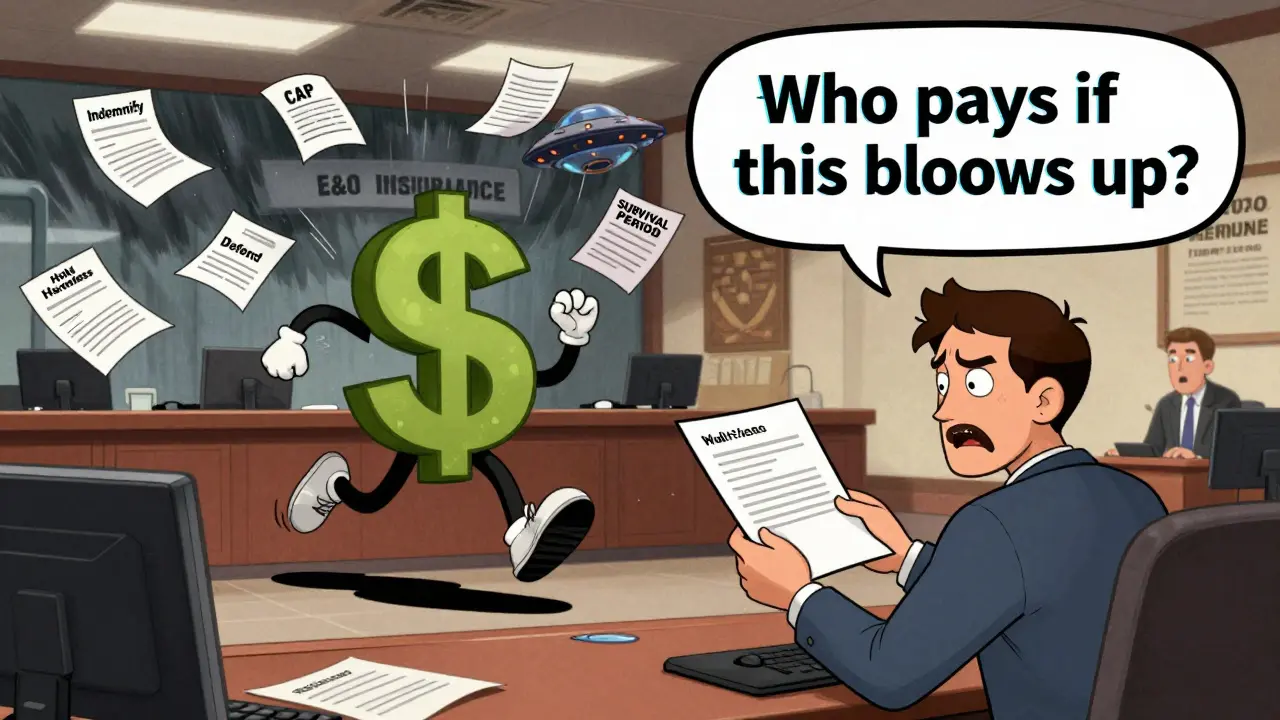
When two parties enter a deal-whether it’s buying a company, licensing software, or signing a service contract-they’re not just exchanging money for goods or services. They’re also swapping risk. And that’s where indemnification comes in. It’s not a fancy legal term meant to confuse you. It’s a simple idea: if something goes wrong because of one side’s mistake, that side pays for it. This isn’t optional. It’s in nearly every contract you’ll ever sign as a business. Skip it, and you’re gambling with your money.
What Indemnification Actually Means
Indemnification means one party agrees to cover the costs if the other party gets hit with a loss. That could be legal fees, a settlement, a fine, or even a customer lawsuit. Think of it like insurance-but instead of paying an insurer, you’re making the other party pay you if they mess up.
For example: You buy a SaaS platform from a vendor. Later, a third party sues you, claiming the software violates their patent. If the contract has an indemnification clause, the vendor has to pay your legal bills and any damages. Without it? You’re on the hook. That’s why smart buyers demand this. Sellers know it’s coming. It’s not a favor-it’s standard.
There are three key phrases you’ll see in these clauses: indemnify, defend, and hold harmless. They’re not the same.
- Indemnify = Pay for losses. If you get sued and lose $500,000, the indemnifying party writes you a check for that amount.
- Defend = Pay for lawyers. Even if you win the case, legal fees add up fast. The indemnifying party covers those.
- Hold harmless = Don’t blame me. If you do something stupid that causes a problem, the other party can’t turn around and sue you for it. It’s a shield against counterclaims.
Some contracts use all three. Others just say "indemnify." But if you’re signing one, make sure you know what each word means. Courts treat them differently.
The Seven Parts of a Solid Indemnification Clause
Not all indemnity clauses are created equal. A weak one leaves you exposed. A strong one protects you. Here’s what every good clause needs:
- Scope of Indemnification - What exactly is covered? Only third-party lawsuits? What about regulatory fines? Tax penalties? Breaches of confidentiality? The clause must list them. Vague wording like "any losses" is a trap.
- Triggering Events - When does the obligation kick in? Common triggers: breach of contract, negligence, IP infringement, failure to comply with laws. If the clause doesn’t name these, it’s useless.
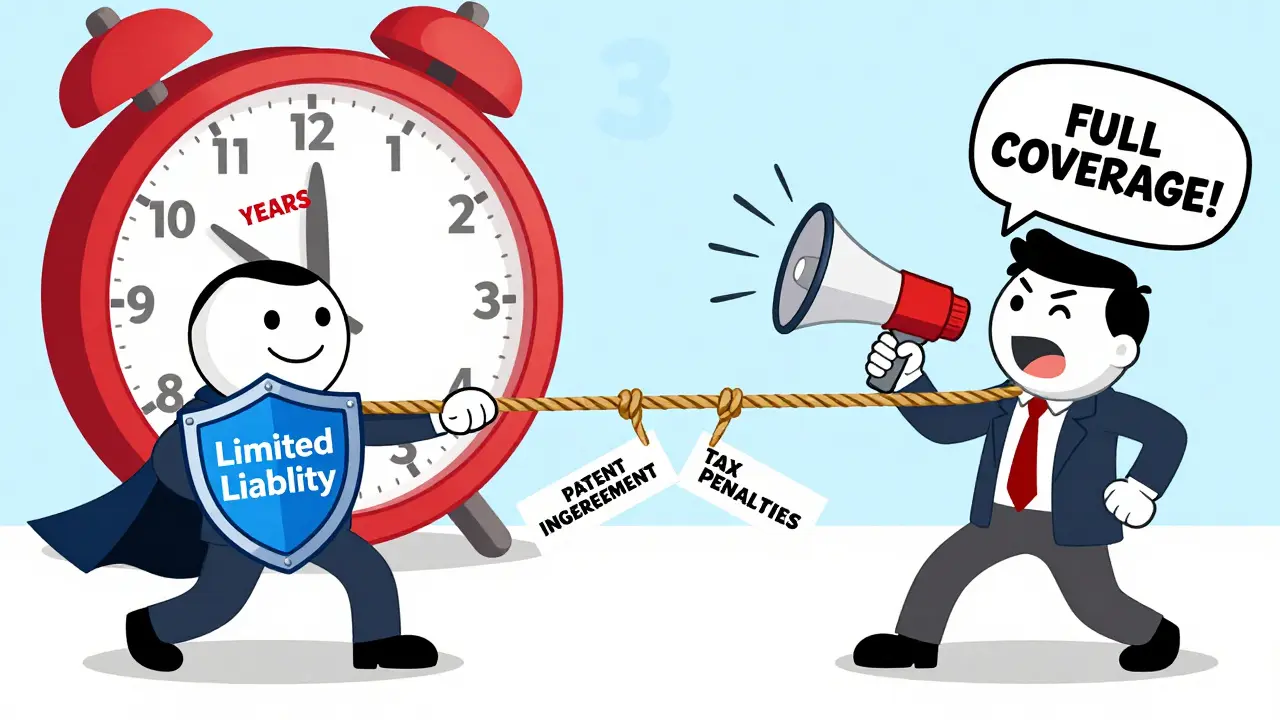
- Duration - How long does the protection last? Some clauses expire when the contract ends. Others last for years. In mergers, fundamental reps (like ownership of assets or tax status) often survive 3-5 years. Non-fundamental ones? Maybe 12-18 months.
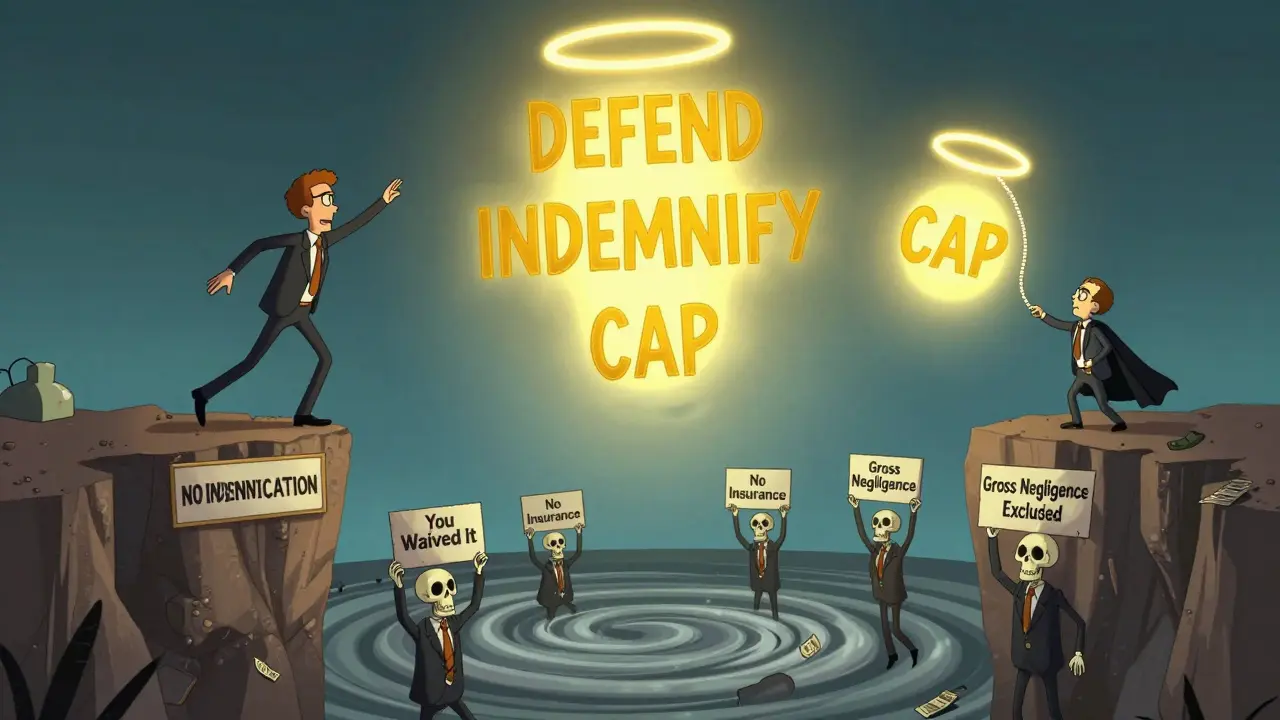
- Limitations and Exclusions - No one pays for everything. Most contracts exclude indirect damages (like lost profits) or punitive damages. There’s also usually a cap-say, the total purchase price. If the deal was $10 million, your max payout is $10 million. That’s fair. Unlimited liability? That’s a dealbreaker.
- Claims Procedure - You can’t just send a bill. You have to notify the other party in writing, usually within 30 days. You might need to share evidence. You might even have to let them control the defense. Skip the steps? You lose your right to be paid.
- Insurance Requirements - Can the other party actually pay? If they’re a startup with no assets, indemnification is just words on paper. Smart contracts require them to carry insurance-like errors and omissions (E&O) or cyber liability-and name you as an additional insured.
- Governing Law and Jurisdiction - Where will disputes be settled? London? New York? Texas? This matters because laws vary. In some states, you can’t indemnify someone for their own gross negligence. In others, you can. Know the rules before you sign.
Mutual vs. Unilateral Indemnification
Not all deals are one-way. In some cases, both sides protect each other. That’s mutual indemnification. In others, only one side pays. That’s unilateral.
Unilateral is more common. For example:
- A software company indemnifies its customer if the software infringes on someone’s patent.
- A contractor indemnifies a property owner if a worker gets hurt on site.
Mutual indemnification shows up in joint ventures, construction projects, or partnerships where both sides have equal risk. Say you and another company build a shared app. If one of your employees sues because of a safety issue, you both cover each other’s costs. It’s balanced. Fair. But rare in standard sales.
Watch out for power imbalances. Big companies often force small vendors into unilateral clauses. If you’re the vendor, push back. Ask for caps. Ask for insurance. Ask for a carve-out for claims caused by the buyer’s misuse.
Fundamental vs. Non-Fundamental Representations
In mergers and acquisitions, indemnification ties directly to what the seller says about the business. These are called "representations and warranties."
- Fundamental reps are the bedrock: Do you own the company? Do you have the legal right to sell it? Are there hidden debts? Tax liens? These are so critical they survive for years-often 3 to 5 years after closing.
- Non-fundamental reps cover things like employee contracts, software licenses, or environmental compliance. These usually last 12 to 24 months.
Why the difference? Because if the seller lied about who owns the IP, the whole deal collapses. If they missed one outdated employee contract? It’s annoying, but fixable. The law treats them differently. So should your contract.
What Practitioners Say
Lawyers who do this daily say one thing: Indemnification is the most negotiated part of a contract after price. Buyers want broad coverage. Sellers want narrow limits. The middle ground is where deals get done.
Buyers: Push for broad triggers, long survival periods, no caps. But be realistic. If you’re buying a small business, demanding unlimited liability is a non-starter.
Sellers: Accept that some indemnification is normal. But fight hard on exclusions. Demand that "defend" only applies if you’re given control of the defense. Push for insurance proof. Limit caps to the deal value. Exclude consequential damages. Every word matters.
One common mistake? Signing a boilerplate clause without reading it. I’ve seen deals where the buyer assumed they were protected against data breaches-only to find the clause only covered patent suits. That’s not a glitch. That’s negligence.
Real-World Example
Imagine you’re a UK retailer buying a customer data system from a US vendor. Six months later, hackers steal 10,000 customer records. You’re fined £200,000 by the ICO. You sue the vendor.
If the contract says: "Vendor shall indemnify Buyer for losses arising from breaches of data security caused by Vendor’s negligence," you’re covered.
If it says: "Vendor shall indemnify Buyer for third-party IP claims," you’re out of luck.
The difference? One sentence. One word. That’s why you read every line.
What You Should Do
Here’s how to protect yourself:
- Always demand indemnification in any commercial contract-not just big deals.
- Define everything. No vague terms. No "any loss" or "related to." Name the exact risks.
- Cap the liability. Never agree to unlimited exposure.
- Require proof of insurance. If they can’t pay, the clause is worthless.
- Control the defense. If you’re the indemnified party, insist on approving lawyers. If you’re the indemnifier, demand control to avoid runaway legal bills.
- Know the survival period. For fundamental reps, 3 years is standard. For everything else, 12-18 months.
- Check governing law. UK law differs from US law. If you’re dealing across borders, pick a neutral jurisdiction-or get local legal advice.
Indemnification isn’t about trust. It’s about planning for failure. The best contracts aren’t the ones that assume everything will go right. They’re the ones that prepare for when it goes wrong.
Is indemnification the same as insurance?
No. Insurance is a third-party policy where you pay premiums and get coverage from an insurer. Indemnification is a contract between two parties where one agrees to pay the other if something goes wrong. Insurance can back up indemnification, but it doesn’t replace it.
Can I waive indemnification in a contract?
Yes, but it’s risky. Most businesses won’t sign without it. If you’re the buyer and you waive indemnification, you’re accepting full responsibility for any mistakes the seller made before or during the deal. Only do this if you’ve done deep due diligence and the risk is negligible.
What if the indemnifying party goes bankrupt?
Then you’re out of luck unless they had insurance. That’s why requiring insurance isn’t optional-it’s critical. If the other party is undercapitalized, negotiate a letter of credit or escrow account to cover potential claims.
Are indemnification clauses enforceable in the UK?
Yes, as long as they’re clear, reasonable, and don’t violate public policy. UK courts will not enforce clauses that indemnify someone for their own fraud or gross negligence. Always draft with precision and get legal review.
Can I limit indemnification to direct damages only?
Absolutely-and you should. Most contracts exclude indirect, consequential, or lost profit damages. These are hard to predict and can balloon quickly. Sticking to direct damages (like legal fees, fines, or repair costs) keeps the risk manageable.
Final Thought
You don’t need a law degree to understand indemnification. You just need to ask: "Who pays if this blows up?" If the answer isn’t clear, the clause is broken. Fix it before you sign. Because when things go wrong, you won’t care about legal jargon-you’ll care about your bank account.
Indemnification is one of those things that seems like legal jargon until you’re the one getting sued for $200k because a vendor’s API had a漏洞.
Then you realize: yeah, this clause isn’t optional. It’s armor.
You know, I’ve read this piece three times now, and I still feel like I’m being handed a legal grenade with the pin pulled - and someone’s saying, ‘Just read the fine print, it’s fine!’
But what if the fine print is written in Comic Sans? Or worse - in a jurisdiction where ‘indemnify’ is interpreted as ‘maybe, if you ask nicely’?
And don’t get me started on ‘hold harmless’ - sounds like a child’s game of tag where the tagger gets to say, ‘I didn’t mean to!’ while you’re bleeding out on the sidewalk.
I’m not even mad. I’m just… tired.
Wait - so if I’m the vendor, and I indemnify the buyer… but I’m a two-person startup with $5k in the bank and no insurance?
That’s not a clause. That’s a suicide note with a fancy header.
And yet - I’ve seen 87 contracts signed this way. People just nod and say, ‘Oh yeah, indemnification - of course!’
Meanwhile, the buyer’s lawyer is already drafting the lawsuit.
Y’all are playing business poker with a deck full of jokers.
Let me get this straight - you’re telling me that in a world where AI can write a contract in 3 seconds, we’re still stuck arguing over whether ‘indemnify’ includes ‘emotional distress from having to read legalese’?
Also, ‘governing law’? Like, if I’m in Texas and the vendor’s in Berlin, and the server’s in Singapore… who’s the judge? A confused robot? A sentient IKEA manual?
And don’t even get me started on ‘consequential damages.’ That’s just corporate speak for ‘we’ll pay for your hospital bill, but not for the therapy you need after realizing your life’s savings went to a vendor who used a free WordPress plugin to build your CRM.’
I love contracts. They’re like relationship agreements - except instead of ‘I’ll do the dishes,’ it’s ‘I’ll pay for your lawsuit if your customer sues you because we forgot to patch a SQL injection from 2014.’
This is exactly why I refuse to sign any contract without a lawyer reviewing it - even if it’s for a $50/month SaaS tool.
I once signed a ‘simple’ agreement because ‘it was standard.’ Six months later, I got hit with a $120k penalty because the vendor’s software violated a patent I didn’t even know existed.
They said, ‘We indemnify you.’ But they had no insurance. No assets. Just a website built in Wix.
Now I demand proof of E&O insurance. Before I even see the pricing page.
It’s not paranoia. It’s survival.
What if this whole indemnification thing is a trap?
What if the ‘standard clause’ is designed to make you feel safe… so you don’t do due diligence?
What if the real goal is to get you to sign quickly, then later claim your ‘misuse’ voided the clause - even if you didn’t touch the software?
And who writes these clauses? Lawyers? Or corporations with a team of psychologists trained to exploit human optimism?
I’ve seen contracts where ‘indemnify’ is buried under 14 subclauses, 3 footnotes, and a mandatory arbitration clause that forces you to fly to Nebraska for a hearing.
This isn’t protection. It’s a legal honeypot.
As someone from India who has negotiated dozens of cross-border SaaS deals, I can confirm: indemnification is the make-or-break clause - not price.
Western companies often assume ‘indemnify’ means ‘pay everything.’ But in many jurisdictions, including India, courts strictly interpret indemnity clauses - and if it’s not explicitly worded, it’s void.
One client signed a contract saying ‘vendor shall indemnify for any loss’ - and when a data breach occurred, the vendor argued ‘loss’ didn’t include regulatory fines.
So now, I always insist on: (1) explicit enumeration of covered events, (2) insurance proof with named beneficiary, (3) governing law clause that’s neutral (Singapore or London), and (4) a cap tied to 150% of the contract value.
And yes - I use emojis. 🛡️💰📜
Thank you for this. I’ve been in tech long enough to know that ‘standard clause’ = ‘I hope you don’t read this.’
But honestly? The real problem isn’t the clause. It’s the culture of ‘just hit agree.’
I’ve had clients sign contracts without even knowing what ‘hold harmless’ meant - and then blame me when they got sued.
So now I make them read the clause out loud. In front of their team. And I record it.
It’s not cruel. It’s preventative.
Also - yes, I’m the one who added the ‘defend’ part to our template. And yes, I cried when it got approved. 😭
Indemnification is the legal version of ‘I’ll cover the tab if we crash the car.’
But here’s the twist - you’re not just signing a promise. You’re signing a gamble on someone else’s competence.
And let’s be real: most vendors are one buggy update away from becoming a liability.
That’s why I treat indemnification like a seatbelt - you don’t wear it because you think you’ll crash. You wear it because you know you might.
Also - ‘cap at deal value’? Genius. If you’re paying $2M for a company, your max exposure should be $2M. Not $200M because someone’s lawyer had a creative afternoon.
And yes, I’ve seen contracts where the cap was ‘$0’ because ‘we’re a startup.’
That’s not a business. That’s a time capsule of regret.
Westerners always overcomplicate this. In India, we don’t need 7-part clauses. We say: ‘You break it, you pay for it.’ Done.
Why do you need ‘governing law’? Why do you need insurance? Why do you need ‘hold harmless’?
Just sign. Trust. Pay when it happens.
Our system works. Your system? It’s a lawyer’s goldmine.
Also - if you’re scared of a $200k fine, maybe don’t buy software from a US vendor who doesn’t know what GDPR is.
What if indemnification clauses are just a distraction?
What if the real danger isn’t the contract - but the fact that we’ve outsourced trust to legal documents?
What if the vendor who refuses to cap liability… is the one who actually cares about their customers?
And what if the vendor who demands insurance, jurisdiction, and 14 subclauses… is the one who’s already planning to disappear after the deal closes?
I’ve seen companies with perfect indemnity clauses go bankrupt - and companies with no clause survive because they had integrity.
Maybe we’re not protecting ourselves from risk.
Maybe we’re protecting ourselves from each other.