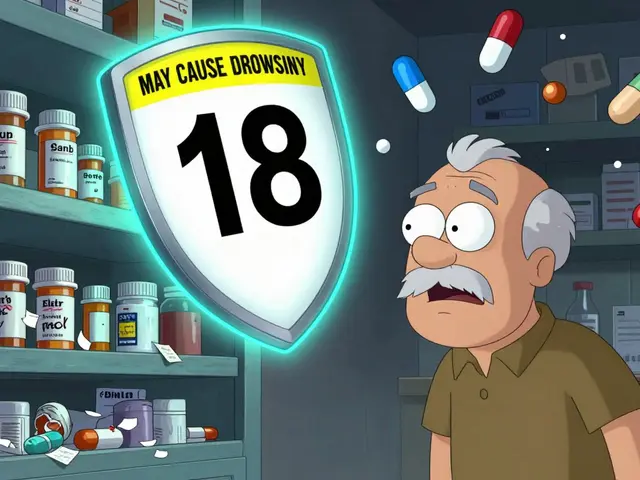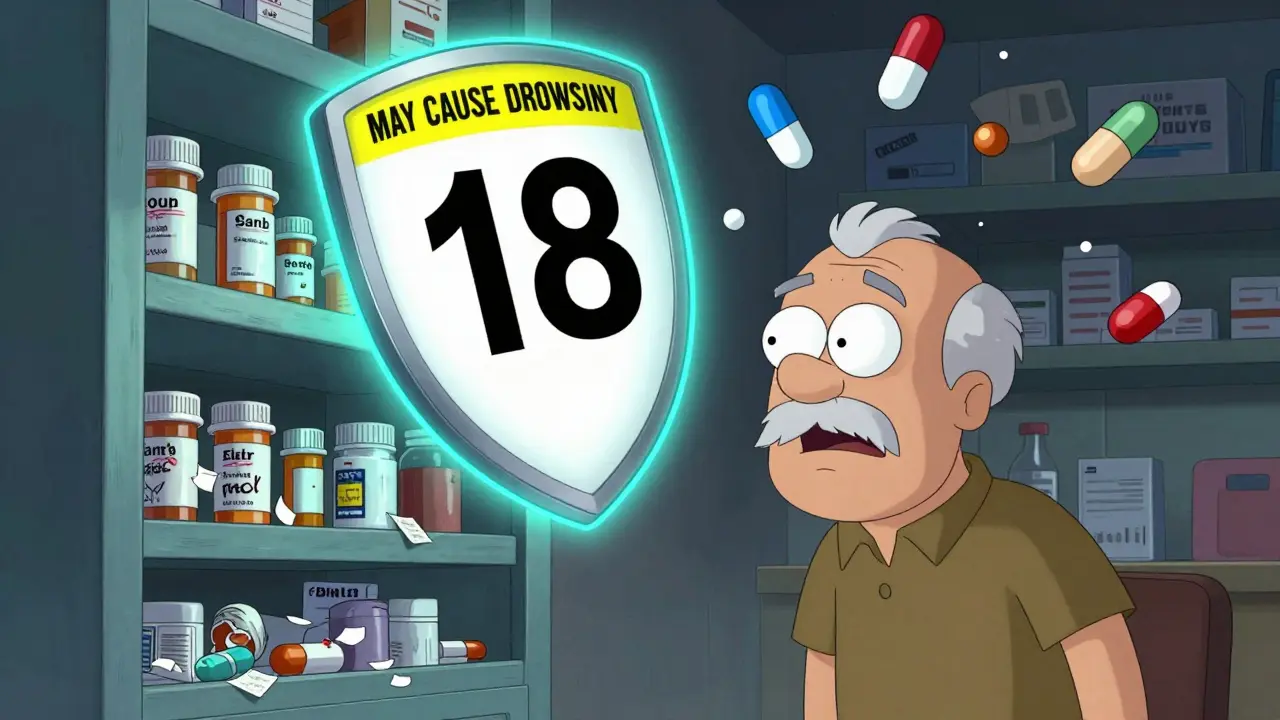
Imagine opening your medicine cabinet and not being able to read what’s inside. Not just blurry text - but completely unreadable. For millions of people with low vision, this isn’t a hypothetical. It’s daily reality. And the consequences? Taking the wrong pill, missing a dose, or even overdosing because the label was too small. It’s not just inconvenient - it’s dangerous.
Why Standard Prescription Labels Fail People with Low Vision
Most pharmacy labels are printed in 8- to 10-point font. That’s tiny. For someone with age-related macular degeneration, glaucoma, or diabetic retinopathy, even 12-point text can be impossible to read. The American Foundation for the Blind found that most people with moderate vision loss can’t read anything smaller than 14-point. Standard labels don’t just strain the eyes - they force people to guess. And guessing with medication? That’s how emergencies happen.It’s not just about font size. The layout matters too. Labels often cram in drug name, dosage, frequency, refill info, and warnings in a messy, cluttered way. Some use all caps. Others use light gray text on white. Glare from the label surface makes it worse. One study showed that older adults with low vision took up to 8 seconds longer to read a standard label - and those extra seconds can mean a life-altering mistake.
What Makes a Prescription Label Actually Accessible?
Accessible doesn’t mean “bigger text.” It means designed for real use. The gold standard, backed by the FDA and the Access Board, includes these key features:- Font size: 18-point minimum - 24-point is even better. Anything smaller defeats the purpose.
- Sans-serif fonts only - Arial, Verdana, or APHont™ (a free font designed specifically for low vision users).
- High contrast - Pure black text on pure white background. No grays, no beige, no off-whites.
- No glare - Matte finish, not glossy. Glare turns readable text into a blur.
- Left-aligned, simple layout - One piece of info per line. Instructions in lowercase letters, numbers in uppercase (e.g., “take 2 tablets once daily”).
- Yellow highlighting - Used sparingly to draw attention to critical warnings like “May cause drowsiness” or “Take with food.”
These aren’t suggestions. They’re based on research from the National Center for Biotechnology Information (PMC4860753) and endorsed by the American Printing House for the Blind. And yes - most standard prescription bottles can’t fit all this in one label. That’s why many pharmacies now use duplicate labels: a small, clear sticker with the large print info that goes right over the original.
More Than Just Big Text: Audible and Digital Options
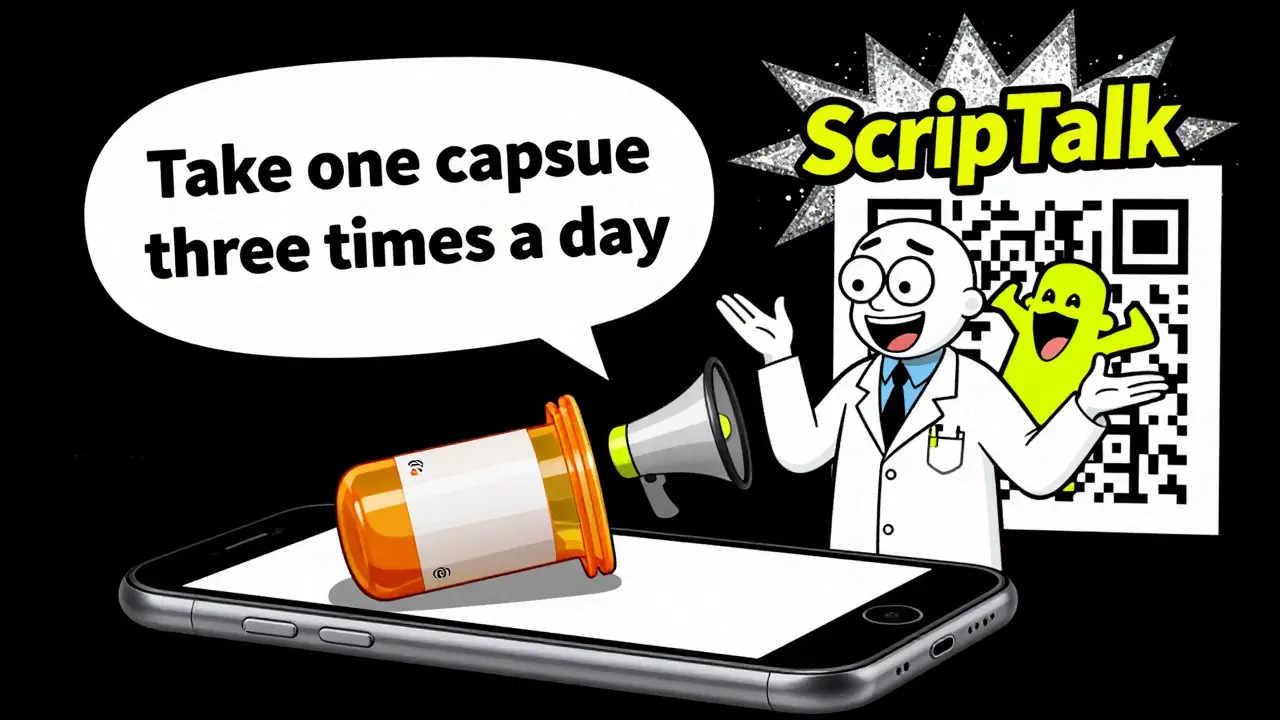
Not everyone can read even 18-point text. Some people are completely blind. Others have trouble focusing on static text. That’s where technology steps in.ScripTalk is one of the most widely adopted systems. It uses a small RFID chip embedded in the label. When you tap your smartphone or a dedicated reader (like the one at CVS or Walgreens) against the bottle, it plays a clear, recorded message: “This is Amoxicillin 500mg. Take one capsule three times a day for 10 days. Do not take if allergic to penicillin.” No app needed - just a tap. It’s available in over 9,000 U.S. pharmacies.
QR code labels are another option. UK HealthCare’s ScriptView system lets you scan a code with your phone and get an audio version of your label. Some even let you choose the voice speed or language. It’s great if you’re tech-savvy. But if you don’t own a smartphone or aren’t comfortable using one, it’s useless.
Braille labels exist too - but only about 10% of people with vision loss read Braille. So while they’re important for some, they’re not a universal solution.
Who Offers These Labels - And How to Get Them
You don’t have to beg for help. Accessible labels are your legal right under the FDA Safety and Innovation Act of 2012. Major chains have been required to offer them since 2014. Here’s what’s available:- CVS: Offers ScripTalk, large print labels, and translated labels. Free.
- Walgreens: Provides large print and ScripTalk. Ask at the counter.
- Walmart: Large print labels available at most locations.
- UK HealthCare: ScriptAbility - includes large print, audio, and translated labels. Free for all patients.
- Independent pharmacies: Some do. Many don’t. If your local pharmacy doesn’t offer it, ask for the manager. Most don’t know about the law - but they’ll comply if you cite it.
You don’t need a doctor’s note. You don’t need to prove your vision loss. Just say: “I need a large print or audible prescription label. It’s required by federal law.” If they hesitate, ask to speak to the pharmacist on duty. Most pharmacists are happy to help once they understand the request.
What to Do If Your Pharmacy Refuses
It happens. A 2023 survey found that 37% of users had to ask multiple times before getting an accessible label. Some pharmacists just don’t know the policy. Others think it’s too much work.If you’re turned away:
- Ask for the pharmacy’s compliance officer or manager.
- Explain you’re requesting a label under the FDA Safety and Innovation Act (Public Law 112-144).
- Ask them to check the American Pharmacists Association’s guidelines - they’ve published clear instructions for staff.
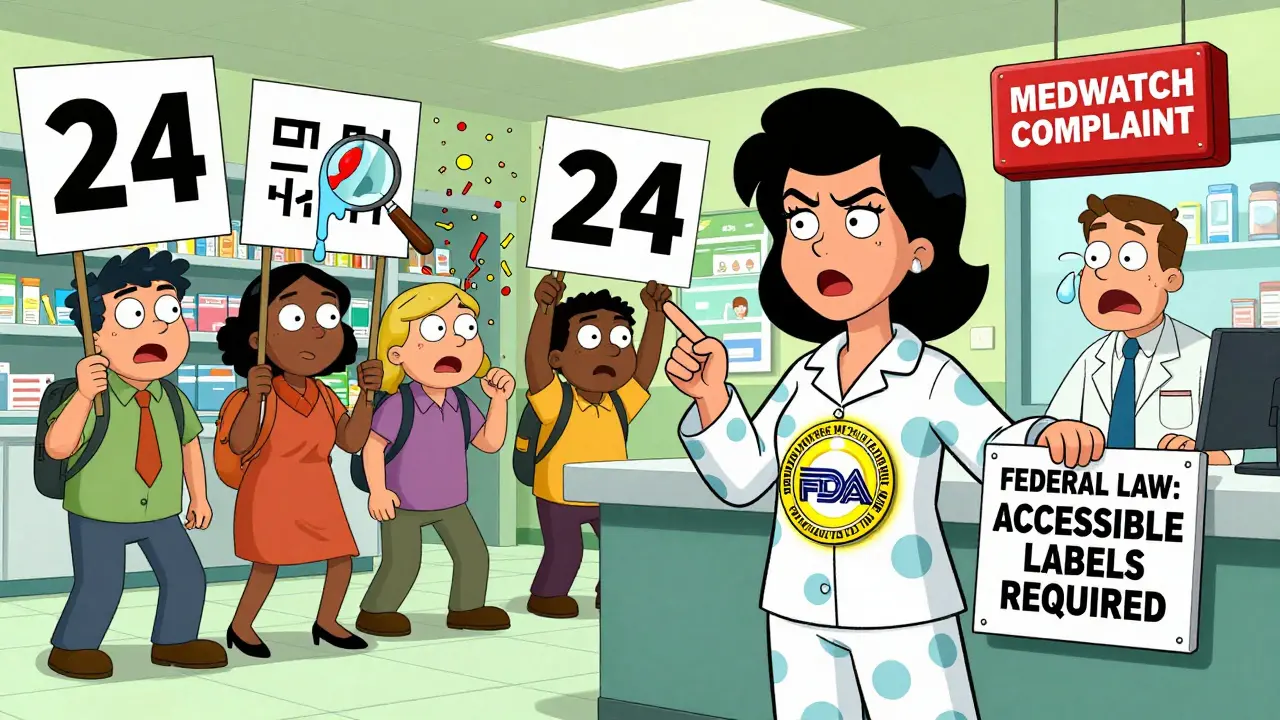
- If they still refuse, file a complaint with the FDA’s MedWatch program. You can do it online in under 5 minutes.
Since 2022, the Department of Justice has settled three cases against pharmacies for failing to provide accessible labels - totaling $450,000 in fines. That’s not a threat. It’s a warning.
Real Impact: Stories from People Who Use Them
One user on Reddit, who goes by “VisionLiberation,” said: “Since my pharmacy started offering 18-point Arial labels, I stopped taking the wrong pills twice a week. It’s literally life-changing.”A 78-year-old diabetic in Manchester reduced her hypoglycemic episodes by 75% after switching to a QR-code audio label system. She used to miss her insulin doses because she couldn’t read the tiny print. Now, she hears the instructions clearly - every time.
Across 1,247 verified reviews on Healthgrades, accessible label services average 4.7 out of 5 stars. The top two reasons people praise them? “I can finally read my meds on my own” and “I don’t panic anymore when I open the bottle.”
What’s Next? The Future of Prescription Labels
The FDA is pushing for more. By 2026, electronic prescriptions and patient portals must also be accessible. That means apps and websites need to support screen readers and text-to-speech.AI tools like Be My Eyes are now integrating with pharmacies. You point your phone at a label, and a volunteer on the other end reads it aloud in real time. It’s free. It’s fast. And it’s growing - over 1.2 million labels have been read through the system since June 2023.
By 2026, the American Pharmacists Association predicts 100% of U.S. pharmacies will offer large print labels. That’s not a guess. It’s based on demographic trends: over 8 million Americans over 65 have vision loss - and that number is rising fast.
Bottom Line: You Have the Right - and the Power
Accessible prescription labels aren’t a luxury. They’re a necessity. And you don’t have to wait for your pharmacy to catch up. You can ask for them today. You can insist on them. You can even help educate your pharmacist.Take a moment to check your own labels. Can you read them clearly? If not, call your pharmacy. Ask for large print. Ask for audio. Ask for a sticker. Don’t wait for a mistake to happen. Millions have already made the switch - and they’re safer, calmer, and more in control because of it.
Your health shouldn’t depend on how well you can squint.
Are large print prescription labels free?
Yes. All major pharmacy chains in the U.S. and U.K. offer large print, audible, and other accessible labels at no extra cost. This is required by federal law under the FDA Safety and Innovation Act. Independent pharmacies may charge in rare cases, but they’re still legally required to provide accessible labels - even if they need to order them.
What if my pharmacy doesn’t know about accessible labels?
It’s common. Many staff haven’t been trained. Politely ask to speak to the pharmacist on duty. Say: “I need an accessible label under the FDA’s 2012 mandate.” You can also mention the American Foundation for the Blind’s guidelines. Most pharmacists will comply once they understand the legal requirement. If they still refuse, file a complaint with the FDA’s MedWatch system - it takes less than five minutes.
Can I get accessible labels for my elderly parent?
Absolutely. You can request accessible labels on behalf of someone else. Just bring their prescription and let the pharmacy know you’re helping them manage their medications. Many families make this request for aging parents, especially those with dementia or macular degeneration. Pharmacies are used to this and will help without hesitation.
Do I need to be legally blind to qualify?
No. You don’t need any diagnosis or documentation. If you have trouble reading standard prescription labels - whether due to aging, diabetes, glaucoma, or any other condition - you’re eligible. The law protects anyone with low vision, not just those who are legally blind.
What’s the difference between ScripTalk and large print labels?
Large print labels are physical - they’re just bigger text on a sticker. ScripTalk is digital. It uses a hidden chip in the label that plays an audio recording when tapped with a reader or smartphone. ScripTalk gives full details, including warnings and refill info, while large print is limited by space. Many people use both: large print for quick checks and ScripTalk for full details.
Can I use a magnifier or phone app instead?
You can - but it’s not the same. Magnifiers and phone cameras help, but they don’t solve the core problem: poor design. Standard labels are cluttered, low-contrast, and hard to focus on even with magnification. Accessible labels are designed from the start to be readable. They’re faster, more accurate, and reduce stress. Think of it like this: you can read a tiny book with a magnifier - but wouldn’t you rather have a book printed in clear, large type?
Are these labels available outside the U.S.?
Yes. The UK’s NHS and health providers like UK HealthCare offer free large print and audio labels through their ScriptAbility service. Canada, Australia, and parts of Europe also have similar programs, though availability varies. Always ask your local pharmacy - many are adopting these standards even without formal mandates.