
When a patient needs an IV antibiotic, a life-saving chemotherapy drug, or even just normal saline to stay hydrated, they expect it to be there. But in hospitals across the U.S., that’s no longer a guarantee. As of July 2025, there were still 226 active drug shortages - and nearly two-thirds of them involve sterile injectables. These aren’t minor inconveniences. They’re life-or-death gaps in care that hit hospital pharmacies harder than any other part of the healthcare system.
Why Injectables Are the First to Go Missing
Not all drugs are created equal when it comes to supply chain fragility. Injectable medications - especially sterile ones - are uniquely vulnerable. They require clean-room manufacturing, aseptic filling, and rigorous testing. One tiny contamination can wipe out an entire batch. And unlike pills or creams, you can’t just swap them out for a similar-looking alternative. Bioavailability, dosing, and route of administration matter. A misstep can kill. About 80% of the active pharmaceutical ingredients (APIs) used in these injectables come from just two countries: China and India. A single tornado, like the one that hit a Pfizer plant in North Carolina in 2023, can knock out 15 critical drugs. A quality violation at a factory in India shut down cisplatin production - a cornerstone of cancer treatment - for months. These aren’t rare events. They’re predictable. Manufacturers also have little incentive to invest in these drugs. Most sterile injectables are generics. Profit margins hover between 3% and 5%. When a factory has to choose between upgrading equipment for a low-margin product or focusing on something more profitable, the injectables lose. The result? Aging equipment, understaffed labs, and supply chains that snap under pressure.Hospital Pharmacies Are Carrying the Weight
Retail pharmacies might run out of a popular antibiotic now and then. But hospital pharmacies? They’re dealing with 35-40% of their essential inventory in shortage - and 60-65% of those are sterile injectables. That’s not a spike. That’s a structural collapse. Anesthetics? 87% in shortage. Chemotherapeutics? 76%. Cardiovascular drugs? 68%. These aren’t niche medications. They’re the backbone of emergency rooms, ICUs, and operating theaters. When normal saline runs out, nurses have to switch patients to oral hydration - even if it’s less effective. When propofol is unavailable, surgeries get delayed. One hospital in Massachusetts postponed 37 procedures in just three months because they couldn’t get enough anesthetics. The impact isn’t just logistical - it’s ethical. Sixty-eight percent of hospital pharmacists say they’ve faced impossible choices: Do you give the last vial of epinephrine to the cardiac arrest patient or the one in septic shock? Forty-two percent admit they’ve had to use less effective alternatives, knowing it could harm outcomes. These aren’t hypotheticals. They’re daily realities.
Why the System Isn’t Fixing Itself
You’d think the FDA would step in. After all, they regulate drug safety. But here’s the truth: the FDA has limited power to prevent shortages. Only 14% of shortage notifications lead to timely fixes. The Drug Supply Chain Security Act requires tracking - but doesn’t force manufacturers to stockpile. The Consolidated Appropriations Act of 2023 demanded earlier warnings - but it cut shortage duration by just 7%. The Biden administration pledged $1.2 billion to boost domestic manufacturing in 2024. That sounds promising - until you realize it’ll take 3 to 5 years to see results. Meanwhile, only 12% of sterile injectable producers use modern continuous manufacturing, which could make production faster and more reliable. The rest are still using 1980s-era equipment, running on thin margins, and hoping nothing breaks. Even when hospitals try to adapt, they’re under-resourced. Seventy-six percent have set up shortage management committees - but only 32% feel those teams have enough staff, time, or authority to make a real difference. Pharmacists are spending nearly 12 hours a week just tracking down alternatives, calling distributors, and rewriting protocols. That’s 12 hours they’re not spending counseling patients or checking for dangerous interactions.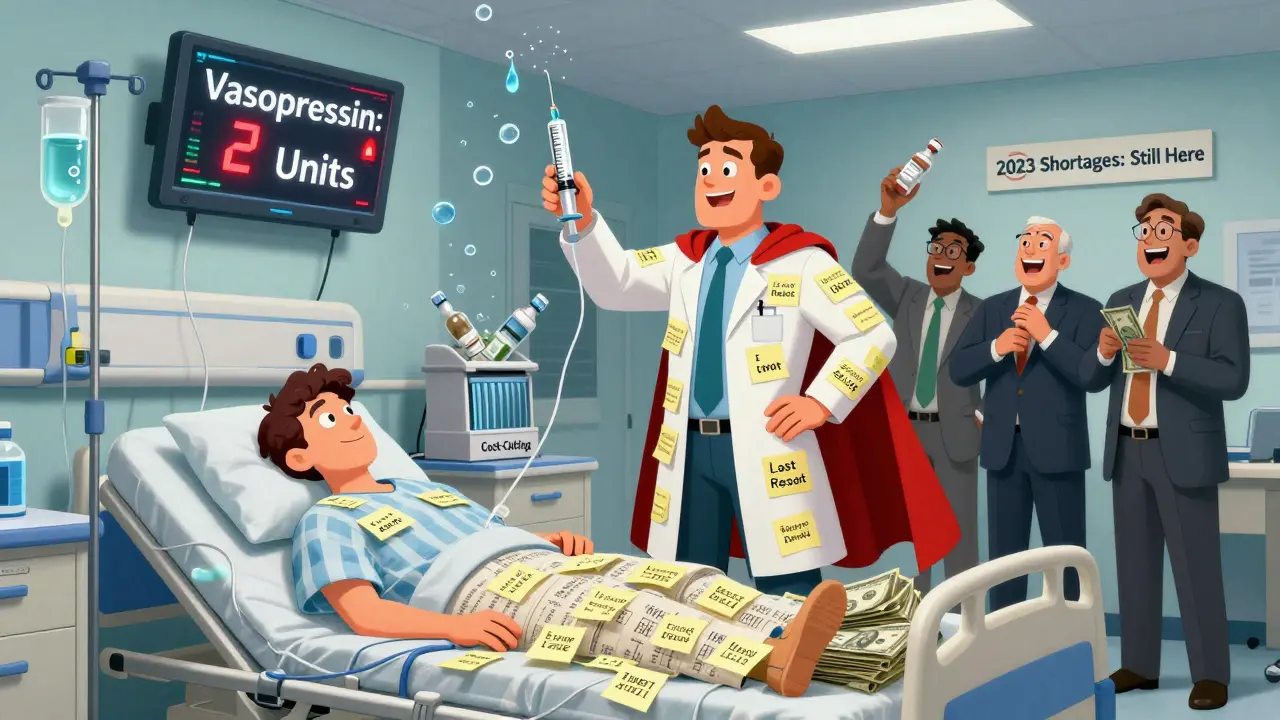
It’s wild how we treat medicine like it’s just another commodity. We don’t run out of toilet paper in a pandemic, but we can’t get saline? Something’s broken when profit decides who lives and who doesn’t.
And yet nobody talks about this at dinner parties. We’d rather scroll memes than face the fact that someone’s kid might not get their chemo because a factory in India had a power outage.
Oh please. This is what happens when you outsource everything and then act shocked when the system collapses. China and India don’t care about your ICU. They care about their GDP. If you want reliable meds, start paying manufacturers enough to build proper infrastructure - not just slap a ‘Made in USA’ sticker on a label.
Let me tell you something - I’ve seen it firsthand. Last winter, we ran out of norepinephrine for three days. Three days. I watched a 68-year-old man go into cardiac arrest while the pharmacy team scrambled to find a vial from a hospital 90 miles away. We used dopamine instead. It worked - barely. But the patient’s kidneys never recovered.
And this? This isn’t an anomaly. It’s the new normal. The FDA has a checklist. The manufacturers have a spreadsheet. And patients? We’ve turned them into variables in a cost-benefit equation. That’s not healthcare. That’s a horror show with a white coat.
Y’all aren’t hearing me - we’re not powerless. I work in a small hospital in Nebraska. We started pooling our inventory with three other regional hospitals. Now we have a shared dashboard. When one runs low, the others shift. It’s not perfect, but we’ve cut our emergency swaps by 60%.
It takes work. It takes trust. But we’re doing it. We don’t need a billion-dollar federal plan - we need more hospitals willing to collaborate instead of hoard.
It’s not merely a ‘shortage’ - it’s a systemic collapse of moral hazard, enabled by regulatory capture and the grotesque commodification of human biology. The FDA’s ‘guidance’ is a paper-thin veil over a cartelized oligopoly. Three firms control 65% of the market - and they’re not ‘manufacturing’ - they’re *extracting* value from the suffering of the vulnerable. The term ‘generic’ is a lie. These are life-or-death commodities - and they’re priced like toilet paper.
my coworker just told me they had to use tap water to dilute a med last week bc they were out of sterile water. like… what??
im not even mad, im just… tired. we’re all so tired.
While the systemic issues are undeniable, it’s worth noting that some hospitals are making incremental progress through inter-facility collaboration and inventory optimization. These solutions, though modest, demonstrate that localized action can mitigate broader failures. Sustainability in pharmaceutical supply chains requires both policy reform and institutional adaptability.
Hey - I know it’s easy to feel helpless, but here’s the thing: you don’t have to fix everything to make a difference. If you’re a nurse, pharmacist, or even just someone who cares - start talking. Talk to your reps. Talk to your hospital admin. Ask: ‘What’s our backup plan for epinephrine?’
Small actions add up. We’ve got people in the trenches doing the right thing every day. We just need to make sure they’re not doing it alone.
in india we make these drugs but we dont get paid enough to fix the machines
my cousin works in a plant that makes ceftriaxone - they still use 1990s machines. no one cares until someone dies in usa