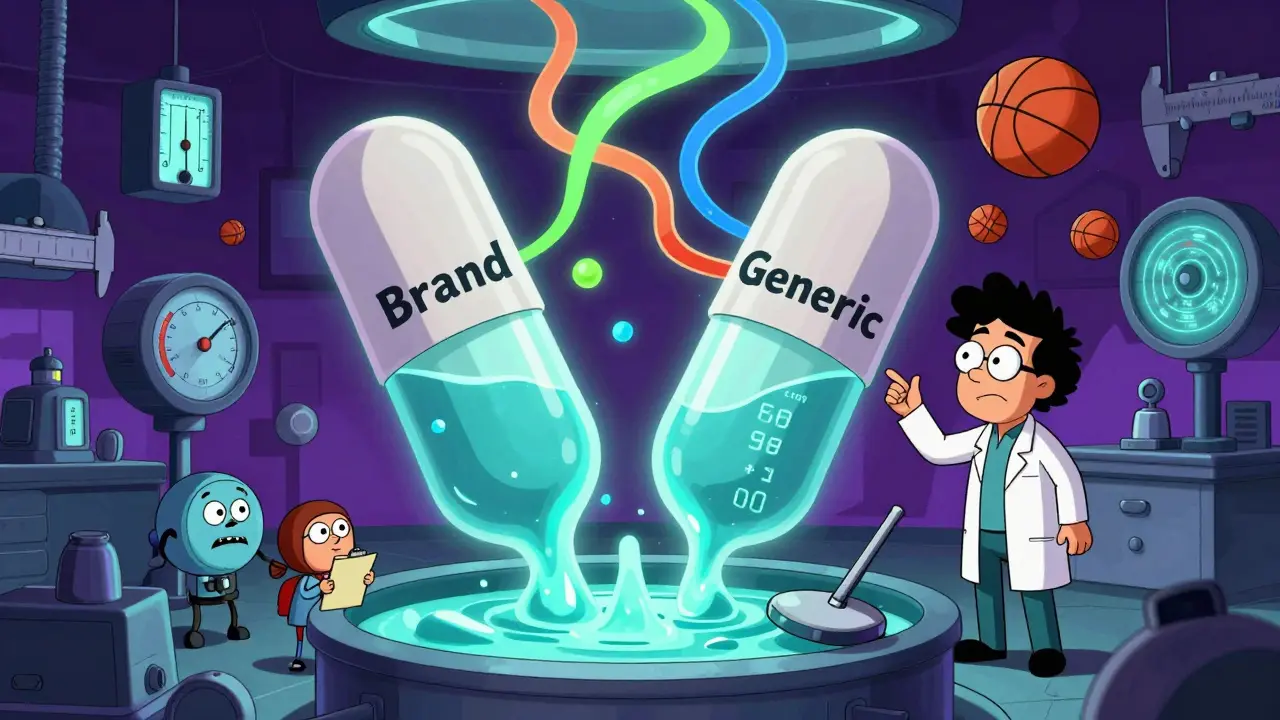
When you pick up a generic pill, you expect it to work just like the brand-name version. But how do regulators know it really does? The answer lies in something called dissolution profiles. This isn’t just lab jargon-it’s the key to proving that a generic drug releases its active ingredient the same way as the original, in the same amount, at the same pace. Without this test, there’s no way to guarantee safety or effectiveness without testing on real people every single time.
What Dissolution Profiles Actually Measure
Dissolution testing simulates how a pill breaks down in your body. Imagine putting a tablet in a warm, acidic liquid that mimics stomach fluid. Over time, you measure how much of the drug dissolves into that liquid-every 5, 10, 15, 30, 45, and 60 minutes. You do this for both the brand-name drug and the generic version, side by side, under identical conditions.
The result? A curve showing how much drug is released over time. If both curves match closely, regulators say the two products are likely to behave the same way in your body. This is especially important for drugs where even small differences in absorption can cause big problems-like blood thinners, seizure meds, or thyroid pills.
The f2 Factor: The Industry Standard
The most common way to compare these curves is using the f2 similarity factor. It’s a mathematical formula that calculates how close the two dissolution profiles are. The goal? An f2 score between 50 and 100. A score of 100 means the curves are identical. A score of 50 is the minimum accepted by the FDA, EMA, and other global regulators.
Here’s how it works: You test 12 individual tablets from each product. You plot the percentage of drug released at each time point. The f2 formula compares those points across the entire curve. If the average difference is small enough, you get a pass.
But here’s the catch: f2 isn’t perfect. In 2022, a study of 1,450 generic drug applications found that 92% used f2-but nearly 1 in 5 of those that passed f2 still showed differences in how fast the drug came out early on. That’s because f2 treats all time points equally. Two profiles can have the same overall score but release the drug in completely different patterns-one fast, then slow; the other steady all the way.
When f2 Isn’t Enough
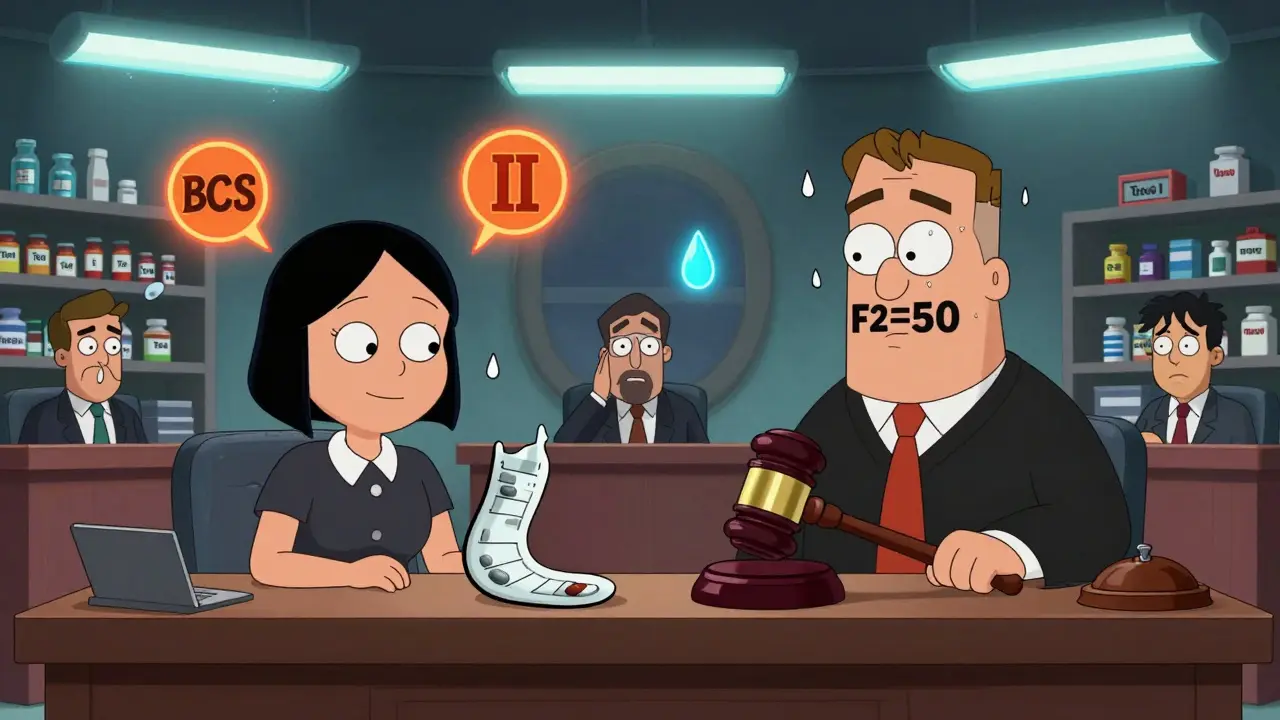
For drugs that dissolve very quickly-like those in BCS Class I (highly soluble and highly permeable)-f2 can be misleading. If 85% of the drug is out in under 15 minutes, there’s almost no variation left to measure. In those cases, the FDA now recommends using bootstrapping, a statistical method that runs the f2 calculation thousands of times to see if the result is truly reliable.
Another option is the Mahalanobis Distance Test (MDT), which looks at the entire shape of the curve, not just the numbers. It’s better at catching subtle differences in release patterns. One 2021 study showed MDT correctly flagged dissimilar profiles 94% of the time, compared to 82% for f2 bootstrapping. But MDT requires advanced software and trained statisticians, so it’s not used in routine testing.
For the most critical drugs-those with a narrow therapeutic index (NTI)-the FDA’s 2023 draft guidance now requires an f2 score of at least 65, not 50. That’s because even a 5% difference in absorption could cause toxicity or treatment failure. For less risky drugs, f2 ≥ 50 still holds.
Why the Method Matters More Than the Number
Dr. Lawrence Yu, former FDA deputy director, said it best: “f2 > 50 is necessary but not sufficient.” A good test doesn’t just give a number-it has to be discriminatory. That means it must be sensitive enough to detect even small changes in the formulation.
How do you make sure your test is discriminatory? You stress the product. You heat it. You crush it slightly. You age it. Then you test it. If your dissolution method can’t tell the difference between a normal tablet and a damaged one, it’s useless for comparing generics.
Real-world example: A Pfizer scientist reported a case where their generic version scored f2 = 49.8-just 0.2 points below the cutoff-despite identical clinical performance. They had to redesign the entire tablet coating just to pass the test. That’s how strict the system is.
What Happens Behind the Scenes
Behind every successful generic approval is a lot of lab work. You need:
- 12 tablets tested for each product
- Identical equipment: USP Apparatus 2 (paddles), 50-100 rpm, 37°C ± 0.5°C
- Correct dissolution media: pH 1.2 (stomach), 4.5, and 6.8 (intestine), depending on the drug
- Enough volume to keep the drug dissolved (sink conditions)-usually 3x the maximum drug amount
- Calibrated machines: vessel concentricity within 0.5mm, shaft wobble under 1.0mm
- Full dissolution curves, not just averages
- Statistical code and calibration records for audit
One survey of 127 labs found that 73% of failed dissolution comparisons weren’t because the generic was different-they were because the testing method itself was inconsistent. A slightly misaligned paddle, a temperature drift of 0.4°C, or a dirty dissolution vessel can throw off results. That’s why labs spend weeks validating their methods before ever testing a single generic.
How This Saves Time and Money
Why go through all this? Because without dissolution profile comparison, every generic drug would need a full clinical bioequivalence study-testing on 24-36 healthy volunteers, with blood samples taken every hour for 24-48 hours. That costs $1-2 million and takes 6-12 months.
Dissolution testing? Around $200,000 and 3-4 months. A 2021 University of Maryland study showed it cuts development costs by up to 60% and speeds up approval by 12-18 months. In 2022-2023, 78% of all generic applications to the FDA included dissolution profile comparisons. And 84% of biowaiver requests based on dissolution similarity were approved in 2023-up from 68% in 2015.
For companies like Teva, a single successful dissolution-based biowaiver for a 25mg amlodipine tablet saved $1.2 million and got the drug to market 14 months faster.
What’s Changing Now
The field is evolving. The FDA and EMA are pushing for biorelevant dissolution testing-using media that more accurately mimic what’s in your gut, including bile salts and enzymes. This is especially important for poorly soluble drugs (BCS Class II and IV), where traditional pH-based media don’t tell the whole story.
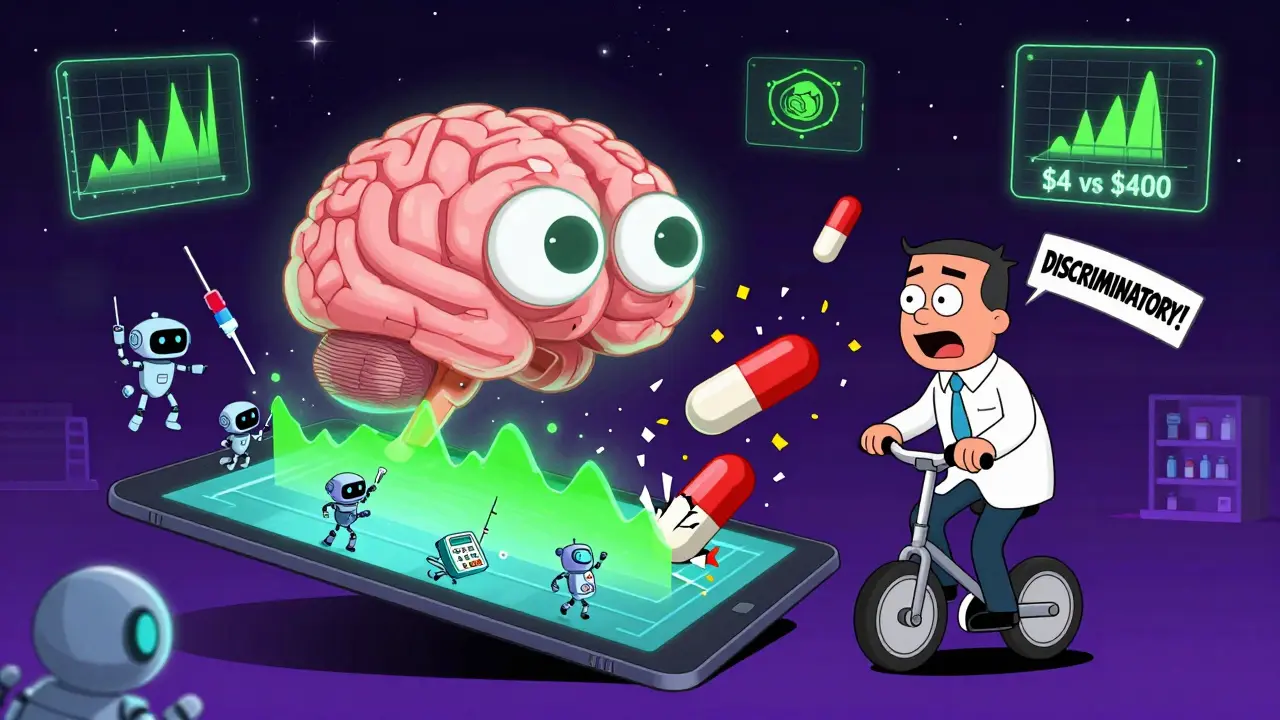
Also, AI is starting to enter the picture. Thirty-seven percent of top pharmaceutical companies are now piloting machine learning models that predict in vivo performance from dissolution curves. Instead of waiting for clinical data, they can simulate it.
By 2026, regulators aim to fully standardize biorelevant testing for all BCS Class I and III drugs. That means even more accurate comparisons-and fewer surprises after a drug hits the market.
What This Means for You
If you’re a patient, you can trust that generics approved using dissolution profiles are safe and effective. The system isn’t perfect, but it’s one of the most rigorously validated tools in modern pharmacy. Every generic you take has passed this test-or a full clinical study.
If you’re a pharmacist or a healthcare provider, understanding dissolution profiles helps you answer patient questions. When someone says, “Why does this generic feel different?” the answer might not be the drug-it could be the filler, the coating, or even how the pill was made. But if the dissolution profile matches, the active ingredient is doing its job the same way.
If you’re in pharma, this is your roadmap. Master the method. Validate your equipment. Don’t just chase the f2 number-build a test that can tell you when something’s wrong before it ever reaches a patient.
Bottom Line
Dissolution profile comparison is the silent gatekeeper of generic drug quality. It’s not flashy. It doesn’t make headlines. But it’s the reason you can buy a month’s supply of lisinopril for $4 instead of $400. It’s the reason millions of people around the world get the medicines they need, when they need them. And it’s built on science-not luck.
What is the f2 similarity factor in dissolution testing?
The f2 similarity factor is a mathematical formula used to compare two dissolution profiles-typically a generic drug and its brand-name counterpart. It calculates how closely the release curves match across multiple time points. A score between 50 and 100 is considered acceptable by regulators, with 100 meaning the profiles are identical. It’s the most widely accepted method for demonstrating bioequivalence without human trials.
Why is dissolution testing used instead of bioequivalence studies for generics?
Dissolution testing is faster, cheaper, and less invasive than bioequivalence studies, which require blood sampling from human volunteers. When dissolution profiles are similar under strict conditions, regulators accept them as proof that the generic will behave the same in the body. This approach has been validated over decades and is now used in over 78% of generic drug applications to the FDA.
Can two drugs have the same f2 score but still behave differently in the body?
Yes. The f2 factor measures overall similarity but doesn’t account for the timing or sequence of release. Two profiles could have the same f2 score-one releasing 80% of the drug in the first 10 minutes, the other slowly over 60 minutes-but the body may absorb them differently. That’s why regulators now recommend using additional methods like bootstrapping or MDT for high-risk drugs.
Are all generic drugs required to pass dissolution profile testing?
Almost all immediate-release solid oral generics must pass dissolution profile comparison to gain approval. The FDA and EMA require it unless the drug qualifies for a biowaiver based on the Biopharmaceutics Classification System (BCS). For BCS Class I drugs, dissolution testing is mandatory. For others, bioequivalence studies may still be needed.
What makes a dissolution method “discriminatory”?
A discriminatory dissolution method can detect small but meaningful differences in drug release caused by changes in formulation, manufacturing, or aging. To prove it’s discriminatory, labs test stressed samples-like tablets that have been overheated, over-compressed, or aged. If the method can’t tell the difference between a normal tablet and a flawed one, it’s not sensitive enough for regulatory use.
How do regulatory agencies ensure dissolution testing is done correctly?
Regulators require strict adherence to USP <711> standards for equipment calibration, environmental controls, and test conditions. Labs must submit full dissolution curves, calibration records, and statistical analysis code. Inspectors can audit these records during facility inspections. Poorly calibrated equipment or inconsistent methods are common reasons for application rejections.
Is there a difference between FDA and EMA requirements for dissolution testing?
The core requirements are very similar: both use f2 ≥ 50 as the baseline, require 12 units tested, and follow USP apparatus standards. The EMA now requires 90% confidence intervals for mean dissolution profiles at each time point, while the FDA is moving toward tiered f2 thresholds based on therapeutic index. Both are now pushing for biorelevant media for complex drugs.
What role does the BCS play in dissolution testing?
The Biopharmaceutics Classification System (BCS) groups drugs based on solubility and permeability. For BCS Class I drugs (high solubility, high permeability), regulators allow biowaivers based solely on dissolution profile comparison. For Class II and IV drugs (low solubility), dissolution testing alone is rarely enough-bioequivalence studies are still required. BCS helps determine how rigorous the testing needs to be.
For those working in generics, the message is clear: Don’t cut corners on dissolution testing. The numbers matter-but so does the science behind them. And for everyone else, remember: that low-cost pill on the shelf? It passed a test designed to make sure it works just like the expensive one.
So let me get this straight-we’re trusting some lab in India to test pills with a math formula that can’t even tell if a drug comes out fast or slow? And you call this science? I’ve seen more rigor in my nephew’s middle school science fair.
The f2 similarity factor, as defined in ICH Q1B, requires a minimum of 12 units per batch, with a confidence interval of ±5% at each time point. The 50-100 range is not arbitrary-it is derived from statistical power analysis under the assumption of normal distribution of dissolution data. Your assertion that it is ‘just math’ reflects a fundamental misunderstanding of pharmacokinetic modeling.
They’re lying to you. The FDA doesn’t care about your generic pills-they care about keeping Big Pharma’s profits alive. That f2 score? It’s a rigged game. I’ve seen lab reports where the same tablet was tested three times and got three different scores. And the machines? They’re calibrated with a ruler and a prayer. You think your $4 pill is safe? It’s a lottery ticket with your life on it.
This is one of those beautiful, quiet triumphs of modern medicine-where science, not hype, keeps people alive. The fact that we can validate bioequivalence without invasive trials, without million-dollar studies, without putting healthy volunteers through blood draws… that’s not just efficient. It’s humane. The engineers, chemists, and statisticians working behind the scenes? They’re the real heroes. And yes, the system’s imperfect-but it’s the best we’ve got, and it’s saved millions.
Dissolution is the proxy. The body is the truth. But the proxy works-because the body doesn’t care how you measure it, only if the drug arrives.
It’s funny how we treat pills like they’re magic boxes. We don’t question how they’re made, just that they work. But this-this whole process-is the quiet, meticulous work of people who care enough to measure every millisecond of release. It’s not glamorous. But it’s the reason your anxiety med doesn’t suddenly stop working. Or worse, overdose you.
Yet-yet-you omit the critical caveat: that f2 is only valid under sink conditions, which are rarely representative of human physiology-especially in fasted vs. fed states. Moreover, the use of USP Apparatus II (paddles) for all drugs is archaic; for poorly soluble compounds, the dissolution rate is governed by diffusion layers that paddles cannot replicate. The EMA’s 2021 guidance explicitly recommends rotating basket systems for BCS Class II-why is this not standard? Because inertia. And corporate lobbying. And laziness.
78% of generics use this method? That’s because the FDA is pressured to approve drugs faster to appease insurers and politicians. The real bioequivalence studies? They’re buried. The data? Suppressed. You think your thyroid med is safe? Try switching brands. Some people get seizures. Others get heart palpitations. And when they complain? They’re told, ‘It’s just your mind.’
Thank you for this. I’ve been trying to explain to my patients why their generic isn’t ‘weaker’-it’s just the same, measured with extreme precision. The fact that we can compare curves across time, account for variability, and still maintain safety… it’s a testament to how far we’ve come. And yes, the system isn’t flawless-but it’s built on evidence, not speculation. That’s worth defending.