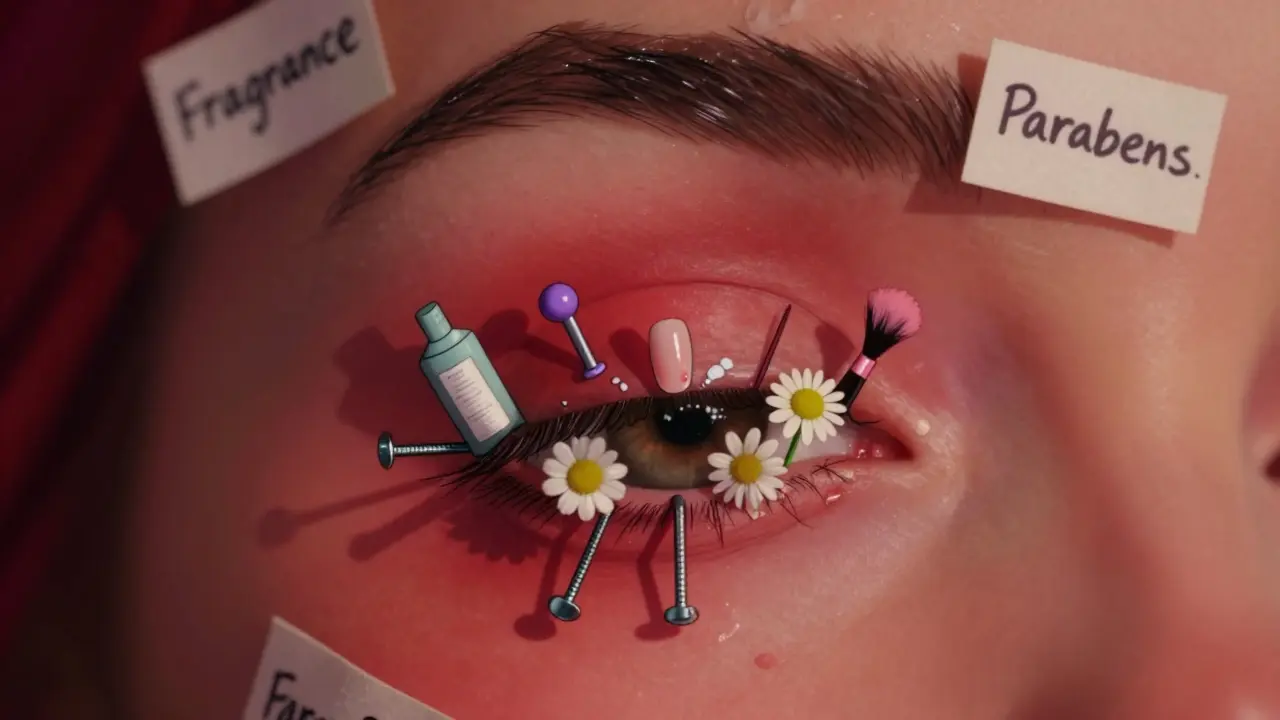
Ever wake up with puffy, itchy eyelids and wonder why? You didn’t change your face cream. You didn’t touch anything unusual. But there it is-red, flaky, burning skin right on your eyelids. If this sounds familiar, you’re not alone. Eyelid dermatitis affects more than 1 in 20 adults, and cosmetic allergens are behind nearly three-quarters of those cases. The problem? Most people blame poor hygiene, stress, or cheap makeup. The real culprit is often something hiding in plain sight: a chemical in your nail polish, shampoo, or even your sunscreen.
The skin around your eyes is the thinnest on your entire body-just half a millimeter thick. That’s thinner than a sheet of printer paper. It’s also unprotected, constantly exposed, and regularly touched by fingers coated in lotions, makeup, or hand creams. When an allergen lands on this delicate skin, your immune system doesn’t just react-it overreacts. This isn’t irritation. It’s an allergic response, called allergic contact dermatitis (ACD), and it takes 24 to 48 hours to show up. So if your eyelids swelled up two days after you painted your nails, you’re not imagining it. You’ve been exposed.
What’s Really Causing Your Eyelid Rash?
The most common triggers aren’t what you think. Fragrances? Yes, they’re a problem. Preservatives? Absolutely. But according to a 2021 NIH study of 215 patients, the #1 cause of eyelid dermatitis is nickel. That’s right-the same metal in cheap jewelry, watchbands, and eyeglass frames. It’s not just in jewelry. Nickel is found in eyelash curlers, eyebrow pencils, and even the metal tips of some eyeliner pens. In fact, 28.7% of all eyelid allergy cases were linked to nickel exposure.
Next up: shellac. Yes, the stuff in gel nail polish. If you get your nails done regularly, you’re at risk. Shellac doesn’t touch your eyelids directly-but when you rub your eyes after touching your nails, you transfer it. A 2023 case log from Bennett & Bloom Eye Centers found that 71% of nail product-related eyelid reactions happened to women who wore gel polish weekly. One Reddit user, MakeupLover87, described a 3-year struggle with swollen eyelids until patch testing revealed she was reacting to toluene sulfonamide formaldehyde resin-a common ingredient in nail polish.
Then there are the sneaky ones: acrylates (used in long-wear mascara and waterproof eyeliner), parabens and formaldehyde releasers (preservatives in eye creams), and botanicals (like chamomile or lavender in ‘natural’ products). A 2023 JAMA Dermatology study found that 33% of ‘clean beauty’ eye products contained hidden plant allergens from the Compositae family-plants like daisies and chrysanthemums-that trigger reactions in sensitive people.
Even your shampoo can do it. If you rinse it out and then rub your eyes, the runoff carries allergens right to your eyelids. Same with hair dye. One dermatologist in Ohio told me, ‘I’ve had patients who thought their eyelid rash was from their eye drops-turns out it was from the dye they used on their eyebrows.’
Why Patch Testing Isn’t Optional
Here’s the hard truth: you can’t guess what’s causing your eyelid dermatitis. Not even close. A 2022 study in MDedge found that doctors relying only on patient history correctly identified triggers in just 37% of cases. That means 63 out of 100 people are being told to ‘avoid makeup’ when the real problem is nickel in their eyelash curler or acrylate in their mascara.
That’s why patch testing is the gold standard. It’s not a fancy test. It’s small patches containing 30-50 common allergens taped to your back for 48 hours. Then, a dermatologist checks for reactions. The accuracy? 95% when done right. The American Academy of Dermatology now recommends a full panel that includes not just the standard allergens but also ophthalmic-specific ones like budesonide, tixocortol pivalate, and acrylates.
Here’s what patients often don’t realize: patch testing isn’t just for ‘serious’ cases. If you’ve had eyelid swelling for more than two weeks, if it keeps coming back, or if it spreads beyond your eyelids, you need it. A 2023 study showed that 63% of people with eyelid dermatitis also had allergies in other areas-like their hands, neck, or face. Fixing the eyelids without addressing the root cause? That’s like putting a bandage on a broken bone.
What You Should Do Right Now
Stop everything. Not just your makeup. Everything. That includes:
- Eye creams and serums
- Face washes and moisturizers
- Nail polish and gel manicures
- Shampoos and conditioners with fragrance
- Any sunscreen or tinted moisturizer that touches your eyelids
Replace them with just one thing: plain petroleum jelly (Vaseline). It’s inert. It doesn’t contain preservatives, fragrances, or botanicals. Apply a thin layer twice a day-morning and night. It’s not glamorous, but it’s the safest thing you can put on your eyelids while you wait for patch test results.
Use cool compresses, not hot water. Heat makes inflammation worse. Dampen a clean cloth with cold water, squeeze it out, and gently lay it over your closed eyelids for 5 minutes, twice a day. Don’t rub. Don’t scrub. Just let it soothe.
And here’s the kicker: wash your hands before touching your face. Seriously. One study found that 42% of cases came from allergens transferred from hands to eyelids. If you just got your nails done, touched your phone, then rubbed your eyes? That’s your trigger.
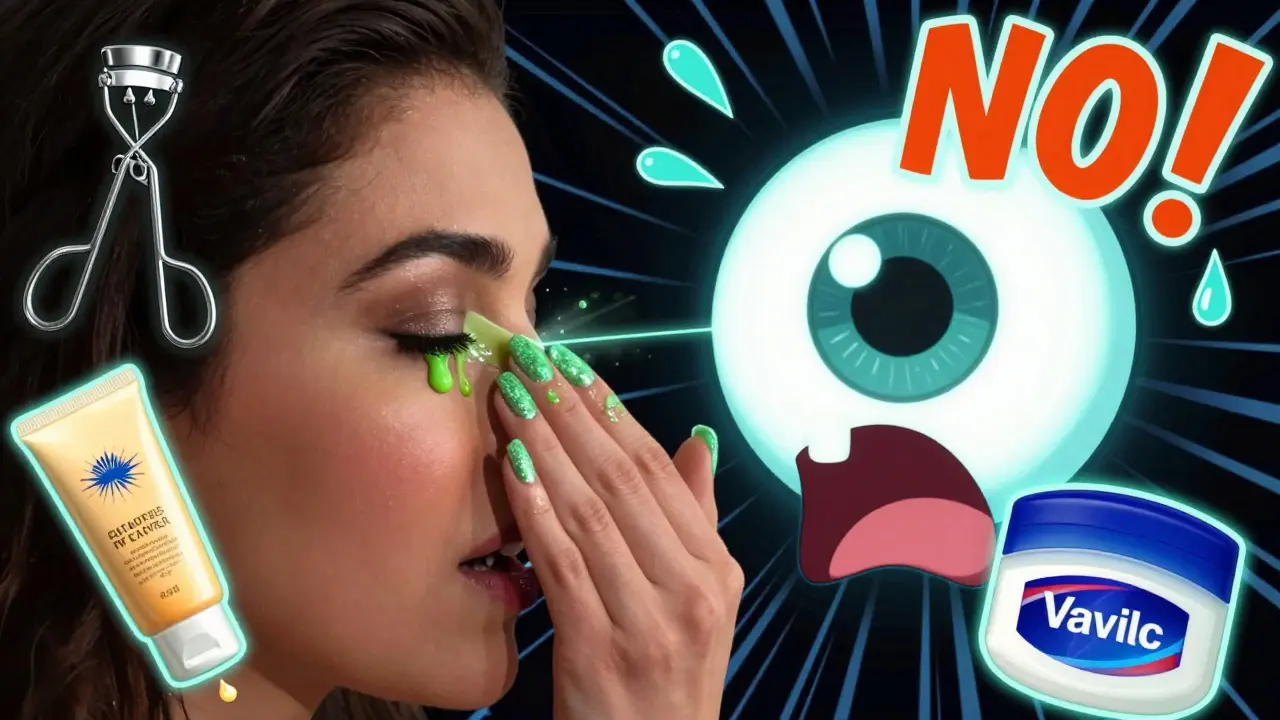
The Treatment Trap: Steroids Can Make It Worse
Many people turn to hydrocortisone cream from the drugstore. Big mistake. The eyelid skin is so thin that even low-potency steroids can cause damage. Prolonged use can lead to skin thinning, cataracts, or glaucoma. Worse? Some people are allergic to the steroids themselves. In the same NIH study, 12% of patients with eyelid dermatitis reacted to budesonide and tixocortol pivalate-two ingredients found in common steroid creams.
The FDA approved a new eyelid-specific treatment in December 2022: Eysuvis 0.25%. It’s a corticosteroid ointment designed to be safe for the eye area. In clinical trials, 89% of users saw complete relief within 14 days-with zero ocular side effects. But it’s not available over the counter. You need a prescription.
Bottom line: don’t self-treat with steroid creams. See a dermatologist. If they push you toward over-the-counter hydrocortisone without patch testing, walk out. You’re not being helped-you’re being delayed.
How to Avoid Triggers for Good
Once you know your allergens, avoidance is simple. But reading labels? That’s where most people give up.
Here’s what to look for on ingredient lists (INCI names):
- Nickel: Look for ‘nickel sulfate’ or ‘nickel chloride’
- Shellac: ‘Shellac’ or ‘lac resin’
- Preservatives: ‘Methylisothiazolinone’, ‘Methylchloroisothiazolinone’, ‘Parabens’ (methylparaben, propylparaben), ‘Formaldehyde’, ‘Quaternium-15’
- Acrylates: ‘Ethyl acrylate’, ‘Hydroxyethyl methacrylate’, ‘Methacrylates’
- Fragrances: ‘Fragrance’, ‘Parfum’, ‘Essential oils’ (lavender, chamomile, citrus)
There’s a free app called Preservative Finder (downloaded over 147,000 times) that lets you scan product barcodes and instantly flags risky ingredients. It’s not perfect, but it’s better than guessing.
Also, use the Contact Allergen Replacement Database (CARD). Updated monthly by the University of Louisville, it lists over 12,800 verified allergen-free products-from eye creams to shampoos. You can search by allergen, product type, or brand. No ads. No hype. Just science.
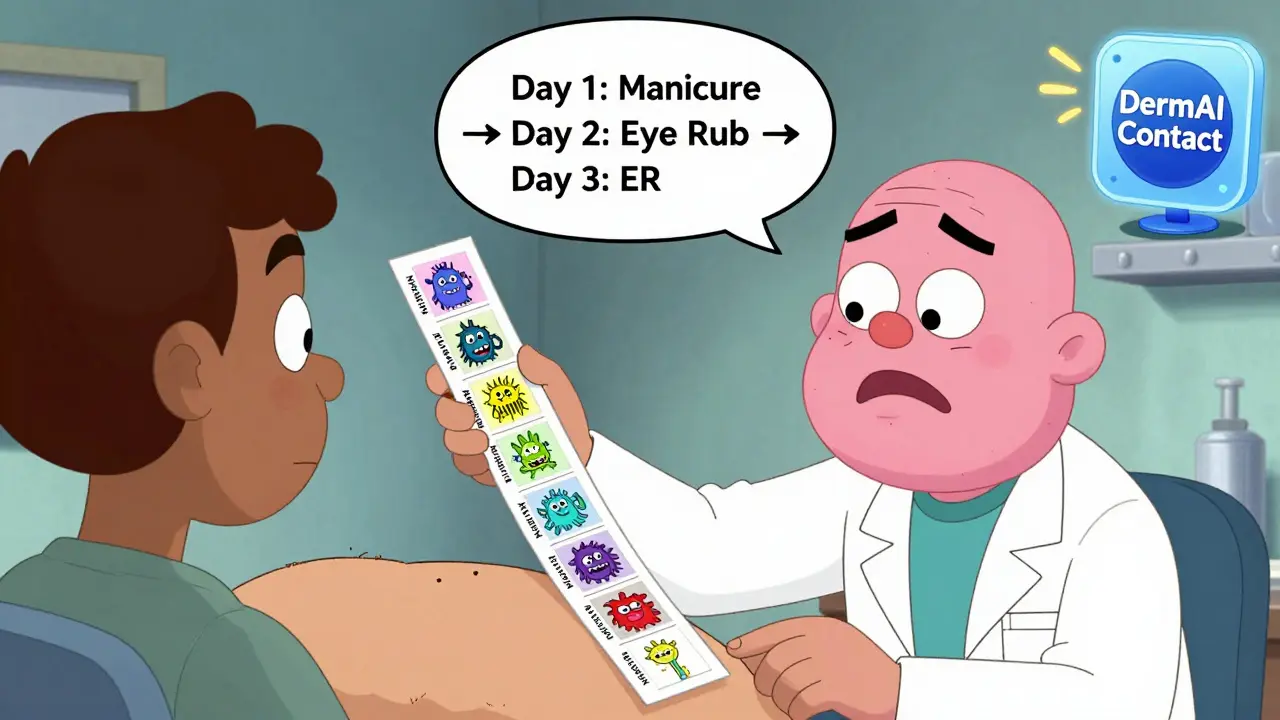
Who’s Most at Risk?
Women between 30 and 40 are hit hardest. Why? Three reasons:
- They’re more likely to use eye makeup daily
- They’re more likely to get regular manicures
- They’re more likely to use ‘natural’ or ‘hypoallergenic’ products-which often contain hidden plant allergens
Men aren’t immune. But their cases are often tied to occupational exposure-metal tools, eyewear, or industrial cleaners. The average age for men is 41.2 years, compared to 34.7 for women.
And yes, it’s getting worse. The Global Contact Dermatitis Market reports a 4.7% annual increase in eyelid dermatitis cases since 2018. Why? Cosmetics are getting more complex. Manufacturers add more preservatives, more fragrances, more ‘beneficial’ botanicals. Each new ingredient is a potential trigger.
What’s Next? The Future of Diagnosis
There’s hope on the horizon. In 2023, a tool called DermAI Contact launched in beta. It’s an AI that asks you 10 questions about your symptoms, habits, and products-and predicts your likely allergen with 76% accuracy. It doesn’t replace patch testing, but it helps you prepare for it. You walk in knowing what to ask for.
By 2027, experts predict a 25% drop in chronic cases thanks to better diagnostics and more collaboration between dermatologists and ophthalmologists. But there’s a dark side: magnetic eyelashes. They’re trending. And they contain nickel. One 2023 study found that 18% of users developed eyelid dermatitis within two weeks of using them.
So if you’re thinking about trying them? Skip it. Or at least test them on your wrist first.
Final Takeaway
Eyelid dermatitis isn’t ‘just a rash.’ It’s your body screaming that something you’re using is toxic to you. Most people try to tough it out, switch brands, or slap on hydrocortisone. Those are band-aids. The real fix? Stop everything. Get patch tested. Find your trigger. Avoid it. Forever.
It’s not about avoiding makeup. It’s about knowing exactly what to avoid. And once you do? Your eyelids heal. Fast. And they stay healed.
The thinness of eyelid skin is what always gets me. Half a millimeter? That's not skin, that's a suggestion of skin. We treat our faces like they're armored tanks when they're actually tissue paper with nerves screaming in the background. And yet we pile on serums, oils, essences, and miracle creams like we're building a skyscraper out of Jell-O. The body doesn't need 17 layers of 'hydration'-it needs breathing room. This isn't skincare. It's performance art with a side of allergic reaction.
And don't get me started on 'clean beauty.' If a plant is in your product and it's not food-grade, it's probably a trigger. Chamomile? It's a daisy. You wouldn't rub a daisy on your eyeball. Why would you let it sit there in a jar labeled 'gentle'? The marketing is designed to make you feel virtuous while your eyelids slowly turn into sandpaper.
It's not about being paranoid. It's about recognizing that your immune system isn't broken-it's doing its job perfectly. The problem is the 47 ingredients we've convinced ourselves are 'safe' because they're vegan or gluten-free. Safety isn't a buzzword. It's a biological fact.
I stopped using everything for six months. Just Vaseline. Cold compresses. No makeup. No shampoo near my face. My eyelids looked like they'd been resurrected. Not because I found the 'right' product. But because I stopped poisoning them with convenience.
The real tragedy? Most people never get patch tested. They just keep trying new brands. It's like trying to fix a leaky roof by painting over the hole. You're not healing. You're just delaying the inevitable collapse.
And yes, magnetic eyelashes? Nickel. Direct contact. No wonder people are waking up with swollen eyes. We're so obsessed with trends we forget we're still mammals with biological limits. The future of beauty isn't more innovation. It's less. Much less.
I had this for two years and thought it was stress or allergies. Turns out it was the eyeliner I bought because it said 'hypoallergenic.' The irony is crushing. I finally got patch tested after my eyelid swelled shut during a Zoom meeting. The allergen? Tixocortol pivalate-found in the steroid cream I'd been using to 'calm it down.'
So I was treating the reaction with the thing causing it. Classic.
Now I use only Vaseline, wash my hands before touching my face, and avoid anything with 'fragrance' or 'essential oils'-even if it's lavender. My skin has never been calmer. And I'm not even that strict with the rest of my routine. Just the eyelids. That tiny area changed everything.
Thank you for writing this. I wish I'd seen it two years ago.
So let me get this straight. You're telling me the reason my eyelids look like I lost a fight with a cactus is because I got a gel manicure? And not even because I touched my eyes-I just rubbed them after touching my nails?
Wow. So the real villain isn't my ex, my job, or my cat. It's Shellac.
Good to know. Now I can blame my aesthetic choices on a chemical I can't even pronounce. Thanks, science. You're a real lifesaver.
Also, I'm not touching Vaseline to my eyelids. That's what I use on my chapped lips. I'm not going full grease monkey just to avoid my own nail polish. I'll just stop getting them done. Simpler.
Biggest takeaway: if you’ve been dealing with this for more than two weeks, you’re not ‘sensitive’-you’re being misinformed.
I used to think patch testing was for people with full-body rashes. Turns out, it’s for anyone who’s been Googling ‘why do my eyelids itch’ for three months straight.
I did it. Found out I was allergic to methylisothiazolinone-which was in my ‘sensitive skin’ face wash. The irony is so thick you could spread it on toast.
Now I use a $3 unscented bar soap and my skin hasn’t flared up in 11 months. No expensive serums. No ‘dermatologist-recommended’ creams. Just soap and water and a little discipline.
Stop spending money on solutions. Start spending time on diagnosis. It’s not glamorous. But it works.
Just got patch tested last week. Nickel. In my glasses. The metal nose bridge. I’ve been rubbing my eyelids for years because they itched. Never thought to check the frames.
Switched to titanium. No more swelling. No more cream. Just… peace.
Check your accessories. Not just your makeup.
Yea i got this too and thought it was just dry skin. I was using this fancy eye cream with chamomile and aloe. Turns out both are like poison to my skin. I switched to plain vaseline and holy crap it cleared up in 3 days. No joke.
Also i never wash my hands before touching my face. That's a game changer. I'm gonna start doing it. Even if i'm lazy.
And the part about steroids? I was using hydrocortisone like it was chapstick. No wonder my skin got thinner. Dumb dumb dumb.
Thanks for the info. Saved me a ton of money and misery.
This is all a lie. The government is hiding the real cause. It's 5G. The EMF from your phone is triggering your eyelid skin because it's so thin. They don't want you to know. They want you to spend money on patch tests and Vaseline so they can profit off your fear.
Also, nickel? That's just a distraction. The real problem is the fluoride in your toothpaste leaching into your tear ducts. I know because I read a blog post from a guy who used to work at the FDA before he disappeared.
Stop using anything with chemicals. Go back to olive oil and honey. That's what our ancestors used. They didn't have eyelid dermatitis.
And if you get patch tested? You're being manipulated. They're tracking your DNA. Don't be a sheep.
So you're telling me people are allergic to nickel in their eyelash curlers? That's the dumbest thing I've ever heard. You're telling me a woman who uses mascara every day is getting dermatitis because of a metal spring? Why not just stop using eyelash curlers then? Why do you need a 3000 word essay on chemical residues when the solution is literally one word: stop.
And Vaseline? That's what your grandpa used to grease his tractor. Now it's the holy grail of skincare? What happened to science?
Also, why are you blaming nail polish? Why not blame the fact that people are too lazy to wash their hands? This isn't a medical crisis. It's a hygiene crisis.
And patch testing? That's a scam. You're just giving dermatologists more money to sit in air-conditioned rooms and stare at little patches.
Just stop touching your face. Problem solved.
Let me break this down for you like you're five. The beauty industry doesn't care if your eyelids are on fire. They care if you buy their next product. That's why they hide allergens under 'fragrance' and 'natural botanicals.' Why? Because if they listed every single compound, you'd stop buying. So they bury it. They bury it in jargon. They bury it in marketing. They bury it under the assumption that you're too distracted to care.
And now you're being told to use Vaseline? The same stuff they use to preserve corpses? That's not a solution. That's a surrender.
The real problem? You're not being told what to avoid. You're being sold a new product to replace the old one. 'Try this new 'hypoallergenic' eye cream!' No. Try nothing. Just stop. Let your skin heal. Let it scream. Listen to it. Not the ad.
And magnetic lashes? Of course they're a trigger. They're metal. They're glued. They're trendy. They're profitable. And they're killing your skin slowly. And the companies? They're laughing. Because you'll buy the next pair after the swelling goes down.
This isn't dermatitis. It's capitalism with a mascara wand.
I’ve been there. I thought I was being dramatic until I saw my reflection after a night of crying-my eyelids were cracked. Like paper that’s been soaked and dried too many times.
Getting patch tested felt scary. Like admitting I’d been lying to myself. But the moment I saw the results? Relief. Not because I found a cure. But because I finally had an answer.
Now I check every product. I read labels like a detective. I use the Preservative Finder app. I even called my nail salon to ask what’s in their gel polish.
It’s exhausting. But it’s worth it.
If you’re reading this and you’re still using ‘gentle’ products with lavender or chamomile? Please. Just stop. For your eyelids. For your peace. You don’t need it.
You’re not weak. You’re not sensitive. You’re just reacting to a system that never asked if you could handle it.
While the clinical data presented herein is both compelling and methodologically sound, one must consider the broader context of consumer behavior in dermatological self-management. The phenomenon of 'clean beauty' as a socio-cultural construct has led to a paradoxical increase in allergen exposure due to the perceived safety of botanical derivatives, which, as noted, are frequently cross-reactive with Compositae family antigens.
Moreover, the reliance on Vaseline as a therapeutic agent, while empirically effective, represents a regression to pre-industrial skincare paradigms-a pragmatic, albeit aesthetically unpalatable, solution. The absence of emollient complexity may be advantageous for barrier restoration, yet it fails to address the psychological need for ritual in daily hygiene regimens.
It is therefore imperative that clinicians not only recommend patch testing but also provide patients with structured behavioral modification frameworks to ensure long-term adherence to avoidance protocols. Without such intervention, recurrence remains statistically inevitable.
Oh honey. You're telling me you didn't know that 'natural' means 'plant-based poison'? I mean, really. You thought lavender was a gift from the gods? Sweetheart, chamomile is a weed that makes bees sneeze. And you put it on your eyeballs?
And Vaseline? How quaint. You're treating your face like it's 1953 and you're about to get your hair done at the beauty parlor.
At least you're not using 'derma-boosting peptides' or 'fermented algae extracts.' Those are just fancy words for 'I'm trying to sell you a $200 jar of nothing.'
Next time, just don't touch your face. And maybe don't get your nails done. Or your eyebrows done. Or your eyelashes done. Or your... well, you get the point.
Love you. Stay safe. And stop spending money on beauty. It's not worth it.
Listen, this is why the West is falling apart. You have people allergic to chamomile? In India, we use turmeric paste on our eyelids for centuries. No dermatitis. No patch testing. Just ancient wisdom. But now? You people are so obsessed with 'science' and 'labels' that you forget how to live. You think a 30-step routine is healing? No. It's poisoning.
And Vaseline? You call that a solution? We use coconut oil. Or ghee. Natural. Pure. No corporate lab. No nickel. No acrylates. Just what the earth gives us.
You think your patch test is science? We have grandmothers who know what triggers what by smell and touch. You need a machine to tell you? Pathetic.
Stop buying Western products. Go back to tradition. Your eyelids will thank you.
The information presented is accurate and well-referenced. The emphasis on patch testing as a diagnostic gold standard is particularly commendable. It is worth noting that the prevalence of nickel allergy in eyelid dermatitis aligns with global epidemiological trends, particularly in populations with high exposure to metal-containing personal care tools.
Additionally, the inclusion of ophthalmic-specific allergens in patch testing panels-such as budesonide and tixocortol pivalate-is a necessary evolution in clinical practice. Many dermatologists still rely on outdated panels that omit these critical components.
The recommendation to use petroleum jelly as a barrier agent is not merely pragmatic but physiologically sound: its occlusive, non-reactive nature makes it ideal for acute phase management.
However, I would add that long-term prevention requires not only avoidance but also skin barrier repair strategies, including ceramide-containing emollients post-recovery. Vaseline is excellent for suppression, but not for restoration.
My eyelids were a mess for a year. Patch test: nickel. In my phone case. I didn’t even think to check that.
Switched to a silicone case. No more swelling.
Also, wash your hands. Seriously. That one change fixed 80% of my issues.
Just wanted to reply to Gretchen-your phone case story? Same. I had a metal iPhone case. I didn’t think about it because I thought ‘it’s just a case.’ But every time I held my phone to my ear and rubbed my eye? Boom. Swelling.
Switched to a silicone case. Zero issues since. I didn’t even know I was doing that until I read your comment.
Thank you. You just saved me from buying another $100 eye cream.