Why Environmental Monitoring Isn’t Just a Checklist
Imagine a food processing line where a slicer hasn’t been cleaned properly. A single Listeria monocytogenes cell gets on the surface. Within days, it multiplies. By the time the product reaches shelves, hundreds of people get sick. The FDA recalls 200,000 units. The company loses millions. And it all started because no one tested the surface in time.
This isn’t hypothetical. In 2022, foodborne illnesses tied to environmental contamination cost the U.S. economy $77.7 billion. Most of these outbreaks could’ve been stopped with basic environmental monitoring. It’s not about being paranoid-it’s about knowing where the risk hides.
Environmental monitoring isn’t just for pharmaceutical plants. It’s critical in food, cosmetics, and any facility where contamination can reach the consumer. The goal isn’t to eliminate every microbe-some are harmless. It’s to control the ones that aren’t.
How Contamination Moves Through Your Facility
Contamination doesn’t show up out of nowhere. It travels. It clings to shoes, rides on air currents, hides in condensation on pipes, and hides in drains. That’s why environmental monitoring uses a zone system to map risk.
Zone 1 is the highest risk: anything that touches the product directly. Think slicers, mixers, conveyors, packaging tools. These surfaces need daily or even hourly swabs. A single missed swab here can lead to a recall.
Zone 2 is close but not direct contact. Think the outside of a refrigeration unit, nearby carts, or the frame of a mixer. These areas get tested weekly. Why? Because microbes from Zone 1 can easily jump here. If you find Salmonella in Zone 2, you’ve got a problem-probably in Zone 1.
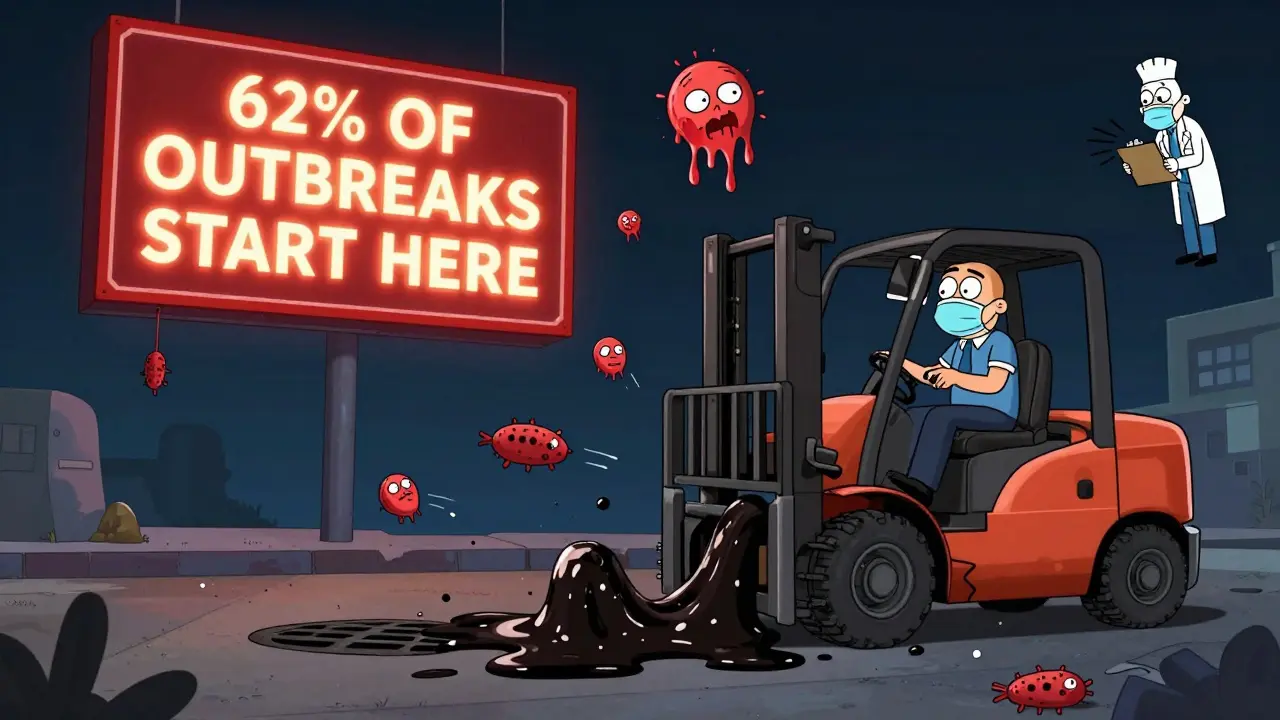
Zone 3 is further away but still near production: forklifts, floor drains, overhead pipes. Sounds low risk? A 2013 study by PPD Laboratories found that 62% of all contamination events came from Zone 3 and 4 surfaces. Floors and drains are silent killers. They don’t touch food, but they hold moisture, grime, and bacteria that get kicked up into the air or washed into product areas.
Zone 4 is the rest: break rooms, offices, entryways. Tested monthly. Not because they’re dangerous, but because they can be entry points. If someone walks in with contaminated boots, Zone 4 is where it starts.
What You’re Actually Testing For
You don’t test for everything. You test for what matters.
In food facilities, it’s mostly microbes: Listeria monocytogenes, Salmonella, and molds. These are the big offenders. The USDA’s Listeria Rule (9 CFR part 430) requires weekly testing for Listeria in Zone 1 and 2 areas for ready-to-eat foods. Miss that, and you’re non-compliant.
Pharmaceutical plants focus on air quality. They need ISO Class 5 cleanrooms (EU Grade B), meaning fewer than 3,520 particles per cubic meter. They use liquid impingers and slit impactors to pull air through sterile media. Results come back as CFU/m³-colony-forming units per cubic meter. Anything above the limit?停产. Stop production.
Water systems are monitored differently. In pharma, water must meet USP <645> standards. That means checking conductivity and total organic carbon (TOC). High TOC? That’s food for microbes. In food plants, they just check if municipal water meets EPA standards. Simpler, but no less vital.
Metals and chemicals? Only if your product is sensitive. Cosmetics might test for lead or mercury. Electronics manufacturers check for ionic residues. Most food plants don’t need this-but if you’re making baby formula or sterile injectables, you do.
How Sampling Actually Works
Swabbing a surface sounds simple. But if you do it wrong, you get false results.
Standard method: use a sterile sponge or swab, dampened with a neutralizing solution. Rub 10x in an ‘S’ pattern over a 10 cm² area. Don’t press too hard. Don’t skip corners. Don’t let the swab touch anything else before or after. The CDC says 68% of facilities mess this up.
Air sampling? You need equipment that pulls liters of air through a collection medium. Slit impactors are common-they smash airborne particles onto agar plates. Sieve impactors work like a colander for microbes. Both must be sterilized before every use. Cross-contamination from the sampler itself is a real problem.
And then there’s ATP testing. It’s not for identifying specific bacteria. It measures adenosine triphosphate-the energy molecule in all living cells. A high ATP reading means organic residue is present. It’s fast: results in 10 seconds. FDA data shows facilities using ATP get back to production 32% faster than those waiting for 48-hour microbial cultures.
But here’s the catch: ATP doesn’t tell you if it’s Listeria. It just tells you the surface isn’t clean. That’s why you use ATP for quick checks and microbiological tests for confirmation. They’re partners, not rivals.
Why More Testing Isn’t Always Better
Many facilities think: more samples = safer. But that’s not true.
A 2017 PPD Laboratories study found that facilities with limited but smart environmental monitoring-focused on high-risk zones, using organism identification, and integrating data-had fewer false positives and better control than those testing every surface daily.
Why? Because you get drowned in data. If you test 200 surfaces a week and 195 come back clean, you ignore the five that don’t. Or worse, you fix the wrong thing. Dr. Laurel Dunn from the University of Georgia says: “The greatest time and resources should go to Zone 1, then Zone 2. Zones 3 and 4? Monitor, but don’t over-invest.”
Also, don’t collect data in silos. ATP results, microbiological results, allergen tests, humidity logs-they need to live in the same system. A 2020 3M handbook found 37% of facilities can’t connect these data streams. That means you’re missing patterns. A spike in ATP on Friday? Maybe it’s tied to a change in cleaning staff. Without integrated data, you’ll never see it.
The Real Cost of Getting It Wrong
Compliance isn’t optional. It’s survival.
The global environmental monitoring market hit $7.2 billion in 2022 and is expected to grow to $12.5 billion by 2027. Why? Because regulators are cracking down.
EU GMP Annex 1, updated in August 2023, now requires real-time data trending in pharmaceutical facilities. No more manual logs. You need sensors that feed data into software that flags trends before they become problems.
The FDA’s 2023 guidance says they’re increasing environmental sampling during inspections of high-risk food facilities. One inspection can shut you down. And it’s not just fines. Reputation dies faster than revenue.
Small facilities struggle the most. Only 48% of those under 50 employees have fully compliant programs, according to USDA data. They lack staff, training, and budget. But they’re not exempt. A single outbreak can wipe them out.
Training is critical. The FDA recommends at least 40 hours of hands-on training before someone can take samples. That’s not optional. That’s the difference between a valid result and a false negative.
What’s Next: AI, NGS, and Smarter Systems
The future of environmental monitoring isn’t more swabs. It’s smarter data.
Next-generation sequencing (NGS) is starting to replace traditional culture methods. Instead of waiting 72 hours to grow Listeria, you can sequence its DNA in under 24 hours. The FDA is encouraging this in their 2023 draft guidance.
AI is coming. By 2027, 38% of monitoring systems will use AI to predict contamination risks based on past data, humidity, foot traffic, and even cleaning schedules. Right now, only 12% do.
And antimicrobial resistance? It’s here. In 2020, 19% of Listeria isolates from food environments showed resistance to multiple antibiotics. That means standard disinfectants might not work. Monitoring now has to track not just presence-but resistance profile.
The goal isn’t just compliance. It’s prevention. The best environmental monitoring program doesn’t catch contamination. It prevents it from ever happening.
Where to Start
- Map your zones-be honest. Don’t call a pipe Zone 2 because it’s easier. If it drips over a conveyor, it’s Zone 1.
- Focus on Zone 1 and 2-spend 70% of your sampling effort here.
- Use ATP for quick checks-pair it with weekly microbiological tests for confirmation.
- Train your team-40 hours isn’t a suggestion. It’s the baseline.
- Integrate your data-use software that brings together ATP, microbial, humidity, and cleaning logs.
- Review quarterly-if your contamination rates haven’t dropped in a year, your system isn’t working.
Environmental monitoring isn’t a cost center. It’s your first line of defense. Skip it, and you’re gambling with people’s health. Do it right, and you protect your brand, your customers, and your future.