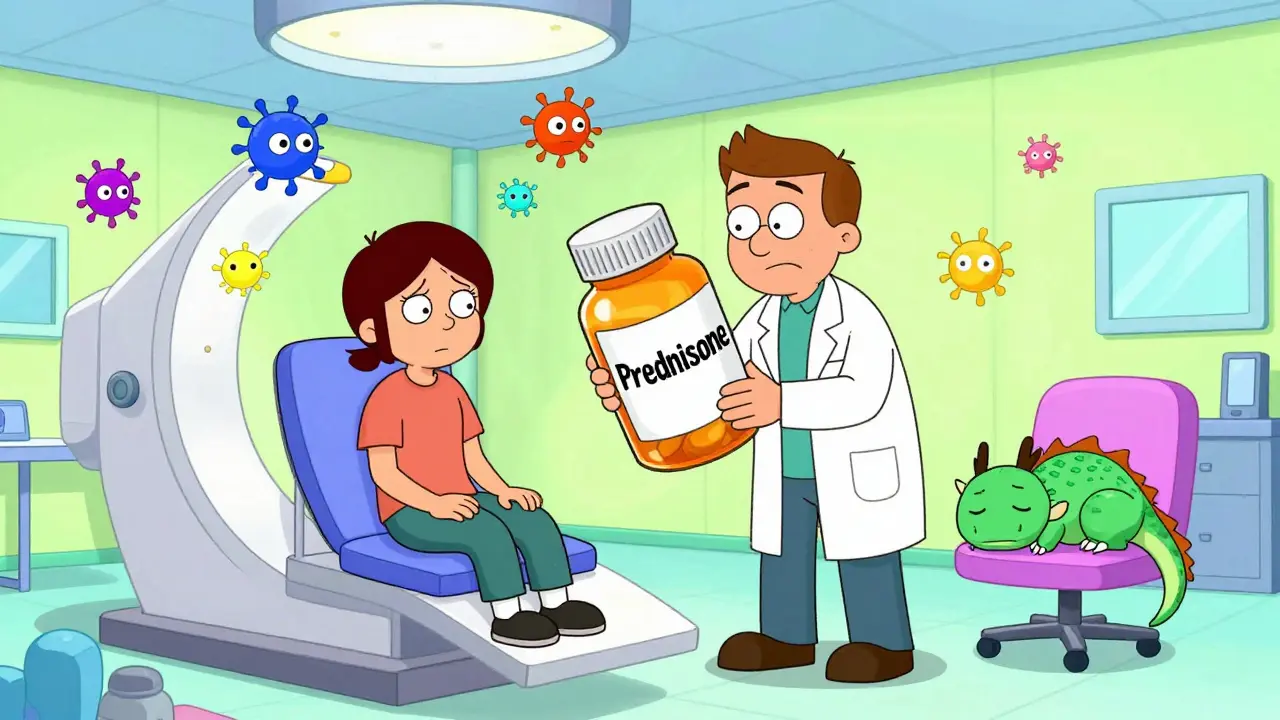
When you’re scheduled for a CT scan or other imaging test that uses contrast dye, most people don’t think about the risks. But if you’ve had a reaction before-or even just heard a story about someone who did-you might be nervous. The good news? We know how to keep you safe. Premedication and smart planning can reduce your risk of a serious reaction by over 90%. But it’s not just about popping pills before your scan. There’s a whole system behind it, and skipping steps can put you in danger.
What Actually Causes a Contrast Dye Reaction?
Contrast dye, usually iodinated, helps doctors see blood vessels, organs, and tumors clearly on X-rays and CT scans. It’s not the same as iodine in table salt or antiseptic like Betadine. That’s a common myth. People with shellfish allergies aren’t automatically at higher risk. Studies show their chance of reacting is only 2 to 3 times higher than someone with no allergies at all-which still means less than 1 in 100 will have any reaction. The real danger comes from a prior reaction to the same type of contrast dye.Reactions are split into two types: immediate (within an hour) and delayed (hours to days later). Immediate reactions are the scary ones-hives, swelling, trouble breathing, even cardiac arrest. They happen in about 0.04% to 0.22% of cases with modern low-osmolar dyes. Severe reactions? Around 1 in 5,000. That’s rare, but not negligible. And if you’ve had one before, your chance of having another jumps to 35%. That’s why premedication exists.
When Do You Need Premedication?
Not everyone needs it. The rules are clear and based on your history:- Mild reaction (like a few hives or mild nausea): Usually no premedication needed. Studies show recurrence is very low.
- Moderate reaction (wheezing, vomiting, low blood pressure): Consider premedication, especially if the scan is critical.
- Severe reaction (anaphylaxis, cardiac arrest): Avoid contrast unless it’s an emergency. Even then, only do it in a hospital with full resuscitation support.
And here’s something important: if you had a reaction to one brand of contrast dye, switching to another brand within the same class can be just as effective as premedication. Yale and UCSF both say this is a smart first move-if the original agent is known and another is available. You don’t always need steroids and antihistamines.
The Two Main Premedication Protocols
There are two standard ways to prep your body. One is for planned, outpatient scans. The other is for emergencies or hospital stays.Oral Protocol (for scheduled scans): This is the most common for people coming in for a routine CT. It needs time to work.
- Prednisone 50 mg by mouth at 13 hours before the scan
- Prednisone 50 mg again at 7 hours before
- Prednisone 50 mg one more time at 1 hour before
- Diphenhydramine (Benadryl) 50 mg by mouth, 1 hour before
Benadryl makes you sleepy. So if you’re on this schedule, you must have someone drive you home. No exceptions. Many imaging centers will reschedule you if you don’t have a ride.
IV Protocol (for inpatients or emergencies): If you’re already in the hospital or having a scan in the ER, you get meds through an IV. Two options:
- Methylprednisolone 40 mg IV, then every 4 hours until the scan, plus diphenhydramine 50 mg IV 1 hour before
- Hydrocortisone 200 mg IV, then every 4 hours until the scan, plus diphenhydramine 50 mg IV 1 hour before
Both work. The choice depends on hospital policy and what’s on hand. The key? You can’t rush this. If you get the meds less than 4 to 5 hours before the scan, they won’t work. The science says so.
What If You Don’t Have 13 Hours?
Life doesn’t always wait. Sometimes you need a scan urgently-like for a suspected stroke or internal bleeding. That’s where the 5-hour accelerated protocol comes in. A 2017 study in Radiology showed this works just as well as the 13-hour version for urgent cases:- Methylprednisolone 32 mg by mouth, 5 hours before
- Methylprednisolone 32 mg by mouth, 1 hour before
No Benadryl needed in this version, which is helpful if you’re already sedated or in critical condition. But this is still newer, and not every hospital uses it. Ask your radiologist.
What About Kids?
Children aren’t just small adults. Their dosing is different. For kids 6 and older who need antihistamine-only premedication (usually for mild prior reactions), UCSF recommends:- Cetirizine 10 mg by mouth, 1 hour before the scan
For younger kids or more severe histories, the team will adjust based on weight and medical history. Pediatric radiology departments have specific guidelines-they don’t wing it.
Safety Planning: It’s Not Just About the Pills
Premedication is only half the story. The real safety net is the system around it.Any facility giving contrast dye must be ready for emergencies. That means:
- Crash carts with epinephrine, oxygen, and airway tools within arm’s reach
- Staff trained in advanced cardiac life support (ACLS)
- Immediate access to an ICU or emergency department
UCSF requires patients with a history of severe reactions to be scanned at specific hospitals-Moffitt-Long, Mt. Zion, or Mission Bay-where rapid response teams are always on-site. UCLA says the same: if you’ve had a bad reaction before, you need to go to a designated imaging center. Not your local clinic.
And here’s a rule you won’t hear often: your doctor must talk to a radiologist before scheduling your scan if you have a known allergy. It’s not optional. That conversation ensures the right protocol is chosen, the right facility is picked, and the right meds are given.
What’s the Cost? And Is It Worth It?
The meds themselves are cheap. Prednisone 50 mg tablets? About 25 cents each. Diphenhydramine? Around 15 cents per dose. Even with three doses, you’re looking at less than a dollar in drug cost. Compare that to a $1,200 CT scan. The cost of a severe reaction? That’s in the tens of thousands-intensive care, prolonged hospital stay, possible long-term damage.Over 95% of U.S. academic hospitals follow these guidelines. Community hospitals? About 78% do. That gap matters. If you’re getting scanned at a smaller facility, ask: Do you have a written protocol for contrast reactions? Do you have epinephrine on hand? Is your staff trained? If they hesitate, consider going elsewhere.
What’s Changing? What’s Next?
The big shift? Less reliance on premedication. Newer contrast dyes are much safer. The old high-osmolar agents caused reactions in 5% of people. Today’s low-osmolar dyes? Less than 0.2%. That’s a 25-fold drop. Some experts now argue that for many patients, switching contrast agents is enough-no steroids needed.The American College of Radiology is expected to release Version 11 of its Contrast Media Manual in late 2024. Early drafts suggest a stronger push toward agent substitution over blanket premedication. The goal? Reduce unnecessary drugs, reduce side effects, and still keep people safe.
But here’s the hard truth: even with perfect premedication, about 2% of patients still have reactions. That’s why vigilance never stops. The team watching you during the scan must be alert. You must speak up if you feel anything strange-flushing, itching, tightness in your chest. Don’t wait. Say something.
Final Checklist Before Your Scan
If you’ve had a reaction before-or think you might be at risk-use this before you leave home:- Did you talk to your doctor and a radiologist about your history?
- Are you scheduled at a facility with emergency response capabilities?
- Do you know which contrast dye you reacted to? Can they switch to a different one?
- Are you on the correct premedication schedule? Did you take it on time?
- Do you have a driver? (Especially if you’re taking Benadryl)
- Do you know the signs of a reaction? (Itching, swelling, dizziness, trouble breathing)
It’s not about fear. It’s about control. You can’t prevent every reaction. But you can stack the odds in your favor-with the right prep, the right place, and the right people watching over you.
Can I have a contrast dye reaction if I’m allergic to shellfish?
No, shellfish allergies don’t automatically mean you’ll react to iodinated contrast dye. That’s a myth. Studies show people with shellfish allergies have only a 2- to 3-fold higher risk than the general population-which still means over 97% won’t have a reaction. The real risk comes from a prior reaction to the same type of contrast dye, not seafood or iodine.
Do I need premedication if I had a mild reaction before?
Usually not. Mild reactions-like a few hives or mild nausea-have a very low chance of coming back. Major guidelines from UCSF and others say premedication isn’t needed in these cases. But if your scan is urgent or you’re anxious, talk to your radiologist. Sometimes a single dose of antihistamine is enough.
How long before the scan do I need to take my premedication?
For the standard oral protocol, you need to start 13 hours before. The last dose of prednisone and Benadryl must be taken 1 hour before. If you’re on the accelerated 5-hour protocol, you take two doses of methylprednisolone-at 5 hours and 1 hour before. If you take your meds less than 4 hours before, they won’t work. Timing matters.
Can I drive myself home after premedication?
No, if you take Benadryl (diphenhydramine), you cannot drive. It causes drowsiness and slows reaction time. Even if you feel fine, your judgment and coordination may be impaired. You must have someone else drive you. Many imaging centers will cancel your appointment if you don’t have a ride.
What if I have a reaction during the scan?
You’ll be monitored during and after the injection. If you feel itching, warmth, nausea, or trouble breathing, tell the tech immediately. They’re trained to respond. Most reactions are mild and treated with antihistamines or steroids right there. Severe reactions are rare but require epinephrine and emergency care-so make sure the facility has a crash cart and trained staff nearby.
Is premedication always effective?
No. Even with perfect premedication, about 2% of patients still have a reaction. That’s why it’s called prophylaxis-not a guarantee. The goal is to reduce risk from 35% down to 2%, not to 0%. That’s why facilities with severe reaction histories are required to have rapid access to emergency care. Always assume a reaction is possible, even if you’re premedicated.
Can I switch to a different contrast dye instead of taking meds?
Yes, and it’s often the best first step. If you know which dye caused your reaction, switching to a different brand within the same class can be just as effective as premedication. Yale, UCSF, and UCLA all recommend this. It avoids unnecessary steroids and antihistamines. Ask your radiologist if a different agent is available.
Are these protocols the same everywhere?
Most academic hospitals follow the American College of Radiology’s guidelines, which are used by over 95% of U.S. centers. But community hospitals vary. About 22% don’t fully follow standardized protocols. If you’re going to a smaller facility, ask if they have a written policy for contrast reactions and if their staff is trained in emergency response. Don’t assume they do.
Let me just say this: if you’ve had a prior reaction, don’t just assume you’re fine because you ‘only got hives.’ I’ve seen too many people downplay it-and then end up in the ER with swelling that looks like a balloon animal gone wrong. The 35% recurrence rate isn’t a suggestion; it’s a warning label. And yes, switching contrast agents? Absolutely do that first. No need to drown in steroids if you can just swap the dye. I’ve been doing this for 15 years, and I still double-check every protocol with the radiologist. Never skip the conversation.
I had a mild reaction last year-just a rash and some nausea. They told me I didn’t need premedication, and honestly? I was relieved. But I still asked if they had epinephrine on hand. They did. And the tech asked me point-blank if I felt anything weird during the scan. That’s the kind of care that makes you feel safe. It’s not just about the meds-it’s about the people paying attention.
so like... why do we even use this dye? like its just poison right? and they give it to you like its water? and then you take pills to fight the poison? why not just not do the scan? like... is this what modern medicine is? poison + pills? i think we lost our way
Swarnima, I get where you’re coming from-it feels wild when you think about it. But imagine not being able to detect a tumor until it’s stage four because we refused contrast out of fear. The dye isn’t poison; it’s a flashlight in the dark. And the premeds? They’re like seatbelts. You don’t need them every time, but when you do? You’re *glad* they’re there. I’ve had two scans with premeds. Felt fine. Walked out. No drama. That’s the win.
Just a heads-up for anyone reading: if you’re on Benadryl, don’t try to drive yourself home. I thought I’d be fine after my last scan. Felt ‘fine.’ Got in the car. Drove two blocks. Had to pull over because everything looked blurry and my brain felt like cotton. Took a 45-minute nap in the parking lot. Don’t be me.
So let me get this straight: we spend $1200 on a scan, then give you $0.50 worth of pills to avoid dying? And if you don’t take them? You’re basically playing Russian roulette with your kidneys? 🤡 I love how medicine is just ‘trust us, we’re experts’ but also ‘oh btw, here’s a 13-hour pill schedule that feels like a cult initiation.’
For anyone stressing about shellfish allergies: I’m allergic to shrimp and had three contrast scans. No issues. The myth is so widespread it’s practically a public service announcement at this point. Don’t let your fear of seafood keep you from getting a life-saving scan. Talk to your doctor. Swap the dye if needed. But don’t skip the scan because of a myth.
Good info. I’m from Canada and we use the same protocols here. But I’ve seen small clinics skip the epinephrine check because they ‘don’t get many reactions.’ That’s not good enough. If you’re getting contrast, you deserve a full emergency setup. Ask before you show up. Don’t assume.
Oh wow. So you’re telling me that after 30 years of medicine, we still don’t have a dye that doesn’t require a 5-pill ritual? How pathetic. And people wonder why they don’t trust doctors. You’ve got a 90% success rate with premeds? That’s not safety-that’s a workaround for a flawed product. The real solution? Develop a safer dye. Not more antihistamines. More innovation. Not more fear.
Excellent breakdown. One point missing: the accelerated 5-hour protocol is not FDA-approved for all cases, and many institutions still consider it off-label. Always confirm your center follows ACR guidelines and has institutional review board approval for accelerated regimens. Don’t let them wing it just because you’re in a hurry. Safety isn’t negotiable.
So you're telling me I need to take 3 pills of prednisone just to get a CT scan? And if I don't, I might die? But my cousin got one without any meds and was fine? So why am I the one who has to suffer? This feels like punishment for being allergic. Like I'm being penalized for my body's choices.
Biggest takeaway? Ask questions. Don’t just sign the form. Ask: ‘Which dye are you using?’ ‘Do you have epinephrine?’ ‘Can we switch agents?’ ‘What’s your protocol for reactions?’ If they hesitate or say ‘We’ve never had a problem,’ walk out. Your life isn’t a risk experiment. I’ve done this twice. Both times, I asked. Both times, they were glad I did.