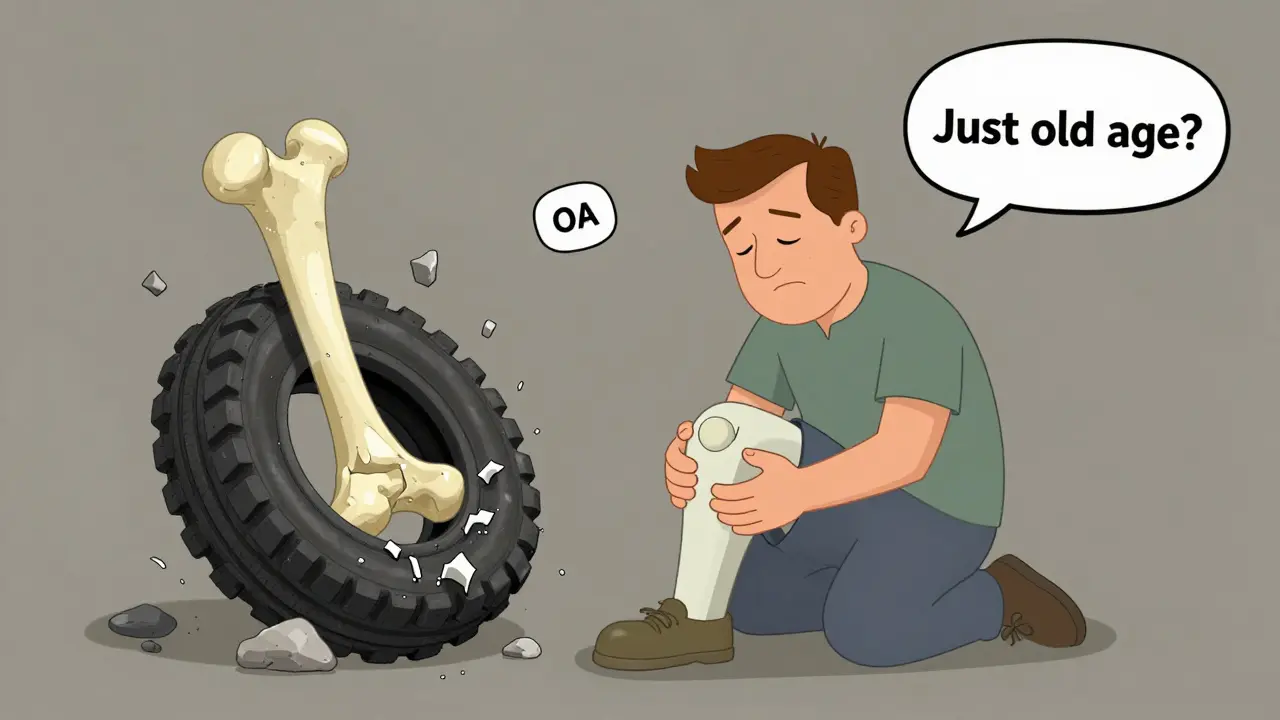
When your knees ache after walking, or your fingers feel stiff in the morning, it’s easy to assume it’s just "arthritis." But not all arthritis is the same. In fact, there are more than 100 types. The two most common - osteoarthritis and rheumatoid arthritis - are completely different diseases in how they start, how they behave, and how they’re treated. Mixing them up can lead to the wrong care, unnecessary pain, and even permanent damage.
What Is Osteoarthritis?
Osteoarthritis (OA) is what happens when the cushioning between your bones wears down. Think of it like the rubber on a tire slowly thinning out from too much use. It’s not an infection or an immune problem. It’s mechanical. Your cartilage breaks down, bones rub together, and your body responds by growing extra bone - what we call bone spurs. This leads to pain, swelling, and stiffness, especially after activity.
OA usually shows up after age 50, though it can happen earlier if you’ve had a joint injury, are overweight, or do a lot of repetitive motion. It most often hits the knees, hips, lower back, neck, and hands. In the hands, you’ll see bumps near the fingertips - these are called Heberden’s nodes. They’re a telltale sign of OA.
The pain gets worse when you move the joint and improves with rest. Morning stiffness? It’s usually brief - under 30 minutes. You might feel a grinding sensation when you move, and your joint might lose its full range of motion over time. X-rays show narrowing of the joint space and bone spurs. Blood tests? They’re normal. That’s because OA doesn’t involve your immune system.
Weight matters a lot. Losing just 5 kilograms can cut knee pain by half. Physical therapy, braces, NSAIDs like ibuprofen, and injections like cortisone or PRP help manage symptoms. If things get bad enough, joint replacement surgery is very common - 90% of all joint replacements in the U.S. are for OA.
What Is Rheumatoid Arthritis?
Rheumatoid arthritis (RA) is not wear and tear. It’s an autoimmune disease. That means your immune system, which normally fights infections, turns on your own body. It attacks the synovium - the lining of your joints. This causes inflammation, swelling, and eventually destroys cartilage and bone. Unlike OA, RA doesn’t just affect joints. It can damage your lungs, heart, eyes, and even your blood vessels.
RA can strike at any age, even in children (called juvenile idiopathic arthritis). It often starts between ages 30 and 60, but it doesn’t care about your age or activity level. Women are three times more likely to get it than men.
RA symptoms come on faster - over weeks or months, not years. Morning stiffness lasts longer than an hour, sometimes all day. Pain and swelling are symmetrical. If your left wrist is affected, your right wrist will be too. The same goes for knuckles, knees, and ankles. You might feel tired all the time, have low fevers, lose weight without trying, or develop firm lumps under your skin near your elbows - called rheumatoid nodules.
RA spares the very tip of your fingers. If you have pain only in the joints closest to your nails, it’s more likely OA. RA targets the knuckles (MCP joints) and wrists. Blood tests often show rheumatoid factor (RF) or anti-CCP antibodies. Ultrasound and MRI can detect inflammation before X-rays show damage. Early diagnosis is critical. If you wait too long, joint destruction can happen in just months.
Treatment is aggressive. You need disease-modifying antirheumatic drugs (DMARDs) like methotrexate. Biologics and JAK inhibitors (like tofacitinib) are used if those don’t work. These drugs don’t just relieve pain - they slow or stop the immune system from attacking your joints. Without them, RA can cause permanent deformities and disability.

How OA and RA Differ Side by Side
| Feature | Osteoarthritis (OA) | Rheumatoid Arthritis (RA) |
|---|---|---|
| Primary Cause | Wear and tear on cartilage | Immune system attacks joint lining |
| Typical Age of Onset | Over 50 | Any age (including children) |
| Joint Symmetry | Often one-sided | Always symmetrical |
| Morning Stiffness | Less than 30 minutes | More than one hour |
| Commonly Affected Joints | Knees, hips, spine, fingertips | Wrists, knuckles, ankles, toes |
| Systemic Symptoms | No | Yes - fatigue, fever, weight loss |
| Diagnostic Tests | X-ray (joint space loss, bone spurs) | Blood tests (RF, anti-CCP), ultrasound |
| Primary Treatment | Pain relief, weight loss, physical therapy | DMARDs, biologics, immune suppression |
| Joint Replacement Likelihood | 90% of all replacements | Less common - more tendon repairs |
Other Common Types of Arthritis
OA and RA make up the majority of cases, but they’re not the only players.
Gout is caused by sharp uric acid crystals building up in joints, usually the big toe. Attacks come suddenly - intense pain, redness, swelling - and often happen at night. Diet, alcohol, and kidney function play big roles. It’s treated with medications that lower uric acid and anti-inflammatory drugs.
Psoriatic arthritis affects people with psoriasis (a skin condition). It can cause swollen fingers that look like sausages, nail changes, and back pain. It’s also autoimmune, so treatment overlaps with RA - DMARDs and biologics are often used.
Ankylosing spondylitis targets the spine and sacroiliac joints. It causes chronic back pain and stiffness, especially in young men. Over time, the spine can fuse. It’s linked to the HLA-B27 gene. Exercise and biologics help manage it.
Lupus-related arthritis comes with the autoimmune disease lupus. It’s often less destructive than RA but comes with other symptoms like rashes, kidney issues, and sun sensitivity.
Why Getting the Right Diagnosis Matters
Using the wrong treatment can make things worse. If someone with RA is told they just have "old age arthritis" and only gets ibuprofen, their joints can be destroyed before they even realize what’s happening. On the flip side, giving a person with OA powerful immune-suppressing drugs could leave them vulnerable to infections with no benefit.
Doctors use a mix of symptoms, physical exams, imaging, and blood tests to tell them apart. If you have pain in your hands, the pattern tells the story. OA? Bony bumps near the tips. RA? Swelling in the knuckles, not the very ends. If your stiffness lasts all morning and you’re tired all the time, that’s a red flag for RA.
There’s also a growing gap in care. Many people with early RA wait months or even years to see a rheumatologist. But studies show that starting DMARDs within the first 3 to 6 months can stop joint damage and even lead to remission in up to half of patients. OA, meanwhile, responds best to lifestyle changes - losing weight, staying active, and avoiding joint stress.
What’s New in Arthritis Care?
Research is moving fast. For RA, newer JAK inhibitors offer alternatives to traditional biologics, though they come with new safety warnings. For OA, scientists are searching for blood or imaging biomarkers that can spot cartilage breakdown before X-rays show damage. Platelet-rich plasma (PRP) injections are being used more often, though evidence is still mixed.
One big shift: OA isn’t inevitable. People who lose weight, strengthen muscles around their joints, and stay active can slow its progress. RA isn’t always progressive either. With early, aggressive treatment, many people live without joint damage.
The bottom line? Arthritis isn’t one disease. It’s a group of diseases. Your treatment plan should match the type you have - not just the pain you feel.
Can you have both osteoarthritis and rheumatoid arthritis at the same time?
Yes. It’s not rare. Someone with RA can develop OA in a joint that’s already been damaged by inflammation. Or an older person with OA in their knees might later develop RA in their hands. Doctors look for different patterns - like symmetrical swelling in RA versus bony growths in OA - to untangle the two.
Does arthritis always get worse over time?
Not necessarily. OA can stay stable for years if you manage your weight and stay active. RA, if caught early and treated aggressively, can go into remission - meaning little to no active inflammation. Many people with RA live full, active lives without major joint damage.
Can blood tests alone diagnose rheumatoid arthritis?
No. Some people with RA have negative blood tests (called seronegative RA). Others have positive tests but no arthritis. Diagnosis relies on combining symptoms, physical exam, imaging, and lab results. A rheumatologist looks at the whole picture.
Is surgery the only option for severe arthritis?
No. Surgery is a last resort. For OA, weight loss, physical therapy, and injections often delay or avoid surgery. For RA, medications can prevent joint damage so badly that surgery is never needed. But if joints are destroyed, replacement or repair can restore function and quality of life.
Can lifestyle changes prevent arthritis?
You can’t prevent RA - it’s autoimmune and linked to genes and environment. But you can reduce your risk of OA by maintaining a healthy weight, avoiding joint injuries, and staying active. Smoking increases RA risk, so quitting helps. For OA, keeping your muscles strong around your joints gives them better support.
I’ve been dealing with OA in my knees for years, and honestly, the biggest game-changer was losing weight. Not because I wanted to look better, but because my doctor said if I didn’t, I’d be on a waiting list for a replacement before I was 60. I dropped 18 pounds, started walking daily, and now I can climb stairs without wincing. It’s not glamorous, but it works.
Also, I didn’t know about PRP injections until last year. My insurance didn’t cover it, so I paid out of pocket - worth every penny. No more grinding sensation when I walk. Just a slow, steady improvement.
As someone who’s been through both OA and RA - yes, you can have both - I want to say how much I appreciate this breakdown. I was misdiagnosed for two years because my doctor thought my hand pain was just aging. Turns out, I had RA in my knuckles and OA in my thumbs. The swelling was symmetrical, but the bony bumps made everyone think it was just OA.
Early DMARDs saved my hands. I can still type, cook, hold my granddaughter. Don’t ignore symmetrical swelling. If your wrists hurt the same way, get tested. Don’t wait.
OMG this is so true!! I live in India and we have this huge problem where people think arthritis is just "old person pain" and they don’t go to doctor until its too late!! My aunt had RA and they gave her painkillers for 3 years before someone said "wait this is autoimmune" and she lost all her finger joints!!
Also why is it that in USA they have all these fancy biologics and here we cant even get methotrexate without a 3 month wait?? Its not fair!! People in US are so lucky!! I wish our govt would prioritize this!!
And dont even get me started on how yoga helps with OA!! I do it every morning and my knees feel like new!!
My mom has RA. She’s 52. Took 14 months to get diagnosed. She cried when the rheumatologist said, "This isn’t just aging."
She’s on a JAK inhibitor now. No more morning stiffness. Can hold her coffee cup again. Just… wow.
Okay but like… why are we still treating OA like it’s just "wear and tear"? Like, yeah, it’s mechanical, but if your body’s breaking down, maybe it’s because you’re eating garbage and sitting on your butt all day? We’re not supposed to be 200 lbs and watching Netflix for 8 hours straight at 55.
And RA? People act like it’s this mysterious curse. Nah. It’s your immune system going rogue because you’re stressed, smoking, and eating sugar like candy. Stop blaming genetics. Start blaming lifestyle.
Also, if you’re still using ibuprofen for RA, you’re doing it wrong. You’re not fixing anything. You’re just masking the fire while the house burns down.
I’ve got OA in my lower back and RA in my hands. It’s weird having both. The back pain is dull, constant, gets worse when I sit too long. The hand pain? Sharp, swollen, worse in the morning, and makes me feel like I’m 80 even though I’m 41.
What helped me most was finding a rheumatologist who actually listened. Most docs just say "take NSAIDs" and call it a day. But when I got on methotrexate, the RA symptoms dropped like a rock. I didn’t even realize how tired I was until it went away.
As someone who moved from the Philippines to the U.S., I’m blown away by how different the care is. Back home, my uncle had RA and they gave him pain patches and told him to "rest more." Two years later, his hands were curled up like claws.
Here? I got blood tests, MRIs, a referral to a specialist in 3 weeks, and a treatment plan within a month. It’s not perfect, but it’s lightyears ahead.
Also - if you’re reading this and you’re from a country where access is limited: please, if you can, travel for care. Even a one-time consult with a rheumatologist can change your whole life. Don’t wait.
Just wanted to say… thank you for writing this. Seriously.
I’ve been living with RA for 8 years. I used to feel so alone. Like no one understood why I couldn’t open jars or why I looked "fine" but was exhausted.
This article? It’s the first time I’ve seen my experience laid out so clearly. I’m gonna share it with my sister. She keeps saying "just push through." Now she’ll get it.
Also… 🙏❤️
OA and RA are not interchangeable terms. That’s the whole point. But here’s the thing - most primary care docs don’t get it. I’ve had three different doctors tell me "it’s just arthritis" and hand me a prescription for naproxen.
RA isn’t just "inflammatory arthritis" - it’s systemic. It’s not a joint problem. It’s a whole-body immune glitch. And if you’re not on DMARDs within 6 months? You’re playing Russian roulette with your mobility.
Also - PRP? Evidence is weak. But for OA? It’s worth a shot if you’ve exhausted everything else. I’m not saying it cures, but it bought me two more years without a knee replacement.
so like… i had this weird thing where my fingers would swell up at night and i thought it was just from typing too much? turns out it was RA. i went to the doc, they did bloodwork, and boom - anti-CCP positive. i was like wait i’m 34??
anyway, methotrexate made me feel like a zombie for 2 weeks but now? i can hold my dog without pain. also i quit smoking. no regrets.
ps: if you think you have this, dont wait. even if your blood test is negative. get an ultrasound. inflammation shows up before the numbers do.
OA is not inevitable. I’m 63. I’ve never had a joint replacement. I lift weights 3x a week. I walk 6 miles a day. I don’t take NSAIDs. My knees feel better than my 30-year-old nephew’s.
It’s not magic. It’s consistency. Strength around the joint = less friction. Less friction = less degeneration.
Also - stop saying "I’m just getting old." You’re not. You’re just sedentary.