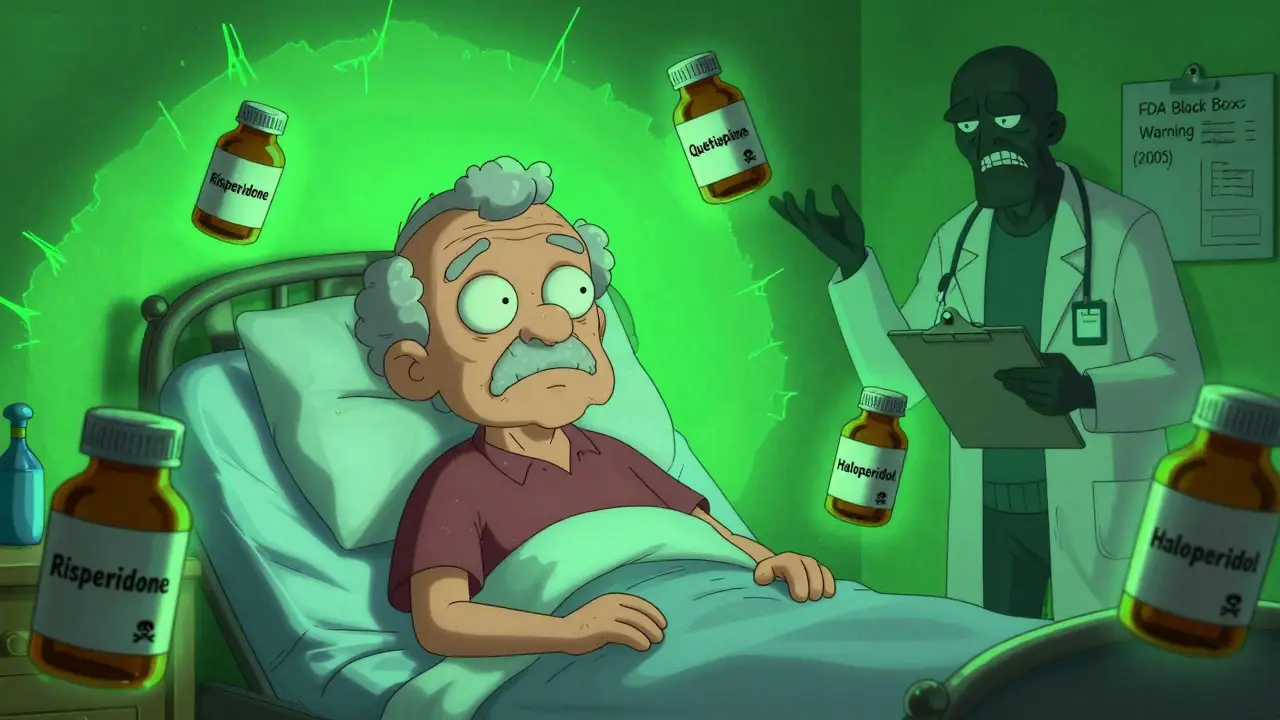
Every year, tens of thousands of seniors with dementia are prescribed antipsychotic drugs to calm agitation, aggression, or hallucinations. It seems like a simple fix: one pill, quieter nights, less stress for caregivers. But behind that easy solution lies a dangerous reality-these medications can double the risk of stroke in older adults with dementia. And the worst part? Many doctors still prescribe them, even though we’ve known this for nearly two decades.
Why Are Antipsychotics Even Used in Dementia?
Dementia doesn’t just mean memory loss. Many people with Alzheimer’s or other forms of dementia develop behavioral and psychological symptoms-things like yelling, pacing, paranoia, or resisting care. These behaviors are terrifying for families and exhausting for staff in nursing homes. When non-drug approaches fail, antipsychotics are often the next step. Drugs like risperidone, olanzapine, quetiapine, and haloperidol are used off-label to suppress these symptoms. But here’s the catch: antipsychotics were never designed for dementia. They were made for schizophrenia and bipolar disorder. Their effects on the aging brain are unpredictable. And the risks? They’re not just theoretical. They’re proven, repeated, and deadly.The FDA Warning That Was Ignored
In 2005, the U.S. Food and Drug Administration slapped a black box warning on every antipsychotic drug-every single one. This is the strongest warning the FDA can give. It said clearly: “Elderly patients with dementia-related psychosis treated with atypical antipsychotic drugs are at an increased risk of death.” The data showed a 60% to 70% higher chance of dying compared to those on a placebo. The biggest killer? Stroke. Not heart failure. Not liver damage. Stroke. And it wasn’t just long-term use. Even a few days on these drugs raised the risk. A 2012 study from the American Heart Association found that just being exposed to antipsychotics made seniors 80% more likely to have a stroke. That’s not a small increase. That’s a red flag flashing in bright neon.Typical vs. Atypical: Does It Even Matter?
You might have heard that newer (atypical) antipsychotics are safer than older (typical) ones. That’s what pharmaceutical companies told doctors for years. But the science says otherwise. A 2023 review in Neurology looked at five major studies. Four of them found that long-term use of older antipsychotics like haloperidol carried a higher stroke risk than newer ones like risperidone. But one study found no difference at all. Another analysis from Johns Hopkins, using Medicare data, showed that while atypical drugs might cause less stroke than typical ones, they still cause a lot-and they still kill. The real problem? Neither class is safe. Both trigger orthostatic hypotension (dangerous drops in blood pressure when standing), worsen metabolic syndrome (leading to diabetes and heart disease), and disrupt dopamine and serotonin systems that control blood flow to the brain. The result? Tiny clots. Blocked arteries. Brain damage.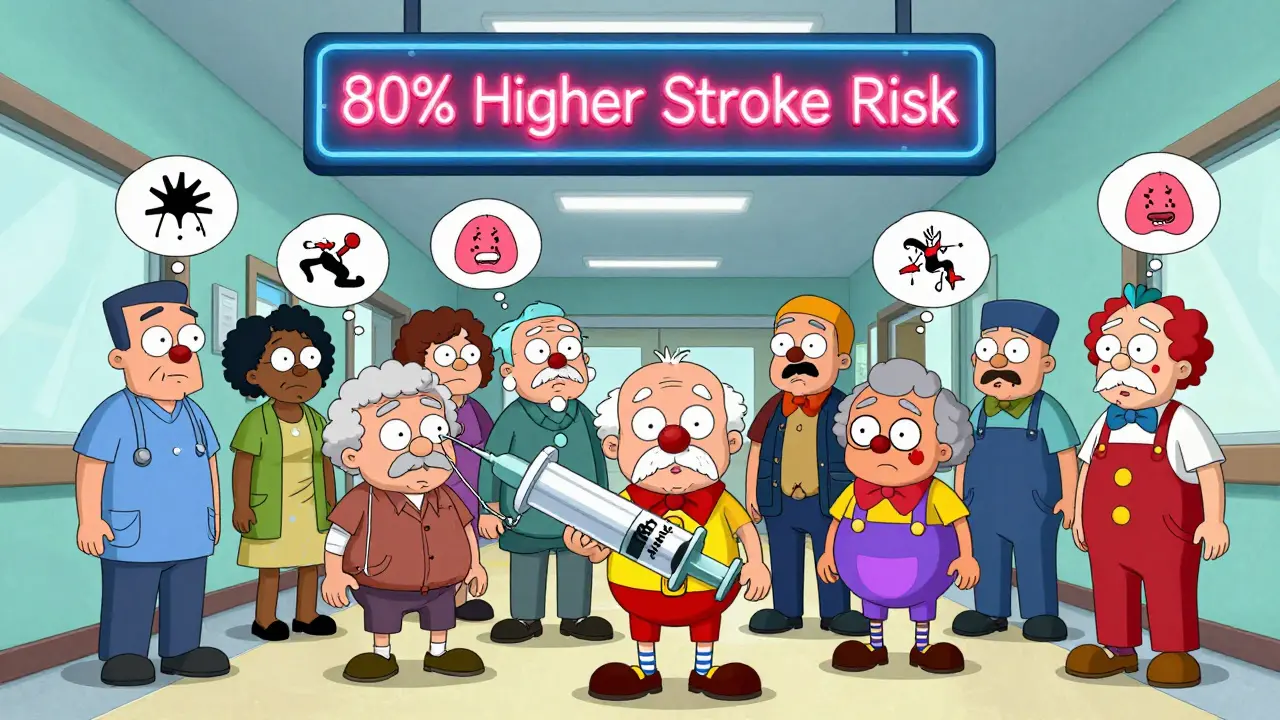
Even Short-Term Use Is Dangerous
Many doctors think, “I’ll just give it for a week or two until things settle down.” That’s what they told me when my aunt was admitted to the nursing home after a fall. She was confused, yelling at shadows. They gave her quetiapine. “It’s just temporary,” they said. But research doesn’t support that idea. The American Heart Association study showed stroke risk jumped within days. No waiting. No buildup. Just exposure. That’s why the American Geriatrics Society’s Beers Criteria-used by every major hospital and pharmacy in the U.S.-says: “Avoid antipsychotics for dementia-related behavioral symptoms. Period.” Yet, in 2025, nearly 1 in 4 nursing home residents with dementia are still on these drugs. Why? Because alternatives are harder. Because families beg for something to work. Because staff are overwhelmed. Because the system is broken.What Happens When You Stop?
Some families hear the risks and ask: “Can we just stop the meds?” Yes-but not without help. Suddenly stopping antipsychotics can cause rebound agitation, hallucinations, or even seizures. The key is a slow, supervised taper. Work with a geriatric psychiatrist or a dementia specialist. Add non-drug strategies first: music therapy, sunlight exposure, consistent routines, reducing noise, checking for pain or infections (which often cause sudden behavioral changes). One study followed 120 seniors who were successfully weaned off antipsychotics. After six months, 78% showed no increase in behavioral symptoms. Many improved. Their families reported better sleep, more engagement, less fear.Non-Drug Alternatives That Actually Work
There’s a myth that behavioral symptoms in dementia are “just part of the disease.” They’re not. Often, they’re signals. - Pain: A resident yelling at 3 a.m. might have a urinary tract infection or a pressure sore. Check for infection first. - Overstimulation: Loud TVs, too many people, flashing lights? Reduce sensory overload. - Unmet needs: Hunger, thirst, boredom, loneliness? These are not “psychiatric”-they’re human. - Environment: Soft lighting, familiar objects, a quiet corner, a favorite blanket. These calm more than any pill. - Music therapy: Studies show personalized playlists reduce agitation more effectively than antipsychotics. - Staff training: Nursing homes with dementia-certified staff report 50% fewer antipsychotic prescriptions. The bottom line? You don’t need drugs to manage dementia behavior. You need time, training, and compassion.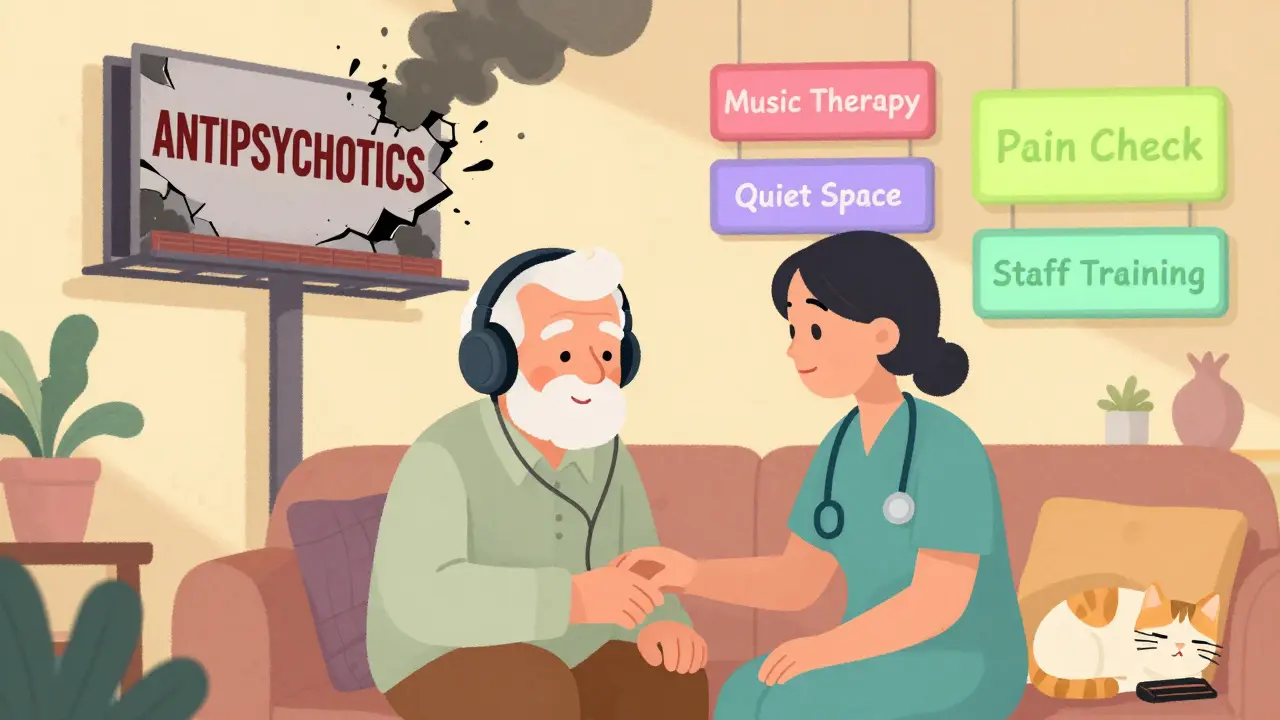
The Hidden Cost: More Than Stroke
Stroke isn’t the only danger. Antipsychotics increase the risk of: - Falls (due to dizziness and low blood pressure) - Pneumonia (from sedation and swallowing problems) - Diabetes and weight gain (especially with atypicals) - Early death (even in people without dementia) A 2020 study of U.S. veterans found that antipsychotic use increased death risk in both dementia and non-dementia seniors. That’s not a side effect. That’s a direct consequence.What You Can Do Right Now
If you’re caring for a senior with dementia:- Ask: “Is this medication necessary? What’s the plan to stop it?”
- Request a full medical review: Check for UTIs, constipation, dehydration, pain, vision/hearing loss.
- Ask for a referral to a geriatric psychiatrist or dementia specialist.
- Push for non-drug interventions before accepting a prescription.
- If they’re already on antipsychotics, ask for a taper plan-not a sudden stop.
Why This Keeps Happening
The system is built for quick fixes. Nursing homes are understaffed. Doctors are rushed. Families are desperate. Antipsychotics are cheap, easy, and fast. Non-drug strategies take time, training, and resources. But here’s the truth: you don’t have to accept this. You can demand better. You can ask for alternatives. You can insist on safety over convenience. The FDA warned us in 2005. The American Geriatrics Society said “avoid” in 2015. Science has only gotten clearer since then. Yet, these drugs are still prescribed like candy. It’s time to change that.Are antipsychotics ever safe for seniors with dementia?
Antipsychotics are never truly safe for seniors with dementia. Even short-term use increases stroke and death risk. The American Geriatrics Society and FDA recommend avoiding them entirely. They should only be considered in extreme cases-like severe aggression that threatens safety-and even then, only after all non-drug options have failed and with close monitoring.
Do atypical antipsychotics have fewer risks than typical ones?
Some studies suggest atypical antipsychotics (like risperidone or quetiapine) may carry slightly lower stroke risk than older drugs like haloperidol. But the difference is small and unreliable. Both types increase stroke risk by 60-80%. Neither is safe. The belief that atypicals are “safer” is outdated and dangerous.
Can antipsychotics cause dementia to get worse?
Yes. Antipsychotics can accelerate cognitive decline. They dull brain activity, which may mask symptoms but also speed up damage. Studies show seniors on these drugs decline faster in memory and thinking skills than those not taking them. The drugs don’t treat dementia-they suppress behavior while the disease keeps progressing.
What should I do if my loved one is already on an antipsychotic?
Don’t stop it suddenly. Talk to their doctor about a slow taper plan. Meanwhile, start non-drug strategies: check for pain or infection, reduce noise and chaos, use calming music, ensure hydration and nutrition. Keep a journal of behavior changes. Many seniors improve after weaning off these drugs, especially with proper support.
Why do doctors still prescribe these drugs if they’re so dangerous?
Because it’s easier. Families are desperate. Staff are overwhelmed. Nursing homes lack training and resources for non-drug care. Many doctors aren’t fully aware of the latest guidelines. And until families push back, the system will keep choosing the quick fix over the right one.
My grandma was on risperidone for 3 months after her dementia got 'worse.' She barely spoke after that. We thought it was the disease. Turns out, it was the drug. We tapered her off slowly with a geriatric psych specialist - and within weeks, she started singing old songs again. She remembered my name. That’s not a side effect. That’s her coming back.
Doctors don’t always know this stuff. But families can push back. You’re not being difficult. You’re being her voice.
stop the pills. try the music. try the sunlight. try holding their hand. it’s not magic. it’s human.
they’re not being difficult. they’re scared. and so are we.
It is well documented that antipsychotic use in elderly dementia patients significantly elevates mortality risk via cerebrovascular events. The FDA black box warning remains underutilized in clinical practice due to systemic pressures in long-term care settings. Non-pharmacological interventions, when properly resourced, demonstrate comparable or superior efficacy in managing behavioral symptoms with markedly reduced morbidity.
Professional guidelines from AGS and NICE are unequivocal: avoid antipsychotics unless imminent harm is present.
Hey, I’m from India and we don’t even have access to these meds in most nursing homes here. But I’ve seen my uncle’s care home in Delhi use music, gentle touch, and routine to calm people down. No pills. Just love and patience. It works. We don’t need fancy drugs - we need better training and more staff. Simple as that.
Let’s not make this harder than it is.
Let’s be real - this isn’t about patient safety. It’s about liability. Pharma knew these drugs killed people. They buried the data. The FDA warning? A PR move. The real reason antipsychotics are still prescribed? Because nursing homes are profit-driven warehouses. They don’t want to pay for trained staff. They want chemical restraints. Cheap. Quiet. Invisible.
And the doctors? They’re complicit. They get kickbacks. They get pressured. They don’t read the studies. They sign the scripts.
This isn’t medical negligence. It’s corporate murder dressed in white coats.
i think this is really important stuff. i’ve seen a friend’s mom go from yelling all day to sitting quietly, smiling, even eating again after they took her off the meds and started playing her favorite country songs every morning.
it’s not perfect. it takes time. but it’s worth it. we just need more people to care enough to try.
thank you for writing this. really.
-p.s. sorry for the typos. typing on my phone at 2am.
The evidence base against antipsychotic use in dementia is robust, consistent, and unequivocal. The persistence of this practice reflects systemic failures in geriatric training, reimbursement structures, and caregiver support infrastructure. Non-pharmacological interventions require investment - in staffing, in education, in time - but they are not only clinically superior, they are ethically imperative.
I urge all clinicians and families to prioritize person-centered care. The alternative is not just ineffective - it is morally indefensible.
Oh, so now we’re blaming Big Pharma and nursing homes? Let me guess - you also think vaccines cause autism and 5G is mind control.
Antipsychotics are lifesavers for families who can’t handle a 90-year-old screaming at the wall because he thinks his wife is stealing his socks. You think music therapy is going to stop someone from throwing a TV? Wake up.
And let’s not pretend doctors are dumb. They know the risks. They prescribe these because they’re the *least bad* option. You want to save grandma? Pay $15,000 a month for a private dementia unit with 1:1 staff. Or shut up and let the professionals do their job.
my uncle got off the meds and started dancing in the hallway 😭🎶
music > pills any day
❤️
THIS is why America is falling apart. We’ve turned our grandparents into chemical zombies because we’re too lazy to hold their hands. We outsource care to corporations that treat people like inventory. And now you want to blame the doctors? No. We let this happen. We stopped caring. We stopped visiting. We stopped fighting.
It’s not the system. It’s us.
And we deserve what we got.
Wow. Another feel-good article from someone who’s never held a dementia patient who tried to climb out the window at 3am.
Music therapy? Really? You think playing Frank Sinatra is going to stop someone from hitting staff? That’s not compassion. That’s delusion.
The only thing worse than antipsychotics? An untrained caregiver with a clipboard and zero authority. You don’t get to romanticize caregiving when the person you’re ‘loving’ is trying to bite your arm off.
Real talk: sometimes, you need the pill. And if you don’t like it? Go work in a nursing home for a week. Then come back and tell me how ‘simple’ this is.
I’ve worked in geriatric care for 18 years. I’ve seen the damage these drugs do. I’ve also seen the chaos when they’re pulled too fast.
The truth is in the middle. We need to stop vilifying doctors and start funding real alternatives - trained staff, better pay, dementia-certified units, and time. No one wins when we treat this like a pill problem.
It’s a human problem.
And we’re all part of it.