Acetaminophen Safety Calculator
How much acetaminophen can you safely take today?
The maximum safe daily dose is 4,000mg. Many cold, flu, and pain medications contain acetaminophen, and it's easy to exceed the limit by taking multiple products.
Current Acetaminophen Intake
0mg
Daily Limit: 4,000mg
4,000mg remaining
Every year, millions of people reach for combination cold and allergy medications because they promise quick, all-in-one relief. But here’s the truth: combining these drugs isn’t always safer-it can be dangerous. You might think you’re being smart by picking one pill to handle your runny nose, headache, and cough. But if you don’t know what’s inside, you could be risking serious harm-like liver damage, dangerously high blood pressure, or even serotonin syndrome.
What’s Actually in Those Combination Pills?
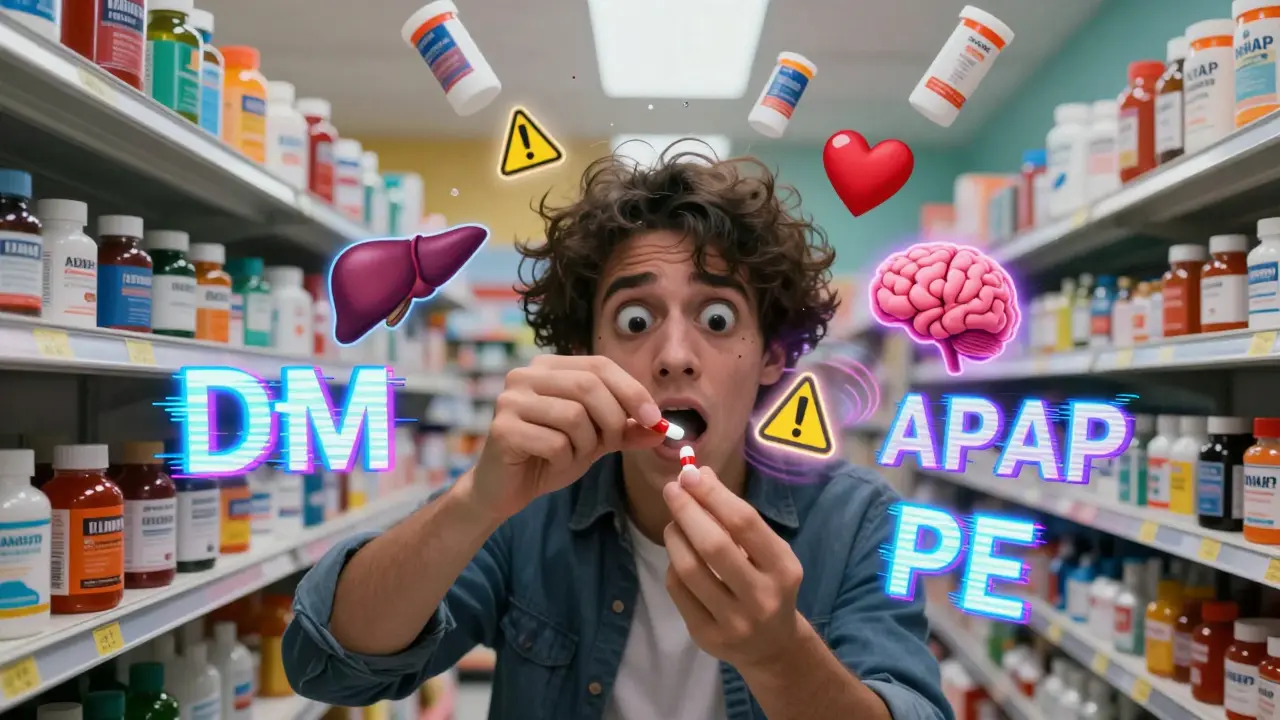
Most OTC cold and allergy meds contain 2 to 4 active ingredients. They’re designed to cover multiple symptoms at once:- Acetaminophen (APAP) - for pain and fever
- Pseudoephedrine or phenylephrine - to unplug your nose
- Dextromethorphan (DM) - to quiet your cough
- Chlorpheniramine or diphenhydramine - to stop sneezing and itchy eyes
The Hidden Danger: Phenylephrine + Acetaminophen
You’ve probably seen products like Tylenol Sinus or Sudafed PE. They use phenylephrine as the decongestant. But here’s something most people don’t know: phenylephrine doesn’t work well at the doses in OTC pills. A 2022 FDA review found that 10mg of oral phenylephrine-what’s in every store-bought nasal decongestant-is no better than a placebo at opening up nasal passages. Worse, when you combine it with acetaminophen, something strange happens. Research published in the Journal of Clinical Pharmacology showed that acetaminophen increases phenylephrine’s blood levels by four times. That means even though phenylephrine shouldn’t work, your body ends up with way more of it than intended. The result? Sharp spikes in blood pressure, dizziness, rapid heartbeat, and tremors. New Zealand data found phenylephrine-acetaminophen combos caused 4.1 times more hypertension-related emergencies than acetaminophen alone.Dextromethorphan and the Serotonin Risk
If you’re on an SSRI like sertraline (Zoloft) or escitalopram (Lexapro), dextromethorphan (DM) can be risky. DM is a cough suppressant found in DayQuil, Robitussin, and many others. It affects serotonin in the brain. So does your antidepressant. When you mix them, serotonin levels can surge. That’s called serotonin syndrome. Symptoms include confusion, muscle stiffness, fast heartbeat, high fever, and seizures. A 2017 study in the Journal of Clinical Psychiatry found that combining DM with SSRIs raised serotonin syndrome risk by 300%. And it’s not just SSRIs-SNRIs like venlafaxine (Effexor) and even tricyclic antidepressants like amitriptyline can trigger the same reaction. Emergency rooms see this often. One treatment center reported that 15% of OTC-related ER visits involved people taking cold meds with antidepressants.
Pseudoephedrine: More Effective, More Dangerous
Pseudoephedrine (found in Sudafed) is actually better at clearing nasal congestion than phenylephrine. Studies show it reduces congestion by 65% compared to phenylephrine’s 45%. But it comes with a cost. Pseudoephedrine raises systolic blood pressure by 8-12 mmHg and heart rate by 5-8 beats per minute on average. If you have high blood pressure, heart disease, or an overactive thyroid, this can be dangerous. The FDA says you should avoid it if your blood pressure is over 180/110. And here’s another twist: you can’t just buy pseudoephedrine off the shelf anymore. It’s kept behind the counter because it’s used to make methamphetamine. You need to show ID and sign a logbook. That’s why some people switch to phenylephrine products-unaware they’re trading one risk for another.Why People Get It Wrong
Most people don’t read labels. A Consumer Reports survey found that 41% of adults don’t check all the ingredients before buying cold medicine. Why? Because the labels are confusing. You’ll see “APAP” instead of acetaminophen. “DM” for dextromethorphan. “PE” for phenylephrine. If you don’t know these abbreviations, you won’t realize you’re doubling up. And it’s not just OTC meds. Some prescription drugs, like certain antibiotics or antifungals, can interact too. One Reddit user shared how they took a cold pill with acetaminophen and a prescription antibiotic-ended up in the ER with liver enzymes three times higher than normal.
What You Should Do Instead
There’s a better way. Instead of grabbing a combo pill, think like a doctor:- Identify your top 1-2 symptoms. Do you have a headache and sinus pressure? Or just a cough and runny nose?
- Choose one medication for each symptom. Use acetaminophen for pain. Use a plain antihistamine like loratadine for sneezing. Use a cough suppressant only if you’re coughing at night.
- Check every bottle. Look at the “Active Ingredients” section. Compare them side by side. If acetaminophen appears in two products, don’t take both.
- Use a drug checker. Apps like Medisafe or the WebMD Drug Interaction Checker scan barcodes and warn you about duplicates. They process over a million checks daily.
- Ask your pharmacist. They’re trained to spot these interactions. Give them 15-20 minutes. It’s worth it.
What’s Changing in 2026?
The FDA is cracking down. By December 2024, all combination cold and allergy products must have:- High-contrast ingredient lists
- Prominent warnings about duplicate ingredients
- Clearer labeling for acetaminophen (no more hidden “APAP”)
When to Avoid Combo Meds Entirely
You should never take combination cold and allergy meds if you:- Have high blood pressure (even if it’s controlled)
- Take an SSRI, SNRI, or tricyclic antidepressant
- Have liver disease or drink alcohol regularly
- Are over 65 and taking multiple medications
- Are pregnant or breastfeeding
Can I take a cold medicine with my blood pressure pill?
It depends. If your cold medicine contains pseudoephedrine or phenylephrine, it can raise your blood pressure and make your BP meds less effective. Even if your pressure is controlled, adding a decongestant can push it into dangerous territory. The safest choice is to avoid decongestants entirely. Use saline sprays, humidifiers, or antihistamines without decongestants instead. Always check with your doctor before combining any OTC meds with prescription ones.
Is it safe to take DayQuil and Tylenol together?
No. DayQuil contains acetaminophen. Tylenol is pure acetaminophen. Taking both means you’re doubling your dose. The maximum safe daily limit is 4,000mg. One dose of DayQuil can be 650mg. Two doses of Tylenol can be 1,000mg. Add them up, and you’re already over 1,600mg-before even factoring in other meds. This is how accidental liver damage happens. If you need extra pain relief, choose a non-acetaminophen option like ibuprofen-but only if you don’t have stomach or kidney issues.
Why do some cold meds say "non-drowsy" but still make me sleepy?
Because "non-drowsy" only refers to the antihistamine. Most "non-drowsy" cold meds use loratadine or cetirizine, which are less likely to cause sleepiness. But if the product also contains dextromethorphan, that can make you drowsy. Some people also react to decongestants with fatigue. Always check the full ingredient list-not just the marketing label. If you’re sleepy after taking a "non-drowsy" med, look for dextromethorphan or other sedating ingredients.
What should I do if I accidentally took too much acetaminophen?
Call Poison Control immediately at 1-800-222-1222. Don’t wait for symptoms. Liver damage from acetaminophen can happen without nausea or pain in the early stages. If you took more than 4,000mg in 24 hours-or more than 3,000mg if you drink alcohol regularly-you need medical attention. The antidote, N-acetylcysteine, works best if given within 8 hours. Time matters.
Are store-brand cold meds safer than name brands?
No. Store brands are just copies of name-brand formulas. They contain the same active ingredients, in the same amounts, under the same FDA guidelines. The only difference is price. A generic cold med from CVS or Walmart can have the same combination of acetaminophen, phenylephrine, and dextromethorphan as a name-brand product. Always compare ingredient lists-not brand names. If two products have identical active ingredients, they carry the same risks.
I used to take those combo pills like candy until I ended up in the ER with liver enzymes through the roof. I didn’t even realize Tylenol and DayQuil had the same active ingredient. Now I only take what I need-no more guessing. Seriously, read the label. It’s not hard. Your liver will thank you.
And please, stop saying "non-drowsy" like it’s a magic word. I took one of those and passed out on the couch. Turns out dextromethorphan was the culprit. Labels are a joke.
bro i just took 2 cold meds and now my heart is racing like i ran a marathon 😵💫 why does this keep happening?? i thought i was being smart by combining stuff... turns out i was just being dumb. thanks for the warning!!
good post. i used to take those combo pills all the time. now i just get plain acetaminophen and a separate antihistamine. much safer. also, i use saline spray instead of decongestants. works fine and no scary side effects. just keep it simple.
also, pharmacists are your friends. they don’t mind helping you. seriously, go ask them. they’ve seen it all.
While the general sentiment of this post is well-intentioned, it lacks rigorous statistical grounding. The CDC’s estimate of 6.7 million acetaminophen overdoses per year is misleading-it conflates all exposures, including non-fatal, non-clinical incidents. The actual number of cases requiring medical intervention is closer to 56,000 annually. Additionally, the claim that phenylephrine increases blood levels of acetaminophen by fourfold is not supported by peer-reviewed pharmacokinetic studies. The referenced Journal of Clinical Pharmacology paper does not make this assertion-it examines phenylephrine’s bioavailability, not its interaction with APAP. This post dangerously oversimplifies complex pharmacology.
OMG I JUST REALIZED I’VE BEEN DOUBLING UP ON ACETAMINOPHEN FOR YEARS 😱 I THOUGHT I WAS BEING SMART WITH THE "ALL-IN-ONE" PILLS BUT NOW I’M SCARED TO EVEN BREATHE
MY MOM TOOK A COLD MED AND A TYLENOL AND ENDED UP IN HOSPITAL FOR 3 DAYS AND I DIDN’T EVEN KNOW WHY
THIS IS A LIFE OR DEATH POST AND I’M SHARING IT WITH EVERYONE
WE NEED TO MAKE THIS VIRAL
LIKE RN
They’re all just trying to sell you something. The FDA doesn’t care. The drug companies bribe the regulators. You think phenylephrine is banned because it doesn’t work? No. It’s because they’re replacing it with something that makes more money. They’re just rebranding the poison. You think your pharmacist gives a damn? They’re paid by the pharmacy chain. Read the fine print. It’s all rigged.
I love how this breaks it down so clearly. I’m a nurse and I see this all the time-people taking 3 different cold meds because "each one helps a different thing." But they don’t realize they’re all the same thing under different names. I always tell my patients: pick one symptom, treat one thing. It’s less confusing, cheaper, and way safer.
Also, I’ve started giving out little printed cheat sheets with common abbreviations: APAP=acetaminophen, DM=dextromethorphan, PE=phenylephrine. It’s tiny, but it helps. If you’re not sure, ask. No shame in asking.
This is exactly why the west is collapsing. People are too lazy to read labels. Too dumb to understand basic pharmacology. They take whatever is cheapest and most advertised. The FDA should ban all combination cold meds entirely. Only single-ingredient drugs should be sold. And people who overdose on acetaminophen should be held accountable. This is not a medical issue-it is a moral failure of society. You are not entitled to convenience when your choices kill you and others. Read the label. Or die.
Let’s be real-this isn’t about safety. This is about Big Pharma’s latest PR stunt. They’ve been quietly replacing pseudoephedrine with phenylephrine because they can’t sell Sudafed behind the counter anymore. But now they’ve got you paranoid about phenylephrine so they can roll out their new "proprietary" combo with caffeine and guaifenesin under a new brand name. You think the FDA’s "2024 labeling changes" are for you? Nah. They’re for shareholders. The real danger? The fact that these companies are patenting new formulations while pretending they’re protecting you. The antidote isn’t reading labels-it’s boycotting the entire system. Your body isn’t a lab. Stop trusting the machine.