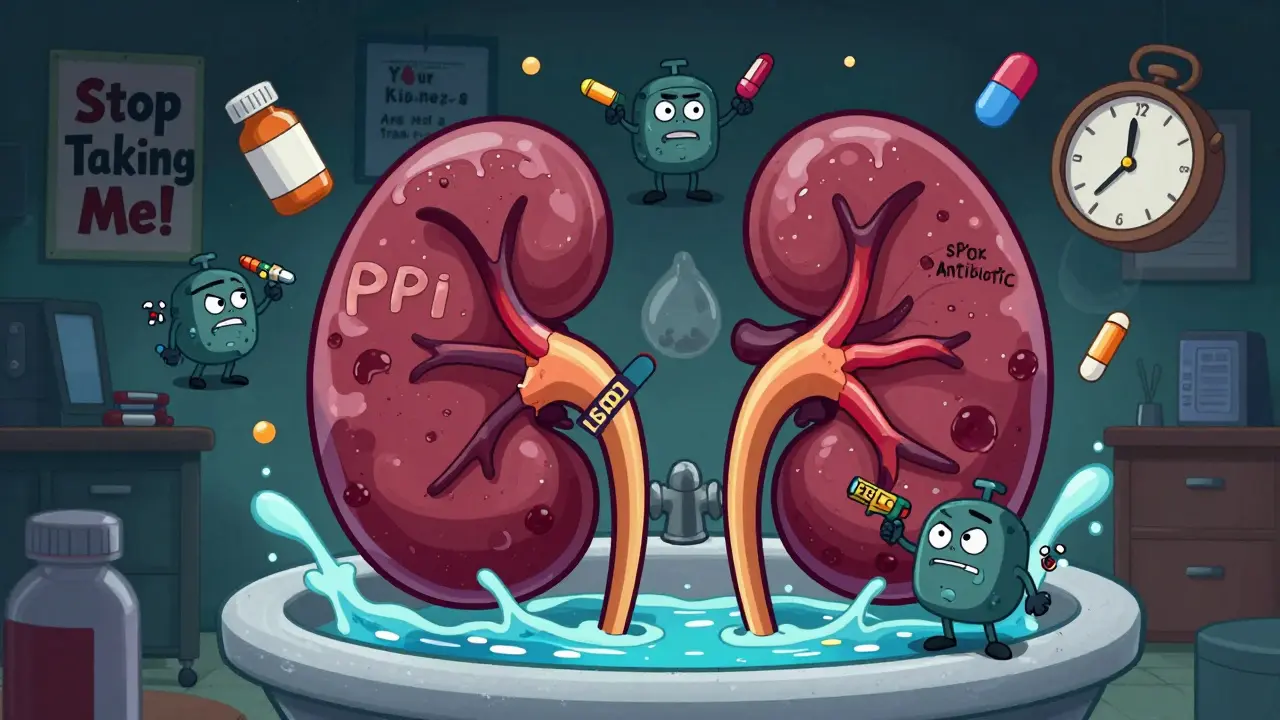
Every year, thousands of people wake up feeling tired, nauseous, or just "off"-only to find out their kidneys are inflamed. Not from infection, not from dehydration, but from something they took every day without a second thought: a common medication. Acute interstitial nephritis (AIN) is one of the most underdiagnosed kidney conditions out there, and drugs are behind most of it. It doesn’t always come with a rash or fever. Sometimes, it just sneaks in, quietly damaging your kidneys over weeks or months. And by the time it’s caught, the damage might already be lasting.
What Exactly Is Acute Interstitial Nephritis?
AIN isn’t a disease you catch like a cold. It’s your immune system overreacting to a drug. Normally, your kidneys filter waste, balance fluids, and regulate blood pressure. Inside them, tiny structures called tubules and the space around them-the interstitium-do most of the work. When a drug triggers AIN, your body sends immune cells into that space. They swell it up. They attack the tubules. And suddenly, your kidneys can’t filter properly.
Think of it like a clogged drain in your sink. The water (urine) can’t flow out. Waste builds up. Creatinine rises. GFR drops. You might feel fine, but your kidneys are struggling. About 5 to 15% of people admitted for sudden kidney failure have AIN. And in most cases-60 to 70%-it’s because of a medication.
Which Drugs Are Most Likely to Cause It?
There are over 250 drugs linked to AIN. But three classes stand out:
- Proton pump inhibitors (PPIs) like omeprazole, pantoprazole, and esomeprazole. Once thought to be harmless, these are now the second most common cause of AIN. A 2022 international registry found they triggered 38% of cases. People often take them for years for heartburn, never suspecting their kidneys are paying the price.
- Antibiotics-especially penicillins, cephalosporins, sulfonamides, and ciprofloxacin. These cause about 29% of cases. They tend to trigger faster reactions-sometimes within days-and are more likely to come with classic signs like fever, rash, or eosinophilia.
- NSAIDs like ibuprofen, naproxen, and celecoxib. These make up 22% of drug-induced AIN cases. They’re sneaky. People take them daily for arthritis or headaches. The damage builds slowly, often after 6 to 12 months of use. These cases are more likely to leave permanent kidney damage.
Other triggers include immune checkpoint inhibitors (used in cancer therapy), diuretics, and even some herbal supplements. The common thread? Long-term use. Older adults on multiple medications are at highest risk. Someone over 65 taking a PPI, an NSAID, and an antibiotic? Their risk is more than three times higher than someone on just one drug.
Why Is It So Hard to Diagnose?
AIN doesn’t scream for attention. It whispers.
You might feel fatigued. Lose your appetite. Have mild nausea. Maybe a low-grade fever. Your urine output drops. Your blood tests show rising creatinine. Your doctor thinks, "Dehydration? UTI?" And that’s where it gets missed.
The classic "hypersensitivity triad"-rash, fever, and eosinophilia-shows up in fewer than 10% of cases. A rash appears in 15 to 50% of people, but it’s often mistaken for an allergic reaction to something else. Eosinophils in the urine (eosinophiluria) sound like a clear sign, but the test isn’t reliable enough to rule AIN in or out.
That’s why the only way to be sure is a kidney biopsy. A tiny sample taken through a needle shows the immune cells invading the kidney tissue. It’s invasive. It’s scary. But without it, you’re guessing. And guessing can cost you kidney function.

What Happens After You Stop the Drug?
Stopping the trigger is the single most important step. In fact, the American Society of Nephrology says it’s non-negotiable. If you’re on omeprazole and your creatinine spikes, you need to stop it-fast. Waiting even a few extra days can make recovery slower or incomplete.
Here’s what recovery looks like, based on real patient data:
- Antibiotic-induced AIN: Most people start feeling better within 72 hours of stopping the drug. Full recovery happens in about 14 days on average. Around 75% regain normal kidney function.
- NSAID-induced AIN: Recovery takes longer-about 28 days. But the big problem? Only 58% get back to normal. The rest are left with permanent damage.
- PPI-induced AIN: Even though the inflammation might be milder, recovery is the slowest-around 35 days. And only 50 to 60% of patients fully recover. That’s worse than antibiotics, despite less dramatic symptoms.
A 63-year-old woman in Florida developed AIN after taking omeprazole for 18 months. She didn’t have a rash or fever. Just fatigue and swelling. Her creatinine hit 4.2. She needed dialysis for three weeks. A year later, her kidney function was still at 45%-down from 90%. She’s not alone.
When Do You Need Steroids?
This is where things get controversial.
No large randomized trial has proven corticosteroids work. But in practice, doctors use them anyway-especially if your kidney function is below 30 mL/min or if you’re not improving after 72 hours of stopping the drug.
Typical protocol: Start with methylprednisolone (0.5-1 mg per kg of body weight) for 2 to 4 weeks. Then switch to oral prednisone and slowly taper over 6 to 8 weeks. It’s not magic. But studies show it helps. One study found patients on steroids were 40% more likely to recover full kidney function than those who didn’t get them.
Still, steroids aren’t for everyone. They raise blood sugar, weaken bones, and can cause mood swings. Your doctor will weigh the risks. But if your kidneys are failing, the trade-off is worth it.
What’s the Long-Term Outlook?
Here’s the hard truth: even if you recover, your kidneys might never be the same.
A 2023 study found that 30% of AIN patients develop chronic kidney disease (stage 3 or higher) within a year. NSAID-related cases are the worst-42% progress to long-term damage. PPIs? Still risky. Antibiotics? Better odds, but not guaranteed.
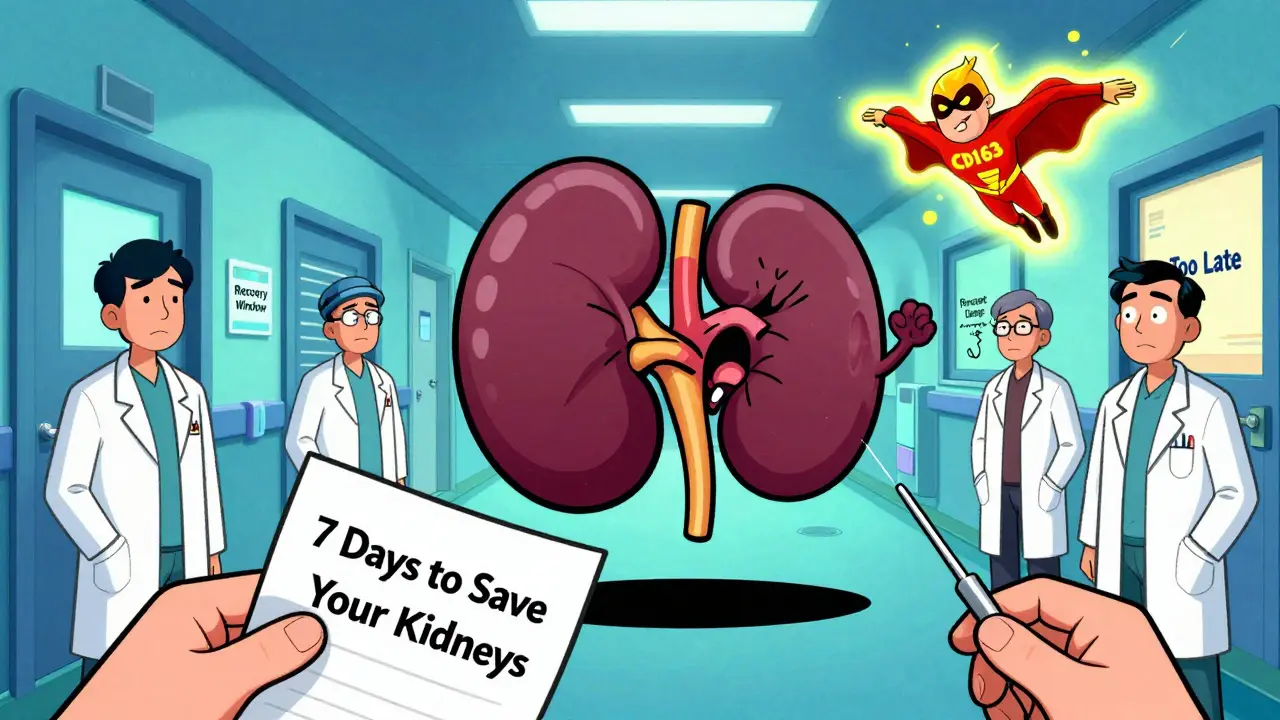
Why does this happen? Because inflammation leaves scars. Fibrosis. Dead tissue. Once it’s there, your kidney can’t regenerate it. That’s why timing matters so much. If you’re diagnosed within 7 days of symptoms starting, your chance of full recovery jumps by 35%. Wait two weeks? That window closes.
Who’s Most at Risk?
You’re more likely to get AIN if you:
- Are over 65 years old
- Take five or more medications daily
- Have preexisting kidney disease
- Use PPIs for more than 6 months
- Take NSAIDs regularly for pain or arthritis
And here’s something many don’t realize: AIN is rising. Between 2010 and 2020, drug-induced cases went up 27%. Why? Because PPIs are everywhere. Over 150 million prescriptions are filled each year in the U.S. alone. Most are unnecessary. Many are taken for years without review.
What Should You Do If You’re Concerned?
Don’t panic. But do pay attention.
If you’re on any of these drugs and notice:
- Unexplained fatigue
- Swelling in your legs or face
- Less urine than usual
- Nausea without stomach upset
- A rise in creatinine on a recent blood test
-talk to your doctor. Ask: "Could this be AIN?" Request a urine test for eosinophils. Ask if your kidney function has changed. If your doctor dismisses it, get a second opinion. Nephrologists specialize in this. Don’t wait.
And if you’re on a PPI or NSAID long-term, ask your doctor if you still need it. Many people take these drugs out of habit, not necessity. A 2021 FDA warning flagged PPIs as a growing cause of kidney injury. It’s time to reassess.
What’s Next for Diagnosis and Treatment?
Researchers are working on non-invasive tests. A biomarker called urinary CD163 showed 89% accuracy in detecting AIN in a 2022 study. If it gets approved, it could replace biopsies in many cases. That’s huge.
Meanwhile, doctors are becoming more aware. More labs now routinely check kidney function in older patients on long-term meds. More pharmacists are flagging high-risk combinations.
But the biggest change? Patient awareness. If you know the signs, you can push for answers. You can ask for a biopsy. You can say no to unnecessary drugs. You can protect your kidneys before it’s too late.
Can acute interstitial nephritis be reversed completely?
Yes, in many cases-especially if caught early. About 70 to 80% of patients recover most or all kidney function if the triggering drug is stopped quickly and treatment starts within 7 days. But recovery isn’t guaranteed. NSAID and PPI-induced cases are more likely to leave lasting damage, even after the drug is stopped. About 30% of all AIN patients develop chronic kidney disease within a year.
How long does it take to recover from drug-induced AIN?
Recovery time depends on the drug. Antibiotic-induced cases often improve in 72 hours and fully recover in about 14 days. NSAID-induced AIN takes longer-around 28 days on average. PPI-induced cases are the slowest, with median recovery at 35 days. The key is stopping the drug as soon as possible. Every extra day of exposure increases the risk of permanent damage.
Are proton pump inhibitors (PPIs) really dangerous for kidneys?
Yes, increasingly so. PPIs like omeprazole and pantoprazole are now the second most common cause of acute interstitial nephritis, behind antibiotics. Studies show they cause 38% of drug-induced AIN cases. Even though symptoms may be milder, recovery rates are lower-only 50 to 60% of patients regain full kidney function. The FDA issued a safety warning in 2021 after reviewing over 1,200 reported cases. Long-term use, especially without medical need, significantly raises risk.
Do I need a kidney biopsy to diagnose AIN?
Yes, currently. Blood tests and urine tests can suggest AIN, but they can’t confirm it. A kidney biopsy is the only way to see the immune cells and inflammation in the kidney tissue. While newer biomarkers like urinary CD163 show promise and may reduce the need for biopsies in the future, they’re not yet standard. If your doctor suspects AIN, a biopsy is the gold standard for diagnosis.
Can I take NSAIDs again after having AIN?
Generally, no. If you’ve had AIN triggered by an NSAID, you should avoid all NSAIDs permanently. Re-exposure carries a very high risk of recurrence-and often worse damage. Even if your kidneys recovered, the inflammation can return quickly. Your doctor will likely recommend acetaminophen for pain instead. Always check with your nephrologist before taking any new medication.
AIN? More like AIN’t diagnosed till it’s too late. PPIs are the new smoking. Everyone’s on ‘em. Docs don’t check creatinine. Lazy. My aunt’s GFR dropped to 38 after 2 years of omeprazole. No rash. No fever. Just ‘you’re old, deal with it.’ 😒
Oh honey, let me tell you about my ex-husband’s nephrologist-this isn’t medicine, it’s corporate negligence dressed in white coats. PPIs are a $10B scam peddled by Big Pharma’s PR arm. They market heartburn as a crisis so you’ll swallow pills like candy. Meanwhile, kidneys turn to Swiss cheese. 🤡 I stopped mine cold turkey after reading this. My creatinine’s down 0.7 in 3 weeks. No steroids. Just common sense. 🌿
It is not merely a matter of pharmacological toxicity, but of systemic diagnostic neglect. The absence of a randomized controlled trial validating corticosteroid efficacy does not negate the clinical consensus-nor does it absolve the medical community of its obligation to intervene preemptively. The data on fibrotic progression post-AIN is unequivocal. To delay biopsy is to gamble with renal parenchyma. This is not anecdote; it is pathophysiology.
THEY KNOW. THEY KNOW PPIs are killing people. That’s why they make them OTC. It’s a slow genocide. 🇺🇸 They don’t want you healthy-they want you dependent. I saw a video on TikTok where a guy’s kidneys failed after 18 months of Prilosec. He was 42. No warning. No recall. 🤬 #BigPharmaLies #StopPPIs
Man, I used to pop ibuprofen like M&Ms for back pain. Then my creatinine jumped from 1.0 to 2.1. No pain, no warning-just a lab slip that said ‘see nephrologist.’ Turned out it was NSAID-induced AIN. Stopped everything. Got steroids. Took 6 weeks to feel human again. Now I use heat packs and PT. I’ll never touch NSAIDs again. Seriously-ask your doc if you *really* need that daily pill. Your kidneys don’t text you when they’re crying.
Wait-so you’re telling me that the same pills I’ve been taking for ‘acid reflux’ since 2017 are slowly killing my kidneys?? And no one told me?? My doctor just said ‘it’s fine’ every time I asked!! I’m 58, on 7 meds, and now I’m supposed to get a BIOPSY?? This is insane!! I’m canceling my next appointment until I get a second opinion!!
Hey everyone-just wanted to say this thread is so important. I’m a nurse in a geriatric unit, and I’ve seen this too many times. Grandmas on PPIs for 10 years. Grandpas on NSAIDs for arthritis. No one checks kidney function unless they’re in the ER. We need better protocols. Not blame. Not panic. Just better screening. If you’re over 60 and on meds-ask for a urine microalbumin and eGFR every 6 months. It’s free. It’s easy. It could save your kidneys.
It’s strange, isn’t it? We’ll take a pill to fix a symptom we don’t even understand… and never ask what it’s doing to the rest of us. The body isn’t a machine with replaceable parts. It’s a symphony. One wrong note-like a PPI-can echo for years. Maybe the real question isn’t ‘can it be reversed?’ but ‘why did we let it get this far?’ 🌱
As a physician from India, I see this daily. Elderly patients on multiple medications, often prescribed without follow-up. We lack resources for biopsies, so we rely on clinical suspicion. This article is a wake-up call for global practice. PPIs are overprescribed everywhere-not just in the U.S. We need global guidelines. And patient education must begin in primary care, not emergency rooms.
My dad had AIN from naproxen. Took him 4 months to recover. Now he’s on a strict no-NSAID list. But here’s the thing-he didn’t even know what ‘interstitial’ meant. Neither did his doctor until the biopsy. So if you’re reading this? Don’t wait for a textbook to explain it. Ask. Push. Google ‘eosinophiluria.’ Print this post. Hand it to your doc. Your kidneys don’t get a second chance.