Visual Dosing Calculator
Dose Conversion Calculator
Calculate correct medication doses between milliliters, teaspoons, and tablespoons to avoid dosing errors
Enter a dose and select a unit to see the conversion.
Important Safety Note
Kitchen spoons are not accurate. A teaspoon holds approximately 4.92 mL, not 5 mL. A tablespoon holds approximately 14.79 mL, not 15 mL. Using kitchen utensils can lead to dangerous dosing errors, especially for children and seniors.
Why Visual Aids Are Critical
The article states that using visual dosing aids can reduce medication errors by up to 55%. Standard kitchen spoons have error rates of 10% or more, while visual dosing tools are accurate 95-98% of the time.
Why Visual Dosing Aids Save Lives
Every year in the U.S., over 1.5 million people are harmed by medication errors. Many of these mistakes happen because someone guessed the dose-used a kitchen spoon, misread a tiny label, or panicked during an emergency. Visual dosing aids aren’t fancy gadgets. They’re simple tools designed to make the right dose impossible to miss. Think of them as GPS for medicine: if you can see it, you can’t get it wrong.
Take pediatric care. A child’s dose isn’t just a fraction of an adult’s-it changes every few months as they grow. In places with limited resources, nurses used to calculate doses by hand, often with paper and pencil. One wrong decimal point could mean underdosing a child with HIV meds or overdosing them with antibiotics. Then came the Visual Dosing Aid (VDA): a syringe with color-coded bands matching weight ranges. No math needed. Just match the child’s weight to the color, and pull the plunger to the line. Errors dropped by more than half.
How Syringes Are Built for Accuracy
Not all syringes are created equal. A regular insulin syringe has fine lines spaced every 0.01 mL. That’s too small for a tired parent at 3 a.m. or a nurse rushing after a code blue. Visual dosing syringes fix that.
Look for these features:
- Enlarged, bold numbers-no squinting needed
- Contrast backgrounds-black lines on white, or yellow on blue
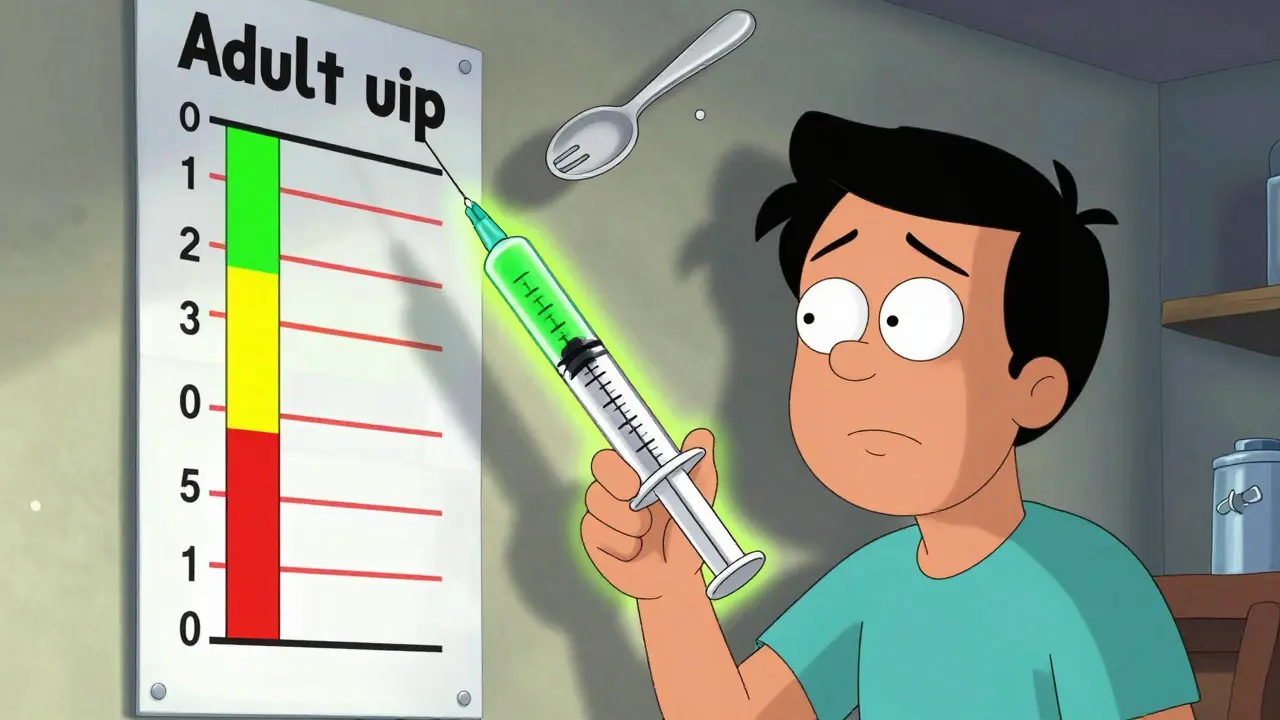
- Color zones-green for safe, yellow for caution, red for danger
- Minimal markings-only the doses you actually use, like 0.5 mL, 1 mL, 2 mL
One study showed that when radiologists gave epinephrine during a simulated allergic reaction, those using visual syringes made errors just 18.2% of the time. Those using standard syringes? 40%. And they did it 55 seconds faster.
These aren’t just for hospitals. Pharmacies now sell visual syringes over the counter for home use. If you’re giving your child liquid medicine every 6 hours, or managing your own blood thinner, this isn’t a luxury-it’s a safety net.
Droppers That Don’t Lie
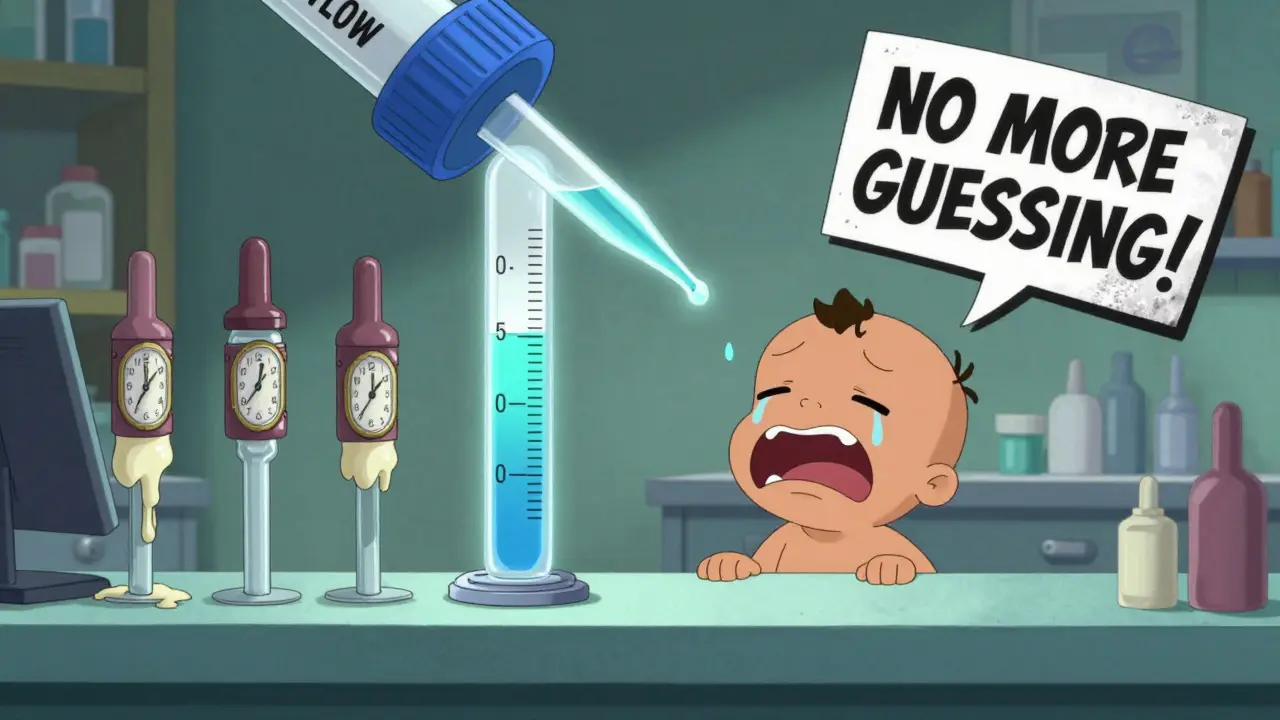
Droppers are everywhere. Baby medicine, eye drops, even some CBD oils. But most droppers? They’re terrible. The rubber bulb stretches. The glass tube bends. You squeeze too hard. You think you got 5 mL, but you got 8.
Modern visual droppers solve this with:
- Transparent measurement windows-you see the liquid level clearly
- Fixed-volume tips-some only hold one exact dose, like 0.5 mL
- Color-changing indicators-the tip turns blue when you’ve drawn the right amount
One parent in Florida told me she switched from a regular dropper to a visual one after her toddler got sick twice from overdosing on fever medicine. “I thought I was careful,” she said. “But I wasn’t. The new one doesn’t let me guess.”
Some droppers even come with a built-in measuring cup that snaps onto the bottle. No pouring, no spills, no confusion. Just twist, draw, and give.
Measuring Cups and Oral Dosing Tools
Kitchen spoons are the #1 cause of pediatric dosing errors. A teaspoon isn’t 5 mL-it’s usually closer to 4.5 mL. And a tablespoon? That’s 15 mL, not 5. Yet people use them all the time.
Visual dosing cups fix this with:
- Large, raised markings-easy to read from any angle
- Spout design-prevents spills when pouring
- Multi-dose scales-shows 1 mL, 2.5 mL, 5 mL, 10 mL
- Non-slip bases-stays put on countertops
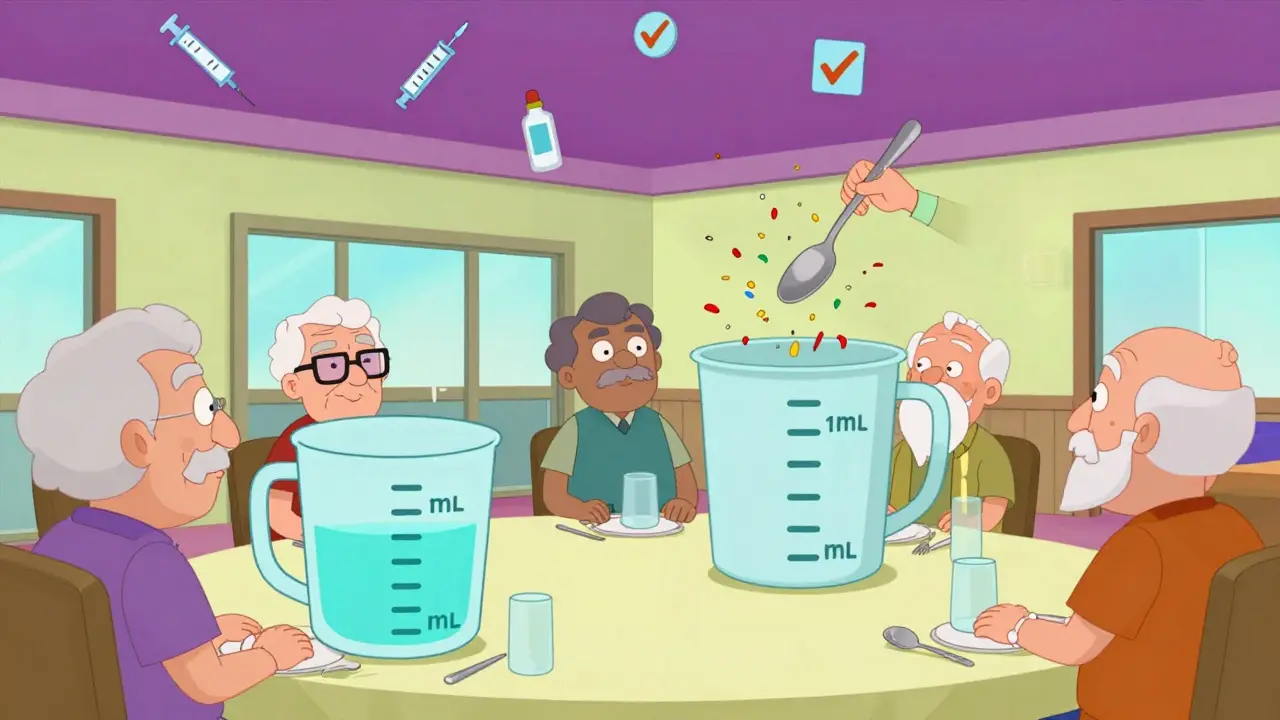
These aren’t just for kids. Elderly patients with shaky hands or vision problems rely on them too. One nursing home in Miami switched all its oral meds to visual cups. Within six months, reported dosing errors dropped by 62%.
Some even have audio cues-soft beeps when the correct volume is reached. But even without tech, the visual design alone makes a huge difference.
What Works Best? A Quick Comparison
| Tool | Best For | Accuracy | Training Needed | Common Errors Avoided |
|---|---|---|---|---|
| Visual Syringe | Injectables, precise liquids (antibiotics, insulin) | 98%+ when used correctly | Minimal | Wrong volume, misreading lines |
| Visual Dropper | Infants, eye drops, small doses under 10 mL | 95%+ with fixed-tip models | None | Over-squeezing, inconsistent drops |
| Measuring Cup | Oral liquids, multiple doses per day | 96%+ | None | Using kitchen spoons, spilling |
| Standard Syringe/Dropper | General use | 60-70% | High | All of the above |
Bottom line: if you’re measuring liquid medicine, don’t use anything without clear, visual markings. The difference isn’t just convenience-it’s safety.
Why Visual Aids Are More Than Just Tools
They change behavior.
Before visual aids, nurses would double-check doses three times. Parents would call the pharmacy. Everyone was stressed. Now? The tool tells you what to do. Confidence goes up. Anxiety goes down.
In the same study where radiologists used visual aids for epinephrine, 97.8% said they’d use it again. 87% said it cut down the time it took to give the medicine. That’s not just faster-it’s life-saving. In anaphylaxis, every second counts.
But here’s the catch: visual aids don’t fix everything. In that same study, 18.2% still made errors. Why? Because some people didn’t read the color zones. Others used the wrong syringe for the drug. The tool helps-but you still have to use it right.
That’s why training matters. Not hours of lectures. Just 5 minutes with the tool before you use it. Practice drawing the dose. Watch the color change. Feel the plunger stop. That’s all it takes.
Where to Get Them and What to Look For
You don’t need a prescription. Most pharmacies stock visual dosing tools now. Look for these brands:
- Medi-Kit-offers color-coded syringes for pediatric doses
- SafeDose-measuring cups with non-slip bases and audio alerts
- ClearDose-droppers with fixed-volume tips and color-change indicators
When buying:
- Make sure the unit is in mL-not teaspoons or tablespoons
- Check that the markings go up to the highest dose you’ll need
- Look for FDA-cleared or ISO-certified tools
- Avoid anything with tiny, faded lines
If your pharmacy doesn’t have them, ask. Most will order them for free. You’re not asking for a luxury-you’re asking for safety.
What’s Next for Visual Dosing?
The next generation is smarter. Some syringes now connect to apps that log doses and remind you when to give the next one. Others have QR codes that pull up dosage charts when scanned.
But the core idea stays the same: reduce guesswork. Make the right choice obvious.
For now, the best tool is still the simplest one: a syringe, dropper, or cup that lets you see exactly how much you’re giving. No math. No confusion. Just clarity.
Frequently Asked Questions
Can I use a kitchen spoon if I don’t have a dosing tool?
No. A kitchen teaspoon holds about 4.5 mL, not 5 mL. A tablespoon holds 15 mL, not 5. That’s a 10% error right away-and it gets worse with repeated doses. Even small errors can be dangerous, especially for children or seniors. Always use a proper dosing tool.
Are visual dosing aids only for kids?
No. While they’re critical for children, they’re just as important for older adults. Vision problems, shaky hands, and memory issues make dosing hard. A visual syringe or cup with bold numbers and color zones helps anyone who needs precision. Many nursing homes now use them for all oral meds.
Do insurance plans cover visual dosing tools?
Sometimes. Medicare Part D and some private plans cover dosing tools if prescribed by a doctor. Always ask your pharmacist-they can help you file for coverage. Even if it’s not covered, they cost less than $10 and last for years. It’s one of the cheapest safety upgrades you can make.
Can visual aids prevent all dosing errors?
No. They reduce errors by up to 55%, but they’re not magic. The biggest remaining risk is self-administration mistakes-like giving the wrong drug or wrong route. Always double-check the label, even if the tool looks right. Visual aids reduce mistakes, but they don’t replace attention.
How do I clean and reuse visual dosing tools?
Most are reusable. Rinse with warm water after each use. Don’t boil or put them in the dishwasher unless the packaging says it’s safe. Some droppers have removable tips-clean those separately. Always dry completely before storing. If the markings fade or the plunger sticks, replace it. Safety tools wear out too.
Next Steps for Safer Dosing
If you’re giving liquid medicine at home:
- Throw out all kitchen spoons used for medicine
- Ask your pharmacist for a visual syringe or measuring cup
- Practice drawing the correct dose once with them
- Keep the tool next to the medicine bottle
- Check the label every time-even if you’ve done it a hundred times
If you work in healthcare:
- Advocate for visual dosing tools in your unit
- Train staff on how to use them-don’t assume they know
- Replace standard syringes with visual ones for pediatric and emergency meds
- Track error rates before and after
Medication safety isn’t about perfection. It’s about reducing the chances of a mistake. Visual dosing aids do that better than anything else. You don’t need to be a doctor to use them. You just need to care enough to try.