Every year, hundreds of thousands of patients in U.S. hospitals suffer harm because of medication errors-errors that could have been prevented. It’s not about negligence. It’s about systems that are broken, outdated, or inconsistently applied. In hospitals and clinics, a single mistake-a wrong dose, a misread label, a missed double-check-can turn a routine treatment into a life-threatening event. The good news? We know how to stop these errors. The challenge is making sure everyone follows through.
What Exactly Is Medication Safety?
Medication safety isn’t just about giving the right pill at the right time. It’s a whole system designed to catch mistakes before they reach the patient. According to the American Society of Health-System Pharmacists (ASHP), it’s any preventable event that leads to inappropriate medication use or patient harm while the drug is under the control of a healthcare provider. That includes prescribing, dispensing, administering, and even patient education.
The numbers are startling. Back in 1999, the Institute of Medicine found that between 44,000 and 98,000 Americans die each year in hospitals from preventable medical errors. About 7,000 of those deaths are tied directly to medications. More recently, studies show at least one medication error happens per hospital patient every day. That’s not rare-it’s routine. And the cost? Around $21 billion a year in extra healthcare spending.
The Top 3 High-Risk Medications That Kill
Not all drugs are created equal when it comes to danger. Some are so risky that they’ve earned the label “high-alert medications.” These aren’t necessarily the most expensive or most powerful-they’re the ones where even a small mistake leads to big harm.
First is insulin. Too much? Hypoglycemia. Too little? Diabetic ketoacidosis. Both can kill within hours. Second is opioids. Overdose isn’t just about addiction-it’s about respiratory failure. Third is anticoagulants like warfarin and heparin. A tiny miscalculation in dose can cause a stroke or internal bleeding.
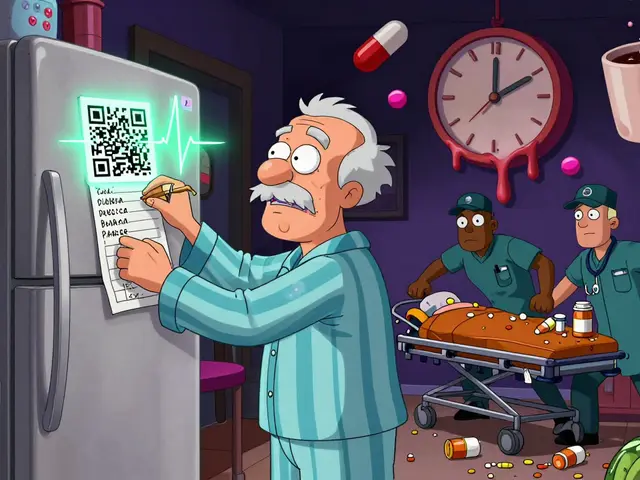
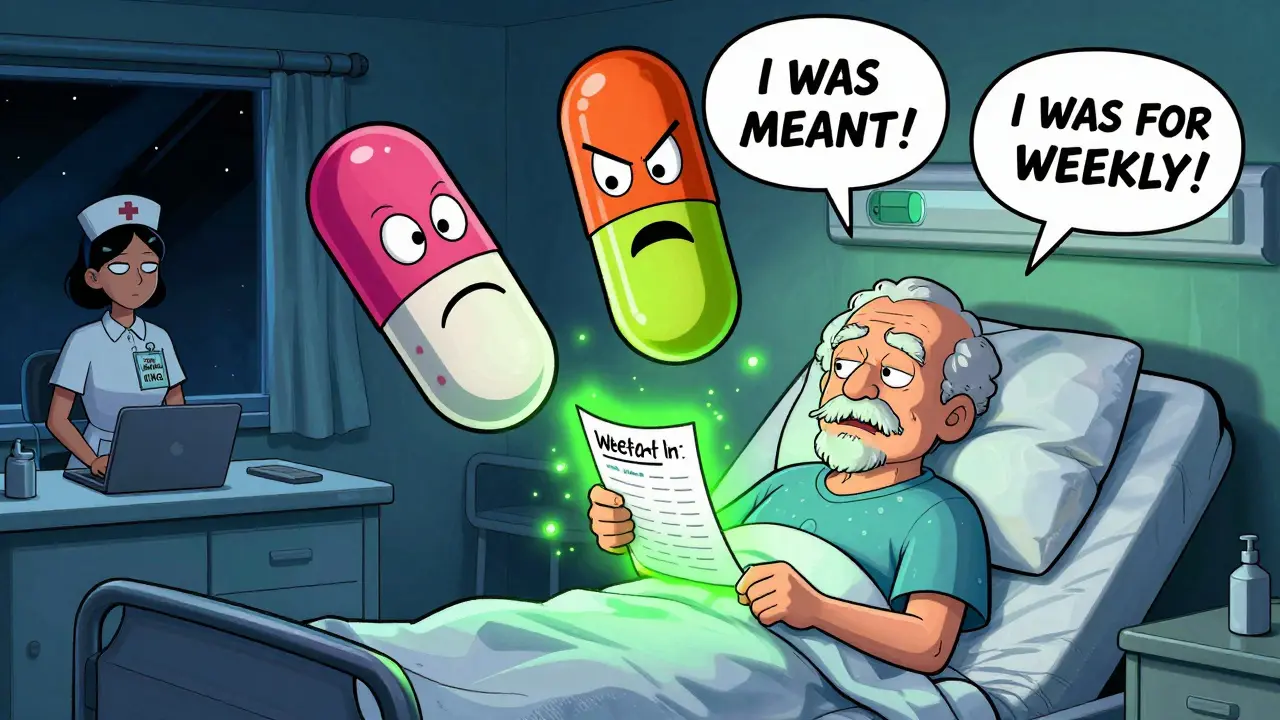
But one drug stands out for its quiet lethality: methotrexate. Used for cancer and autoimmune diseases, it’s normally given once a week. But if someone accidentally takes it daily-because of a confusing order, a mislabeled bottle, or a system glitch-it can cause bone marrow failure and death. The Institute for Safe Medication Practices (ISMP) estimates that since requiring a hard stop in electronic systems for daily methotrexate orders, at least 1,200 serious errors have been prevented each year.
How ISMP’s Best Practices Are Changing the Game
The ISMP Targeted Medication Safety Best Practices for Hospitals (2020-2021) isn’t a suggestion list. It’s a set of 19 mandatory rules built from real error reports. Each one targets a specific, deadly pattern.
Take intrathecal administration of vinca alkaloids. These are chemotherapy drugs meant to go into veins, not the spinal fluid. If they get injected into the spine by accident, they cause paralysis and death. ISMP’s rule? No vial of vinca alkaloids should ever be stored near spinal medications. Period. Hospitals that followed this rule saw zero such errors.
Another rule eliminates glacial acetic acid from hospital floors. It looks like water. It’s used in labs. But if a nurse grabs it thinking it’s saline, and injects it into a patient, it burns tissue and kills. Now, it’s banned from patient care areas entirely.
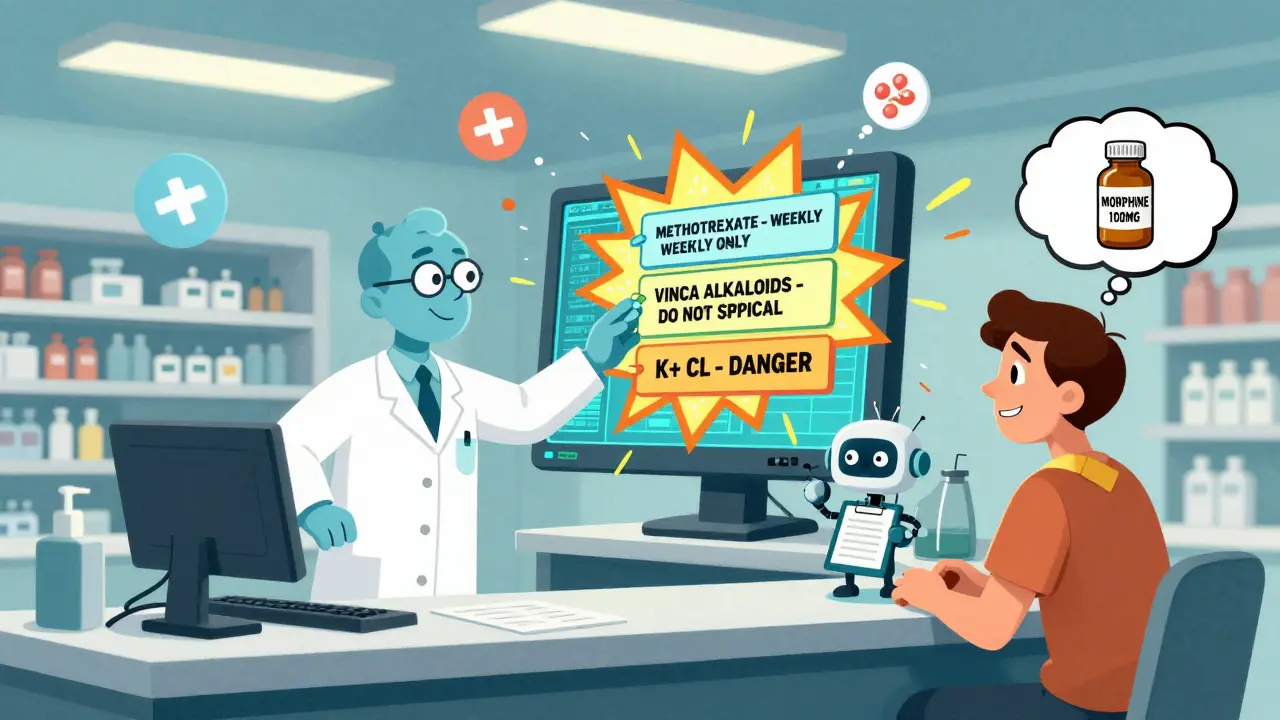
For oral methotrexate, the rule is clear: electronic systems must default to weekly dosing. If someone tries to order it daily, the system locks. A pharmacist must override it-and only after confirming it’s for cancer, not rheumatoid arthritis. Patients get both written and verbal instructions. No exceptions.
Technology: Barcode Scans and EHRs Are Lifesavers
Technology alone won’t fix medication safety. But when it’s used right, it’s the best tool we have.
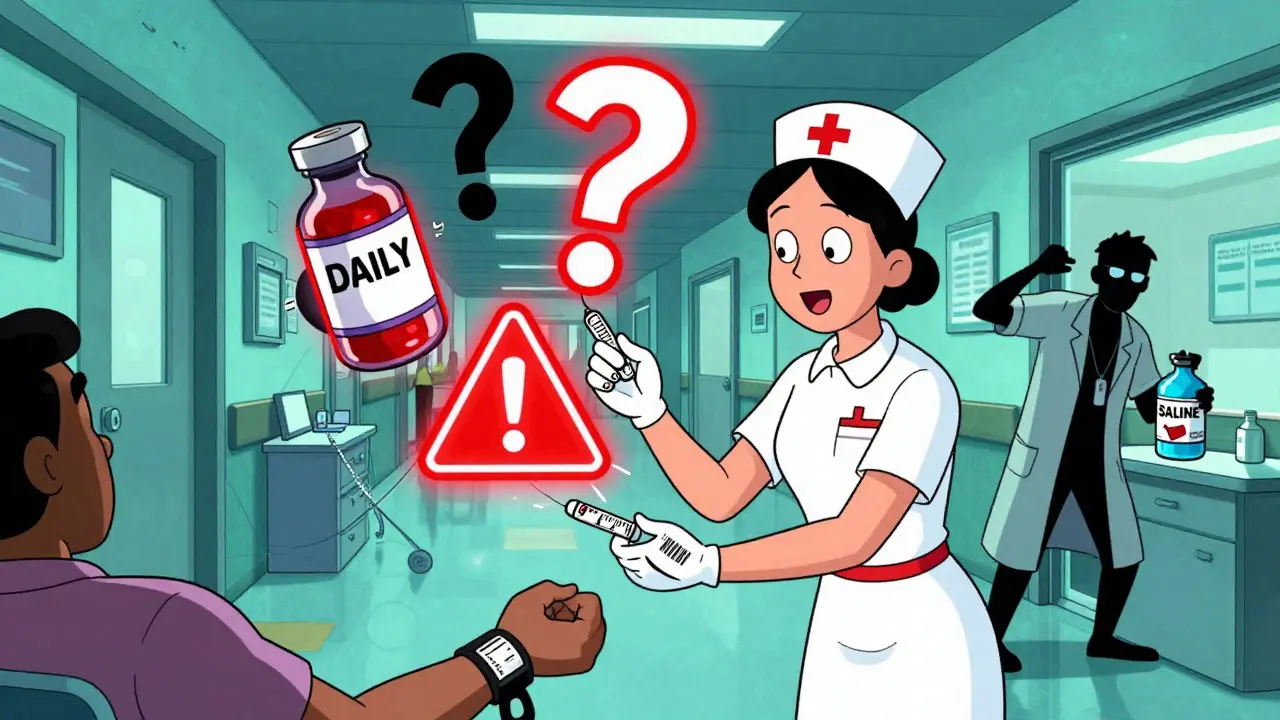
Barcode medication administration (BCMA) systems require nurses to scan the patient’s wristband and the medication’s barcode before giving a dose. If the drug doesn’t match the order, the system alerts them. A 2019 AHRQ study found hospitals with full BCMA use had 55% fewer serious medication errors.
Electronic health records (EHRs) with clinical decision support do more than store records. They flag drug interactions, warn about allergies, check kidney function before prescribing nephrotoxic drugs, and auto-calculate doses based on weight. One hospital cut insulin errors by 70% after adding automated dose range checking.
But here’s the catch: 63% of hospitals say their EHR vendor won’t let them build hard stops for high-risk drugs. That means some safety rules are manual-pharmacists have to double-check every order. That’s slow. And when staff are overwhelmed, those checks get skipped.
Why Staff Resistance Is the Silent Killer
Even the best system fails if the people using it hate it.
A pharmacy director in a Midwest hospital said implementing the methotrexate hard stop prevented three near-misses in the first month. But a nurse manager in a rural hospital complained that requiring both written and verbal discharge instructions created bottlenecks during staffing shortages. She had to choose between safety and speed-and speed won.
Workarounds are everywhere. Nurses tape printed instructions to medication bottles. Pharmacists manually verify orders because the EHR won’t let them automate it. One ICU nurse posted online about a neuromuscular blocker error that happened despite multiple safety layers-because one step was skipped during a shift change.
Implementation takes 12 to 18 months. Staff need 8 to 12 hours of training. If you don’t involve nurses, pharmacists, and doctors in designing the system, you’ll get resistance. And resistance leads to errors.
What’s Missing: Outpatient Clinics and Patient Voices
Most safety rules focus on hospitals. But more errors happen outside them. Between 2018 and 2022, outpatient medication errors rose 47%. Patients get prescriptions filled at pharmacies, take them home, and mix them with supplements or over-the-counter drugs. No one checks.
And patients aren’t just passive recipients-they’re safety partners. A 2022 survey by the National Council on Aging found 68% of seniors feel safer when hospitals verify their identity with name, birth date, and wristband before giving medication. At Mayo Clinic and Johns Hopkins, pilot programs that asked patients to report confusing instructions or side effects caught 32% more errors than staff alone.
The ISMP is planning to expand its best practices to outpatient settings in 2024-2025. That’s a start. But we need more than rules-we need systems that let patients speak up without fear.
The Future: AI and Real-Time Alerts
By 2025, Gartner predicts 75% of U.S. hospitals will use artificial intelligence to detect medication errors in real time. That’s up from just 22% in 2022.
AI doesn’t just flag wrong doses. It learns patterns. If a doctor orders 10 times the normal dose of morphine for a 70-year-old with kidney failure, the system doesn’t just warn-it asks, “Did you mean 10 mg or 100 mg?” It cross-checks with lab results, past prescriptions, and even patient-reported symptoms.
The FDA is also stepping in. New labeling rules for high-concentration electrolytes (like potassium chloride) require clearer warnings. Full compliance is required by December 31, 2024. And the AHRQ wants to cut opioid-related adverse events by 50% by 2027.
But technology won’t fix what culture breaks. If staff are burned out, undertrained, or feel ignored, even the smartest AI can’t save them.
What Needs to Change Now
Here’s the hard truth: medication safety isn’t a tech problem. It’s a human problem.
- Stop treating safety as optional. If a rule is in the ISMP Best Practices, it should be mandatory-not optional.
- Involve frontline staff in design. Nurses and pharmacists know what breaks. Let them fix it.
- Make systems work for people, not the other way around. If a hard stop slows you down too much, redesign it.
- Expand safety beyond the hospital. Outpatient clinics need the same tools as ICUs.
- Listen to patients. They’re the only ones who know if a pill looks different or if a new side effect appeared.
Medication safety isn’t about perfection. It’s about layers. One layer fails? The next catches it. But if every layer is weak, someone dies.
What is the most common cause of medication errors in hospitals?
The most common cause is miscommunication during handoffs-like shift changes or transfers between units. A nurse might not know a patient’s new dose, or a doctor’s order might be unclear. Electronic systems help, but if staff don’t double-check verbally or use standardized tools, errors slip through. Studies show over 60% of medication errors happen during transitions of care.
What is the ISMP Targeted Medication Safety Best Practices?
The ISMP Targeted Medication Safety Best Practices is a set of 19 specific, evidence-based rules developed by the Institute for Safe Medication Practices to prevent deadly medication errors. These include banning glacial acetic acid from patient areas, requiring hard stops for daily methotrexate orders, and preventing intrathecal administration of vinca alkaloids. Unlike general guidelines, these are mandatory, actionable, and built from real error reports submitted by healthcare workers.
Why is methotrexate so dangerous if taken daily?
Methotrexate is typically given once a week to treat conditions like rheumatoid arthritis or cancer. When taken daily, it builds up to toxic levels in the body, shutting down bone marrow function and damaging the liver and kidneys. This can lead to severe infections, bleeding, organ failure, and death. Because the name and appearance are similar to other drugs, and because electronic systems once defaulted to daily dosing, this error became tragically common-until ISMP forced system changes.
Do barcode systems really reduce errors?
Yes. Hospitals using full barcode medication administration (BCMA) systems saw a 55% drop in serious medication errors, according to a 2019 AHRQ study. The system prevents giving the wrong drug, wrong dose, or wrong patient by requiring a scan of both the patient’s wristband and the medication barcode. If they don’t match, the system blocks the dose. It’s simple, reliable, and now standard in most large hospitals.
Why aren’t all hospitals following ISMP’s best practices?
Three main reasons: cost, technology limits, and staffing. Implementing hard stops and new systems can cost $285,000 per hospital. Many EHR vendors don’t allow custom safety rules. And in rural or understaffed hospitals, there’s no one to enforce them. A 2022 ECRI study found only 42% of community hospitals fully implemented all ISMP practices, compared to 78% of academic centers.
What role do patients play in medication safety?
Patients are the last line of defense. A 2022 survey found 68% of adults 65+ feel safer when hospitals verify their identity with name, birth date, and wristband before giving medication. When patients are asked to confirm their drugs, report side effects, or check instructions, error detection improves by up to 32%. Hospitals that include patient feedback in safety protocols are catching mistakes others miss.
Next Steps: What You Can Do
If you’re a patient: Ask for your medication list. Check it against what you were told at discharge. If something looks off-say so.
If you’re a nurse or pharmacist: Push for system changes that reduce workarounds. Don’t accept “that’s how we’ve always done it.”
If you’re a hospital leader: Stop treating safety as a compliance checkbox. Invest in training, fix EHR limitations, and listen to your staff. The best safety system in the world won’t help if no one trusts it.
Medication safety isn’t a goal. It’s a habit. And habits are built one step, one rule, one conversation at a time.